
 PEPTIDE RESEARCH & BRAIN POWER: WHAT DOES THE SCIENCE SAY?
 LEARN MORE AT:
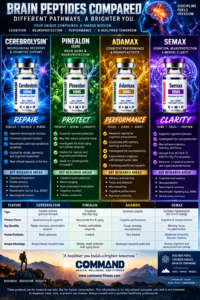
 Cerebrolysin — REPAIR
 Pinealon (EDR) — PROTECT
 Adamax — PERFORMANCE
 Semax — COGNITION
 Different compounds. Different pathways. Different levels of evidence.
| Compound | Primary research focus | Key distinction | Relative human evidence |
| Cerebrolysin | Neurological recovery, cognition, neuroprotection | Complex mixture of neuroactive peptides | ⭐⭐⭐⭐ Strongest of these four |
| Pinealon (EDR) | Brain aging, oxidative stress, neuroprotection | Very small tripeptide (Glu-Asp-Arg) | ⭐ Limited |
| Adamax | Cognitive/nootropic research | Experimental peptide associated with focus, learning and neuroplasticity research | ⭐ Very limited |
| Semax | Cognition, neuroprotection, neurological recovery | Synthetic ACTH-derived heptapeptide | ⭐⭐⭐ Moderate but geographically concentrated |
🧠 Cerebrolysin — REPAIR
Cerebrolysin has been investigated for neuroprotection, cognitive impairment and neurological recovery, including research involving stroke and dementia. Unlike the other three, it isn’t a single peptide but a mixture of low-molecular-weight peptides and amino acids derived from porcine brain tissue.
Research emphasis:
Neurorecovery • neuroprotection • cognition • neurotrophic activity
🧬 Pinealon — PROTECT
Pinealon is the tripeptide Glu-Asp-Arg (EDR). Research has focused on potential effects involving neuronal aging, oxidative stress, cellular signaling and neuroprotection.
It’s particularly interesting from an aging-research perspective, but the evidence base is much smaller than Cerebrolysin’s.
Research emphasis:
Brain aging • oxidative stress • neuronal protection • cellular longevity
⚡ Adamax — PERFORMANCE
Adamax is marketed as an experimental nootropic peptide and is associated with research claims involving focus, memory, learning and neuroplasticity.
However, Adamax has an important limitation: there is very little high-quality, peer-reviewed human clinical evidence supporting these effects. I would therefore keep any Command Fitness description firmly within research terminology rather than presenting these as established benefits.
Research emphasis:
Focus • learning • memory • cognitive performance
🎯 Semax — COGNITION & NEUROPROTECTION
Semax is a synthetic peptide derived from a fragment of ACTH(4–7) with an added Pro-Gly-Pro sequence. It has been investigated particularly in Russia for cognition and neurological protection, including experimental and clinical research related to cerebral ischemia and cognitive function.
Mechanistic research has examined Semax’s effects on neurotrophic signaling, including BDNF-related pathways, although that doesn’t establish that Semax produces clinically meaningful BDNF-mediated benefits in healthy people.
Research emphasis:
Memory • learning • neuroprotection • neuroplasticity • neurological recovery
Side-by-side positioning
For a Command Fitness educational graphic, I’d position the four this way:
CEREBROLYSIN → REPAIR
Neurological recovery • neurotrophic support • cognition
PINEALON → PROTECT
Brain aging • oxidative stress • neuronal health
ADAMAX → PERFORMANCE
Focus • learning • memory research
SEMAX → COGNITION
Memory • learning • neuroplasticity • neuroprotection
Of the four, Cerebrolysin has the broadest clinical research base, while Semax is particularly interesting for cognition/neuroprotection research. Pinealon is more experimental and oriented toward aging/neuroprotection, while Adamax currently has the weakest established clinical evidence.