

A secretagogue is a substance that prompts the body to release something it makes, often a hormone. In peptide discussions, “secretagogues” usually means compounds that stimulate the pituitary gland to release growth hormone (GH). pubmed.ncbi.nlm.nih.gov
Examples include GHRP-2, GHRP-6, and ipamorelin. They stimulate GH release through the ghrelin receptor. CJC-1295 is often grouped with them, but it works through the growth hormone–releasing hormone (GHRH) pathway. Some secretagogues are peptides; others are not. PubMed
The key distinction: a GH secretagogue signals your body to release GH; it is not growth hormone itself. That describes its mechanism, not a guarantee of a particular health or muscle-building result.
The main peptide growth hormone (GH) secretagogues are:
| Peptide | Other name | How it triggers GH release |
| Ipamorelin | — | Activates the ghrelin receptor |
| GHRP-2 | Pralmorelin | Activates the ghrelin receptor |
| GHRP-6 | — | Activates the ghrelin receptor |
| Hexarelin | — | Activates the ghrelin receptor |
These are the peptides most commonly meant by “GH secretagogues.” Research also describes GHRP-1, GHRP-4, GHRP-5, and alexamorelin, though they come up less often. pubmed.ncbi.nlm.nih.gov
A related group also stimulates your body to release GH, but acts through the GHRH receptor rather than the ghrelin receptor: sermorelin, tesamorelin, and CJC-1295. You may see these grouped under the broader term “GH-releasing peptides.” PubMed
GH itself and GH fragments such as AOD-9604 are not secretagogues: they do not work by prompting the pituitary to release GH.
| Peptide | How it works | What human studies demonstrate | Strength of evidence for sustained effects |
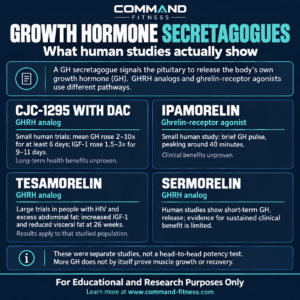
| CJC-1295 with DAC | Activates the GHRH receptor; its DAC modification prolongs exposure | In small placebo-controlled studies of healthy adults, a single injection raised mean GH 2–10-fold for at least 6 days and mean IGF-1 1.5–3-fold for 9–11 days, depending on dose. These are changes from baseline within those studies, not a comparison against the other peptides. PubMed | Strong evidence for a long-lasting hormone response; limited evidence for long-term clinical benefits. |
| Ipamorelin | Activates the ghrelin, or GHS, receptor | A study in healthy men found a brief, dose-related GH pulse after infusion. GH peaked at about 40 minutes, then declined. It established GH release, but did not establish sustained IGF-1 or body-composition benefits. PubMed | Evidence for acute GH release; much less human outcome evidence. |
| Tesamorelin | Activates the GHRH receptor | The strongest larger, longer clinical trials among these four are for tesamorelin in people with HIV and excess abdominal fat. Across two phase 3 trials totaling 806 participants, mean IGF-1 rose by 108 ng/mL versus a 7 ng/mL decrease with placebo at 26 weeks; visceral fat also fell significantly. PubMed | Strongest evidence here for a measured clinical effect in its studied population. That does not establish the same result in healthy adults. |
| Sermorelin | A shorter GHRH fragment that activates the GHRH receptor | Human studies show it produces a short GH response. One study in older men found increased nighttime GH release but no significant rise in IGF-1; responses can vary with the person and study conditions. PubMed | Established ability to release GH, with less convincing evidence for sustained effects than tesamorelin or CJC-1295 with DAC. |
All four have been shown to stimulate growth hormone (GH) release in humans. The clearest difference is the pattern and duration of the response. There is no reliable head-to-head trial of all four that establishes which releases the most GH at comparable doses.
What does research show about peptides that stimulate growth hormone release?
CJC-1295 with DAC has shown prolonged increases in growth hormone (GH) and IGF-1 after a dose. Tesamorelin has the strongest evidence here for a measured clinical benefit: reduced visceral fat in studies of people with HIV and excess abdominal fat. Ipamorelin and sermorelin also trigger GH release, but the studies used different methods and time frames, so these four peptides cannot be fairly ranked by potency.
The DAC distinction matters. The multi-day results for CJC-1295 apply to the DAC form studied. They should not be assumed to apply to products labeled “CJC-1295 without DAC.” An increase in GH or IGF-1 alone does not prove gains in muscle, recovery, or overall health.
For Educational and Research Purposes Only. Learn more at www.command-fitness.com.
Research: CJC-1295 human study · Ipamorelin human study · Tesamorelin trials · Sermorelin study