

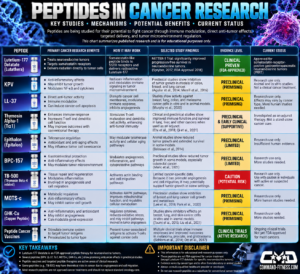
There are peptides and peptide-based therapies being studied for cancer, but it’s important to separate actual cancer treatments from peptides that have only shown anticancer effects in laboratory or animal studies. No general-pu
rpose research peptide should be considered a substitute for oncology treatment.
One of the clearest examples of a peptide-based cancer treatment is Lutetium-177 dotatate (Lutathera). It combines a somatostatin-like peptide with radioactive lutetium-177. The peptide binds somatostatin receptors on certain neuroendocrine tumor cells and delivers radiation directly to them. It is FDA-approved for somatostatin-receptor-positive gastroenteropancreatic neuroendocrine tumors. U.S. Food and Drug Administration The NCI describes this approach as peptide receptor radionuclide therapy (PRRT). Cancer.gov
For the kinds of research peptides you may be thinking about, several are scientifically interesting:
| Peptide / approach | Cancer research interest | Current significance |
|---|---|---|
| KPV | Anti-inflammatory signaling; investigated for effects on inflammatory pathways that can influence tumor environments | Preclinical; not an established cancer treatment |
| LL-37 | Studied for antimicrobial and immune effects and effects on tumor cells | Complicated: research suggests effects can differ substantially by cancer type |
| Thymosin Alpha-1 (Tα1) | Immune modulation, particularly T-cell and dendritic-cell responses | Investigated as an adjunct in oncology; not a stand-alone cancer cure |
| Thymosin Beta-4 / TB-500-related pathways | Tissue repair, angiogenesis and cell migration | Potential concern in cancer because pathways promoting angiogenesis/migration may sometimes benefit tumors |
| Epit alon/Epithalon |
Telomerase, aging and cellular regulation research | Insufficient clinical evidence for cancer treatment; telomerase activation also raises theoretical oncology concerns |
| Tumor-targeting peptides | Designed to recognize receptors expressed by tumor cells and deliver drugs/radiation | Major active research area |
| Peptide cancer vaccines | Present tumor-associated antigens to stimulate immune recognition | Active immunotherapy research; highly tumor/antigen specific |
| Radiolabeled peptides | Target tumor receptors and deliver radiation | Already clinically established for selected cancers |
Cancer-treatment vaccines are another important peptide-related area. They expose the immune system to tumor-associated antigens so that immune cells can recognize and attack cells carrying those antigens. Cancer.gov
There is an especially important distinction with peptides marketed as “anticancer.” Evidence that a peptide kills cancer cells in a petri dish does not establish that it treats cancer in humans. The FDA specifically warns about products marketed with unsupported cancer-treatment or cure claims. U.S. Food and Drug Administration
Also, some peptides associated with growth, tissue repair, angiogenesis, IGF-1, or growth-hormone signaling deserve particular caution in someone with active or suspected cancer. Increasing cellular growth signaling is not automatically beneficial in that setting.