

Veteran-owned business
Product Usage: This PRODUCT IS INTENDED AS A RESEARCH CHEMICAL ONLY. This designation allows the use of research chemicals strictly for in vitro testing and laboratory experimentation only. All product information available on this website is for educational purposes only. Bodily introduction of any kind into humans or animals is strictly forbidden by law. This product should only be handled by licensed, qualified professionals. This product is not a drug, food, or cosmetic and may not be misbranded, misused or mislabeled as a drug, food or cosmetic.

For research use only. Not for human consumption.

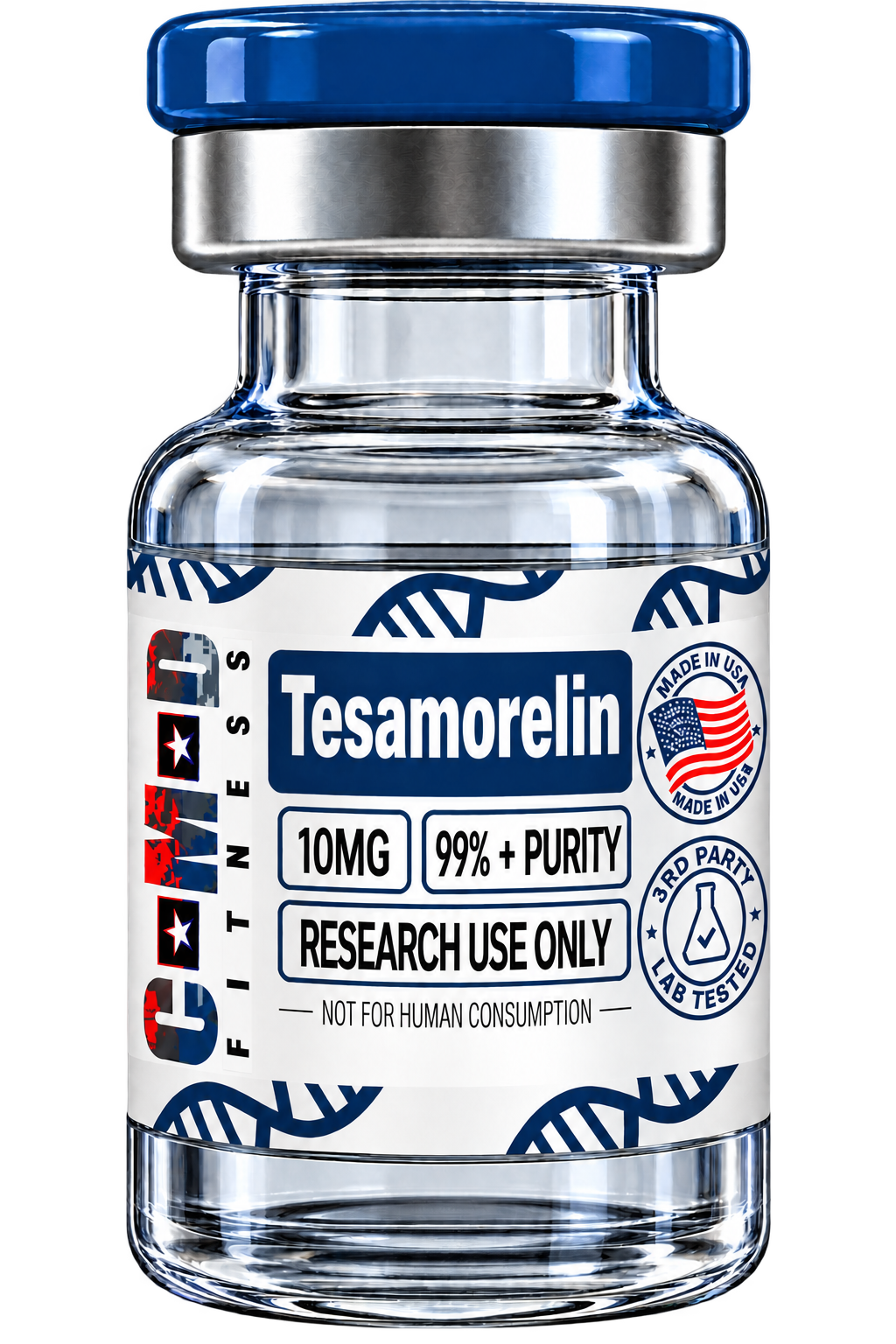
Tesamorelin (10mg)

Tesamorelin is a synthetic 44–amino acid peptide analogue of growth hormone–releasing hormone (GHRH) that stimulates the pituitary to increase endogenous growth hormone secretion. It is primarily used to reduce excess abdominal fat in HIV-associated lipodystrophy and is studied in research for its effects on metabolism, body composition, and fat regulation. Supplied as a lyophilized peptide for reconstitution.

Price:

$75.00

Select Quantity:

7 in stock

Overview

Basic Information

  • Peptide Name: Tesamorelin

  • Peptide Length: 44 amino acids

  • Molecular Weight: ~5.1 kDa

  • Sequence: Synthetic analogue of human growth hormone–releasing hormone (GHRH)

  • Form: Lyophilized powder

  • Appearance: White to off-white crystalline powder

  • Purity: Typically ≥98% (HPLC)


Mechanism of Action

  • Stimulates the pituitary gland to secrete endogenous growth hormone

  • Promotes lipolysis and reduces abdominal fat

  • Influences body composition and metabolic pathways

  • Mechanism mimics natural GHRH signaling via the GHRH receptor


Applications

  • Clinically used for HIV-associated lipodystrophy under the brand Egrifta

  • Research on growth hormone physiology

  • Studies on fat distribution, metabolism, and body composition

  • Preclinical models investigating GH-mediated signaling and metabolic effects


Pharmacological Characteristics

  • Administered subcutaneously in clinical settings

  • Enhances endogenous GH release rather than providing exogenous GH

  • Short plasma half-life, but downstream metabolic effects persist

Biochemical
Characteristics

🧬 Molecular Identity

  • Peptide Length: 44 amino acids

  • Molecular Weight: ~5.1 kDa

  • Structure: Linear peptide, synthetic analogue of human growth hormone–releasing hormone (GHRH)

  • Form: Lyophilized powder, water-soluble


⚗️ Structural Features

  • Predominantly alpha-helical conformation in physiological conditions

  • N-terminal and C-terminal sequences modified for enhanced stability and receptor affinity

  • Amphipathic peptide with hydrophilic and hydrophobic residues allowing receptor interaction

  • Synthetic modifications increase resistance to proteolytic degradation


🔬 Biochemical Function

  • Binds to the GHRH receptor on pituitary somatotrophs

  • Stimulates endogenous growth hormone secretion

  • Promotes lipolysis and influences body composition

  • Does not act directly as growth hormone, but triggers physiological GH-dependent pathways


🧪 Stability & Solubility

  • Highly soluble in water or aqueous buffers

  • Stable as lyophilized powder; solution form is more sensitive to proteolytic cleavage

  • Sensitive to extreme pH, heat, and moisture


💡 Biochemical Significance

  • Used in research to study GH signaling pathways, fat metabolism, and metabolic regulation

  • Clinically relevant in HIV-associated lipodystrophy for targeted reduction of visceral adiposity

  • Provides a controlled method to explore endogenous GH modulation without exogenous hormone administration

Tesamorelin is a well-characterized peptide for both research and clinical applications, bridging metabolic and endocrine studies with therapeutic interventions.

Research Applications

Tesamorelin has been studied beyond its FDA-approved use for HIV-associated lipodystrophy, particularly in research on metabolism, liver disease, and aging. Here’s a detailed breakdown of its research applications:


1. Nonalcoholic Fatty Liver Disease (NAFLD) / Nonalcoholic Steatohepatitis (NASH)

  • Mechanism: By stimulating growth hormone, tesamorelin can reduce liver fat accumulation.

  • Findings: Clinical trials in HIV patients with fatty liver show reductions in hepatic fat content without significant worsening of insulin sensitivity.

  • Potential: Investigated as a therapy for NAFLD/NASH even outside HIV populations.


2. Visceral Adiposity and Metabolic Syndrome

  • Mechanism: Tesamorelin preferentially targets visceral fat, which is closely linked to insulin resistance, cardiovascular risk, and inflammation.

  • Research Use: Studies examine its ability to reduce VAT in non-HIV obese or metabolically unhealthy patients.

  • Outcome Measures: VAT volume via MRI or CT scans, metabolic markers like insulin resistance and inflammatory cytokines.


3. Cognitive Function and Brain Health

  • Hypothesis: Growth hormone and IGF-1 pathways influence brain metabolism and neurogenesis.

  • Studies: Early research explores tesamorelin for age-related cognitive decline, though results are preliminary.


4. Aging and Sarcopenia

  • Goal: Counteract age-related fat accumulation and muscle loss.

  • Evidence: Tesamorelin may modestly increase lean body mass while decreasing visceral fat, but long-term effects and safety in elderly populations remain under investigation.


5. Research Biomarkers

  • IGF-1 Levels: Tesamorelin increases insulin-like growth factor 1 (IGF-1), used as a biomarker for efficacy.

  • Body Composition Imaging: MRI, DXA, and CT scans are standard tools to quantify visceral fat changes in studies.


Key Considerations in Research

  • Population: Most robust data comes from HIV-positive adults; extrapolation to other groups is ongoing.

  • Duration: Clinical trials often last 6–12 months; long-term safety data is limited.

  • Metabolic Monitoring: Close monitoring of glucose metabolism is essential in trials.


In short, tesamorelin is being explored as a targeted therapy for visceral fat reduction, liver fat management, and potentially metabolic and age-related conditions, though most research is still early-stage.
Chemical Properties
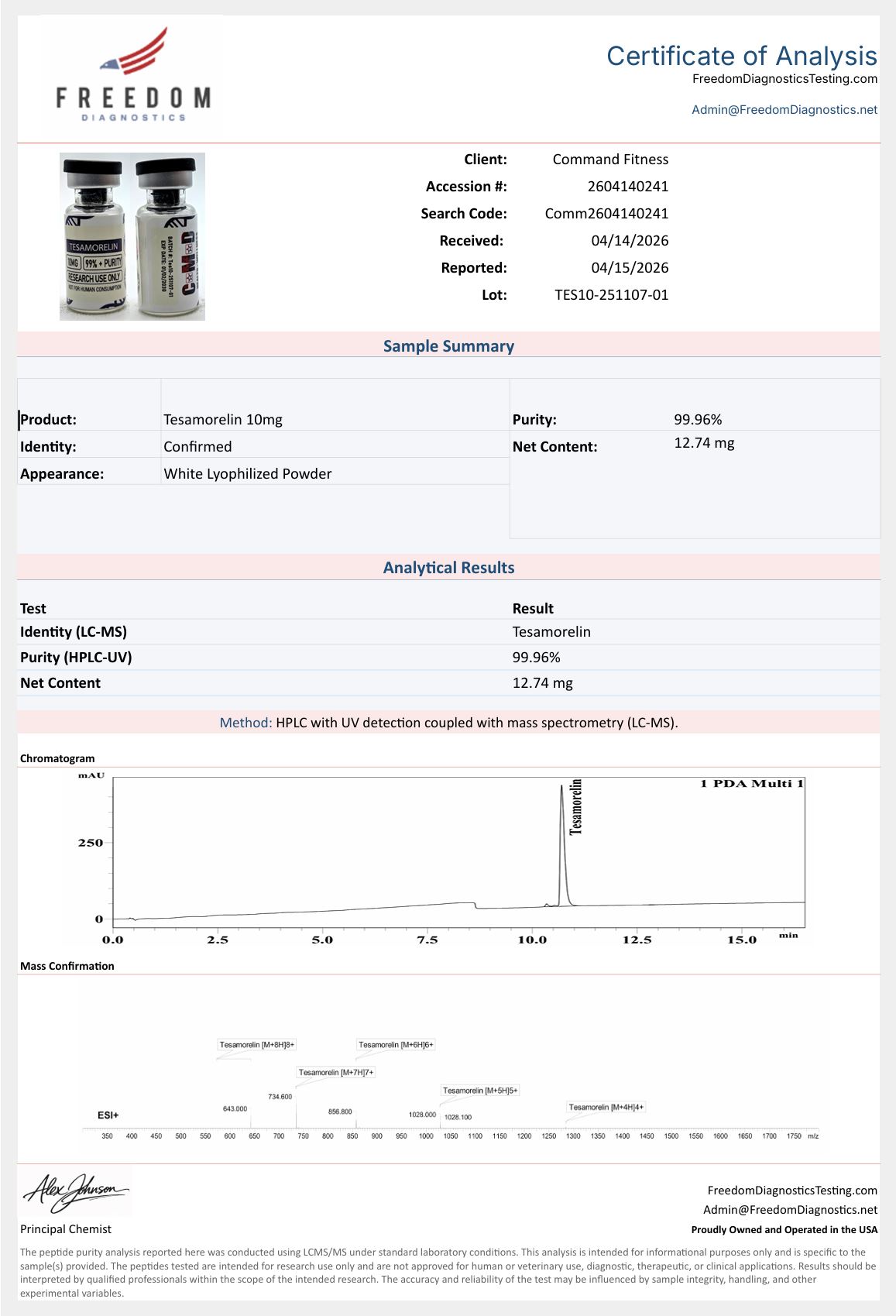
COA /HPLC / MS

3rd Party Testing
Storage

1. Lyophilized (Powder) Form

  • Temperature: Store refrigerated at 2–8 °C (36–46 °F).

  • Light: Keep protected from light.

  • Moisture: Store in the original sealed vial to prevent moisture exposure.

  • Shelf Life: Typically up to 24 months when stored properly (check the specific vial label for expiration).


2. Reconstituted (After Adding Sterile Water)

  • Temperature:

    • Refrigerated: 2–8 °C (36–46 °F)

    • Room Temperature: Short-term use only (usually up to 24 hours; confirm with label instructions).

  • Container: Use immediately from a sterile syringe; avoid storing in syringes for extended periods.

  • Light & Agitation: Protect from light; avoid vigorous shaking to prevent peptide degradation.


3. General Handling Tips

  • Do not freeze the reconstituted solution. Freezing may denature the peptide.

  • Do not shake; gently swirl if needed.

  • Check Appearance: The solution should be clear to slightly opalescent; discard if cloudy or particulate matter appears.


In summary, tesamorelin is most stable as a refrigerated lyophilized powder. After reconstitution, it must be used quickly or refrigerated for very short periods. Proper storage is essential to maintain its activity and avoid peptide degradation.

Your cart is currently empty.

Return to shop

0