

Veteran-owned business
Product Usage: This PRODUCT IS INTENDED AS A RESEARCH CHEMICAL ONLY. This designation allows the use of research chemicals strictly for in vitro testing and laboratory experimentation only. All product information available on this website is for educational purposes only. Bodily introduction of any kind into humans or animals is strictly forbidden by law. This product should only be handled by licensed, qualified professionals. This product is not a drug, food, or cosmetic and may not be misbranded, misused or mislabeled as a drug, food or cosmetic.

For research use only. Not for human consumption.

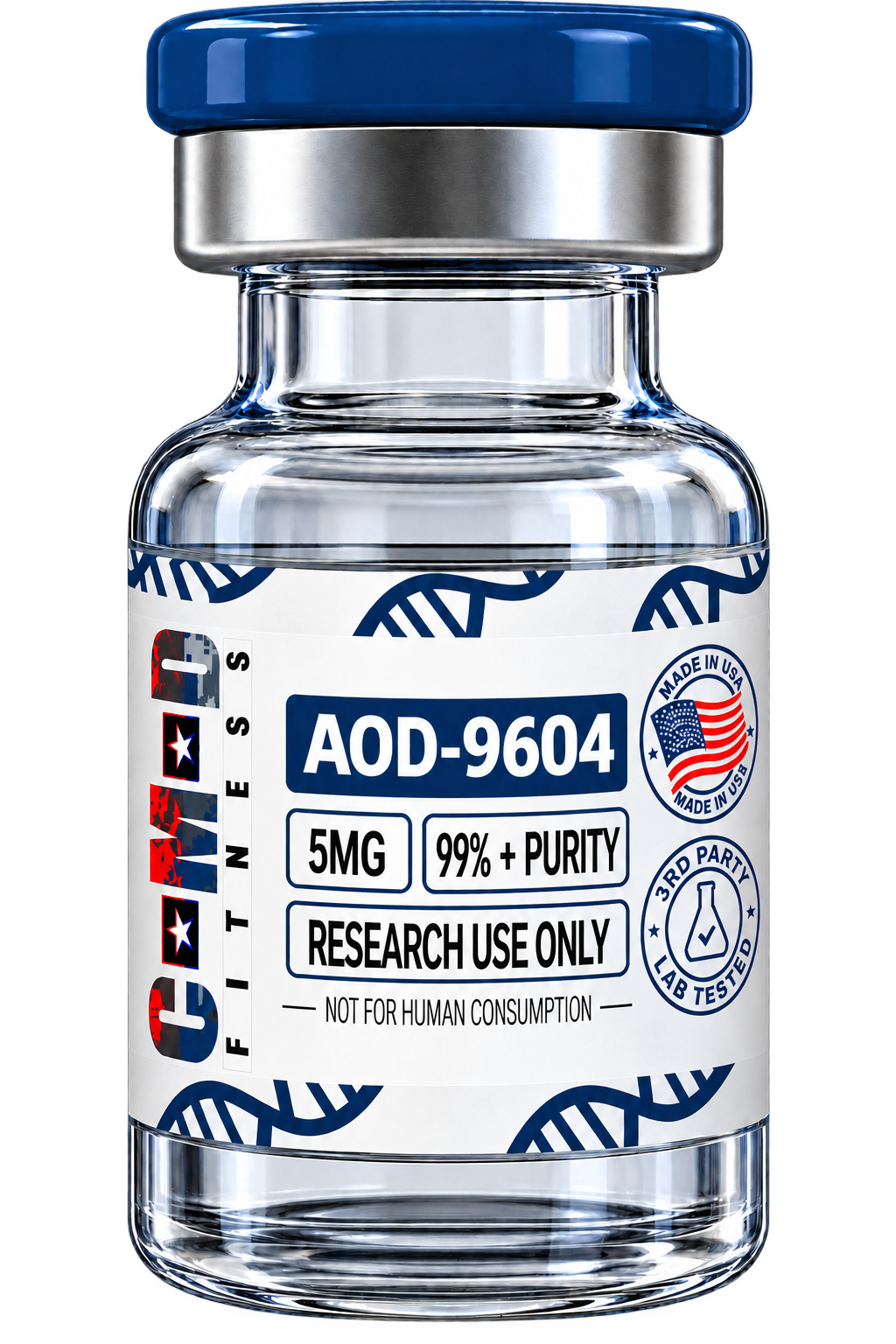
AOD-9604

AOD-9604 is a synthetic peptide fragment derived from the C-terminal region (176–191) of human growth hormone (hGH). It was developed to isolate the fat-metabolism effects of growth hormone without stimulating growth or affecting blood sugar regulation.

🔬 Primary Research Use

AOD-9604 is studied for its potential role in:

  • Supporting lipolysis (fat breakdown)

  • Inhibiting lipogenesis (fat formation)

  • Metabolic and obesity research models

  • Body composition studies

Unlike full-length human growth hormone, AOD-9604 is designed to avoid significant effects on IGF-1 levels or systemic growth pathways in research settings.

Price:

$50.00

Select Quantity:

8 in stock

Overview

Mechanism of Action

  • Mimics the fat-reducing effects of human growth hormone

  • Promotes lipolysis (fat breakdown) and inhibits lipogenesis (fat formation)

  • Designed to avoid stimulating IGF-1 or affecting overall growth pathways

  • Investigated primarily for metabolic regulation and obesity-related research


Applications

  • Preclinical and in vitro research on fat metabolism

  • Studies on body composition and adipocyte function

  • Experimental investigation of metabolic signaling pathways

  • Cosmetic and weight-management research models

Biochemical
Characteristics

AOD-9604 (Advanced Obesity Drug-9604) is a synthetic peptide derived from a specific functional region of human growth hormone (hGH). Its biochemical characteristics are centered on selective metabolic activity—especially fat metabolism—while minimizing broader endocrine effects.


🧬 Core Biochemical Identity

  • Type: Synthetic peptide (16 amino acids)
  • Origin: C-terminal fragment (residues 176–191) of human growth hormone
  • Modification: Addition/substitution of a tyrosine residue to stabilize activity
  • Molecular formula: C₇₈H₁₂₃N₂₃O₂₃S₂
  • Molecular weight: ~1815 g/mol

⚙️ Mechanism of Action (Biochemical Level)

1. Selective Lipolysis Activation

  • AOD-9604 stimulates lipolysis (breakdown of triglycerides into fatty acids and glycerol) in adipose tissue
  • Acts primarily via β3-adrenergic receptors, triggering:
    • cAMP signaling cascade
    • Activation of protein kinase A (PKA)
    • Stimulation of hormone-sensitive lipase

👉 Result: Increased fat mobilization and oxidation.


2. Inhibition of Lipogenesis

  • Reduces formation of new fat by modulating metabolic enzymes involved in lipid storage

👉 Result: Dual effect—burning fat + preventing storage.


3. Tissue Selectivity

  • Primarily acts on white and brown adipose tissue
  • Enhances thermogenesis in brown fat via mitochondrial pathways (e.g., UCP1 activation)

👉 Result: Increased metabolic rate without systemic stimulation.


🧪 Endocrine & Hormonal Profile

1. No Growth Hormone Axis Activation

  • Does not stimulate pituitary GH release
  • Does not bind classical GH receptors involved in growth signaling

2. No IGF-1 Elevation

  • Unlike full hGH, it does not increase insulin-like growth factor-1 (IGF-1)

👉 This is a defining biochemical property:

  • No tissue growth stimulation
  • No anabolic or mitogenic effects

3. Minimal Impact on Glucose Metabolism

  • Does not significantly alter insulin sensitivity or blood glucose levels

👉 Distinguishes it from full growth hormone, which can induce insulin resistance.


🧬 Additional Biological Effects

🦴 Bone & Cartilage Activity

  • May stimulate osteoblast activity (bone-forming cells)
  • Investigated for cartilage repair and osteoarthritis

🔗 Structural/Biochemical Features

  • Contains:
    • Disulfide bond (between cysteine residues) → structural stability
    • High hydrogen bonding capacity (many donors/acceptors) → strong interactions with biological targets
  • Highly polar peptide (low lipophilicity, XLogP ≈ −4.8)

⚠️ Functional Limitations (Important)

  • Clinical studies have shown mixed or limited efficacy for weight loss in humans
  • Not widely approved as a therapeutic drug by major regulators

🧾 Summary of Biochemical Characteristics

Key defining traits:

  • Selective lipolytic peptide fragment of hGH
  • Acts via β3-adrenergic signaling, not GH receptor pathways
  • No IGF-1 or systemic hormonal activation
  • Promotes fat breakdown + inhibits fat formation
  • Minimal effects on glucose metabolism and growth pathways

Research Applications

AOD-9604 has attracted attention mainly as a research peptide rather than a widely approved therapeutic. Its biochemical selectivity (fat metabolism without full growth hormone activity) has shaped where scientists explore it.

Here are the main research applications:


🧬 1. Obesity & Metabolic Research

AOD-9604 is most studied for its effects on fat metabolism.

  • Investigated for lipolysis stimulation and reduced fat accumulation
  • Used in models of obesity to:
    • Examine fat-specific pathways independent of systemic hormones
    • Study energy balance and adipocyte biology
  • Helps isolate the metabolic fragment of Human growth hormone without broader endocrine effects

👉 Value: Allows researchers to separate fat metabolism from growth and insulin pathways.


🔬 2. Adipose Tissue Biology

  • Used to study:
    • White vs. brown fat activity
    • Mechanisms of thermogenesis
  • Helps probe signaling via:
    • β3-adrenergic pathways
    • Mitochondrial uncoupling (e.g., UCP1-related activity)

👉 Value: Tool for understanding how fat cells regulate energy expenditure.


🧪 3. Diabetes & Metabolic Syndrome Models

  • Explored in context of:
    • Type 2 Diabetes
    • Insulin resistance
  • Interest stems from:
    • Minimal effect on blood glucose compared to full GH
    • Potential to modulate fat without worsening glycemic control

👉 Value: Candidate for studying metabolic interventions with reduced endocrine disruption.


🦴 4. Cartilage Repair & Osteoarthritis

  • Studied for regenerative effects in:
    • osteoarthritis
  • Research suggests:
    • Possible stimulation of chondrocyte activity
    • Enhanced cartilage matrix production

👉 Value: Investigational role in joint repair and degeneration models.


🧬 5. Tissue Regeneration & Healing

  • Examined in:
    • Wound healing models
    • Soft tissue repair
  • Potential mechanisms:
    • Cell proliferation modulation
    • Anti-inflammatory signaling

👉 Value: Understanding peptide-driven regeneration independent of IGF-1.


⚙️ 6. Growth Hormone Fragment Research

  • Serves as a model compound to:
    • Study functional domains of Human growth hormone
    • Identify which regions control:
      • Lipolysis vs. growth
      • Endocrine vs. local effects

👉 Value: Helps map structure–function relationships in peptide hormones.


💊 7. Drug Development & Peptide Engineering

  • Used as a scaffold for:
    • Designing next-generation metabolic peptides
    • Improving:
      • Stability
      • Bioavailability
      • Target specificity

👉 Value: Platform for selective metabolic therapeutics.


⚠️ Important Context

  • Despite promising mechanisms, clinical outcomes in humans have been mixed
  • Not broadly approved as a standard treatment for obesity or metabolic disease
  • Most applications remain preclinical or investigational

🧾 Bottom Line

AOD-9604 is primarily a research tool peptide used to explore:

  • Fat metabolism without hormonal side effects
  • Adipose tissue signaling pathways
  • Regenerative and cartilage biology
  • Functional domains of growth hormone


Chemical Properties

AOD-9604 is a synthetic peptide, so its chemical behavior is governed by amino-acid composition, peptide bonding, and its folded structure rather than small-molecule chemistry. Here are its key chemical properties:


🧪 Molecular Identity

  • Type: Peptide (16 amino acids)
  • Derived from: residues 176–191 of Human growth hormone
  • Molecular formula: C₇₈H₁₂₃N₂₃O₂₃S₂
  • Molecular weight: ~1815 g/mol

⚛️ Structural Features

  • Peptide bonds: Linear chain of amino acids linked via amide (–CONH–) bonds
  • Disulfide bridge:
    • Contains cysteine residues forming an S–S bond
    • Provides conformational stability
  • Secondary structure:
    • Can adopt partial α-helical conformations in solution (environment-dependent)

💧 Polarity & Solubility

  • Highly polar and hydrophilic
  • Rich in:
    • Hydrogen bond donors (–NH, –OH)
    • Hydrogen bond acceptors (C=O)
  • Solubility:
    • Very soluble in water and aqueous buffers
    • Poorly soluble in nonpolar solvents

👉 Typical for bioactive peptides interacting with aqueous biological systems.


⚡ Charge & Ionization

  • Contains multiple ionizable groups:
    • N-terminal amine (+)
    • C-terminal carboxylate (–)
    • Side chains (depending on residues like Lys, Arg, Asp, Glu)
  • Net charge depends on pH:
    • Often slightly positive or near neutral at physiological pH

👉 Enables electrostatic interactions with enzymes and membranes.


🔬 Chemical Stability

  • Moderate stability (typical of peptides):
    • Susceptible to:
      • Proteolytic degradation (enzymes)
      • Hydrolysis of peptide bonds (extreme pH or temperature)
  • Disulfide bond:
    • Stable under normal conditions
    • Can be reduced by strong reducing agents (e.g., dithiothreitol)

🌡️ Physical-Chemical Behavior

  • Melting/denaturation:
    • Does not have a sharp melting point like small molecules
    • Instead denatures at elevated temperatures
  • Conformation-sensitive:
    • Structure changes with:
      • pH
      • ionic strength
      • solvent environment

🧬 Interaction Properties

  • Forms:
    • Hydrogen bonds
    • Electrostatic interactions
    • Limited hydrophobic interactions (due to some nonpolar residues)
  • Binding is typically specific and reversible, driven by shape and charge complementarity

⚗️ Chemical Reactivity

  • Reactive sites include:
    • Amine groups → can undergo acetylation or conjugation
    • Carboxyl groups → can form salts or esters
    • Disulfide bond → reversible redox chemistry
  • Generally chemically mild (no highly reactive functional groups)

🧾 Summary

AOD-9604’s chemical profile is defined by:
  • Peptide-based structure with amide bonds and disulfide linkage
  • High water solubility and polarity
  • pH-dependent charge behavior
  • Moderate stability, limited by enzymatic degradation
  • Ability to engage in specific molecular interactions via hydrogen bonding and electrostatics
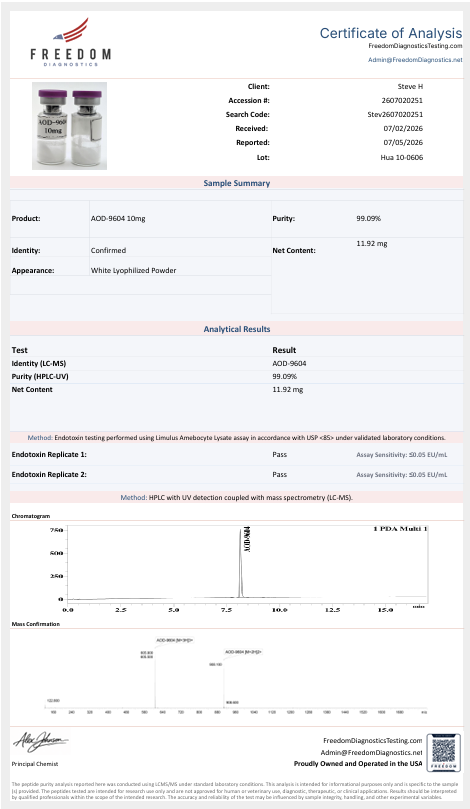
COA /HPLC / MS
3rd Party Testing

Tested by Freedom Diagnostics Testing @www.freedomdiagnosticstesting.com


Storage

Storage

  • Store lyophilized powder at −20 °C in a dry, light-protected environment

  • Reconstituted solutions should be aliquoted and stored at −20 °C to prevent repeated freeze-thaw cycles

Your cart is currently empty.

Return to shop

Category
0