

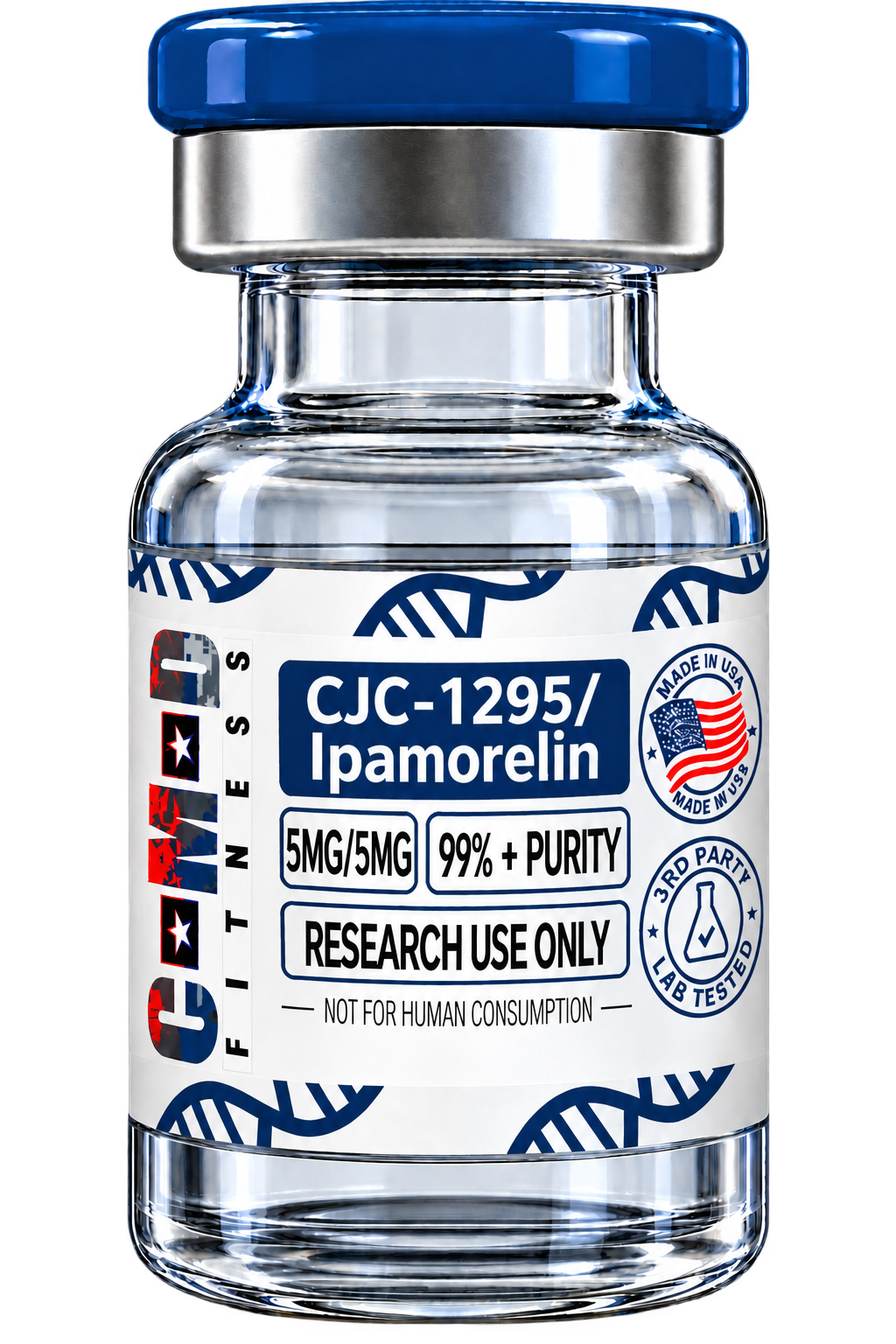

For research use only. Not for human consumption.
The combination of CJC‑1295 (NO DAC) and Ipamorelin is a research-use peptide pairing that stimulates natural, pulsatile growth hormone release through complementary GHRH and ghrelin pathways, enhancing GH and IGF‑1 levels for studies on metabolism, body composition, and tissue repair.
Price:
$70.00
Select Quantity:
68 in stock
CJC‑1295 (NO DAC) and Ipamorelin are often combined in research to maximize endogenous growth hormone (GH) release through two complementary pathways. CJC‑1295 stimulates the GHRH (growth hormone–releasing hormone) receptors in the pituitary, increasing the amplitude of GH pulses, while Ipamorelin activates ghrelin (GHS‑R1a) receptors, triggering additional GH release.
When used together, these peptides create a synergistic, physiologic GH pulse, enhancing levels of IGF‑1 and influencing metabolism, body composition, and tissue repair. The combination is primarily used in experimental and investigational studies, mimicking natural GH regulation more closely than either peptide alone.
Key Points:
Mechanism: Dual-pathway stimulation (GHRH + ghrelin)
Effect: Amplified pulsatile GH release
Research Applications: Metabolism, muscle/fat ratio, IGF‑1 modulation, tissue repair
Status: Investigational; not approved for therapeutic use
30‑amino‑acid synthetic GHRH analog
Modified for protease resistance
Short half‑life (≈1–2 hours)
Linear peptide with α‑helical receptor-binding region
Pentapeptide (5 amino acids)
Selective ghrelin receptor (GHS‑R1a) agonist
Structurally small and highly receptor-specific
Minimal stimulation of cortisol or prolactin compared to earlier GHRPs
The combination activates two distinct receptors on pituitary somatotrophs:
| Peptide | Target Receptor | Pathway |
|---|---|---|
| CJC‑1295 | GHRH receptor | cAMP/PKA signaling |
| Ipamorelin | Ghrelin (GHS‑R1a) receptor | PLC/IP3/Ca²⁺ signaling |
These intracellular pathways converge to:
Increase growth hormone (GH) pulse amplitude
Enhance downstream IGF‑1 production
The dual signaling creates synergistic GH secretion greater than either peptide alone.
Water-soluble peptides
Supplied as lyophilized powders
Amphipathic (contain hydrophilic and hydrophobic residues)
Sensitive to heat, light, and mechanical agitation
Stable refrigerated (2–8 °C)
Promotes pulsatile GH release rather than constant elevation
Stimulates hepatic IGF‑1 synthesis
Influences:
Lipolysis
Protein synthesis
Collagen production
Nitrogen retention
Because GH secretion remains pulsatile, endogenous feedback loops (somatostatin regulation) are partially preserved.
Rapid onset
Short systemic exposure (especially NO DAC version)
Minimal receptor desensitization compared to sustained GH exposure
Designed to mimic natural endocrine rhythms
Biochemically, the CJC‑1295 (NO DAC) + Ipamorelin combination represents a dual-pathway endocrine modulator, activating both GHRH and ghrelin receptors to amplify physiologic growth hormone pulses. The peptides are short-acting, water-soluble, receptor-specific molecules designed for controlled experimental stimulation of the GH–IGF‑1 axis.
Study of pulsatile GH secretion
Evaluation of dual-pathway stimulation (GHRH + ghrelin signaling)
Investigation of somatostatin feedback regulation
Modeling endogenous GH rhythms without exogenous GH administration
This combination is frequently used to examine how natural GH release can be amplified while preserving physiologic control mechanisms.
Assessment of IGF‑1 modulation
Evaluation of downstream GH–IGF‑1 axis signaling
Investigation of hepatic IGF‑1 production dynamics
Research on endocrine aging and hormonal decline models
Experimental models examine effects on:
Lean body mass regulation
Lipolysis and fat metabolism
Nitrogen retention
Protein synthesis markers
Because GH influences metabolic partitioning, this combination is studied in controlled settings to understand its impact on energy balance and tissue composition.
Growth hormone–mediated pathways are studied for:
Collagen synthesis
Connective tissue remodeling
Muscle recovery mechanisms
Bone metabolism signaling
Research focuses on the biochemical pathways rather than clinical treatment claims.
Investigation of age-related GH decline
Study of endocrine rhythm restoration
Exploration of pulsatile stimulation versus continuous exposure models
Used to compare:
Short-acting (NO DAC) vs long-acting GH secretagogues
Dual stimulation vs single-agent therapy
Secretagogue therapy vs exogenous GH administration
Investigational use only
Not FDA-approved for therapeutic treatment
Long-term safety data is limited
Primarily studied in controlled experimental or clinical research environments
The CJC‑1295 (NO DAC) + Ipamorelin combination is used in research to study growth hormone pulsatility, IGF‑1 regulation, metabolic signaling, tissue repair pathways, and endocrine aging, leveraging complementary receptor activation to amplify physiologic GH secretion.
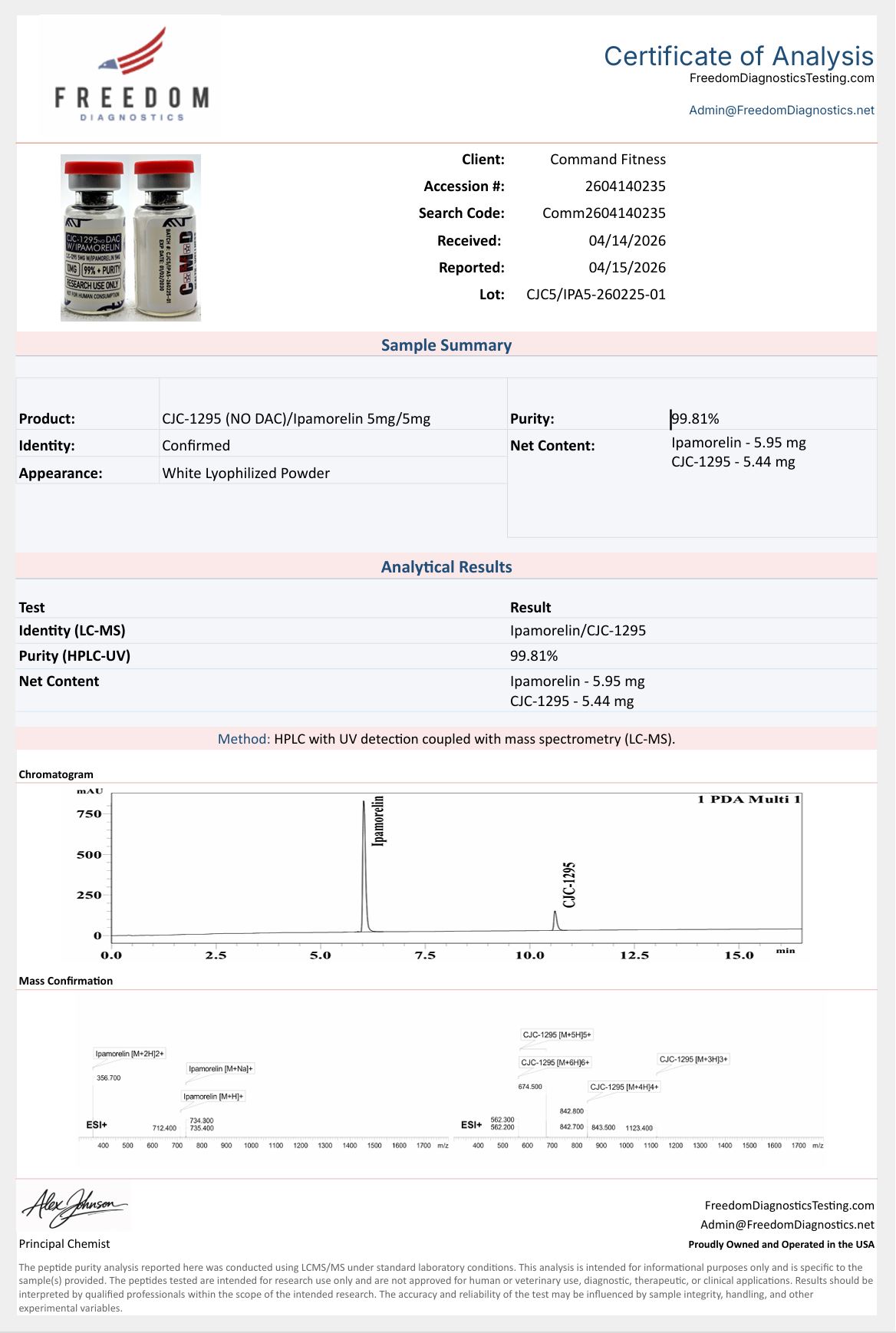
Tested by Freedom Diagnostics Testing @ Freedom Diagnostics Testing – Reliable. Accountable. Accessible.
Temperature: Refrigerate at 2–8 °C (36–46 °F).
Light Protection: Keep away from direct light.
Moisture Protection: Store in the original sealed vial to prevent humidity exposure.
Shelf Life: Typically up to 24 months when stored properly.
Temperature:
Refrigeration (2–8 °C): Recommended for short-term use
Room Temperature: Only for very brief periods (≤24 hours)
Handling:
Use sterile syringes
Avoid vigorous shaking; gently swirl to mix
Appearance Check: Should be clear to slightly opalescent; discard if cloudy or particulate matter is present
Do not freeze reconstituted peptides; freezing may denature the molecules
Avoid heat and light exposure for both powder and reconstituted forms
Use promptly after reconstitution to maintain potency
✅ Summary:
The CJC‑1295 + Ipamorelin combination is most stable as refrigerated lyophilized powder. Once reconstituted, it should be used immediately or stored refrigerated for a very short period to preserve bioactivity.
Command Center is a leading provider of USA manufactured, research peptides.
Copyright 2026 © Command Center All Rights Reserved