

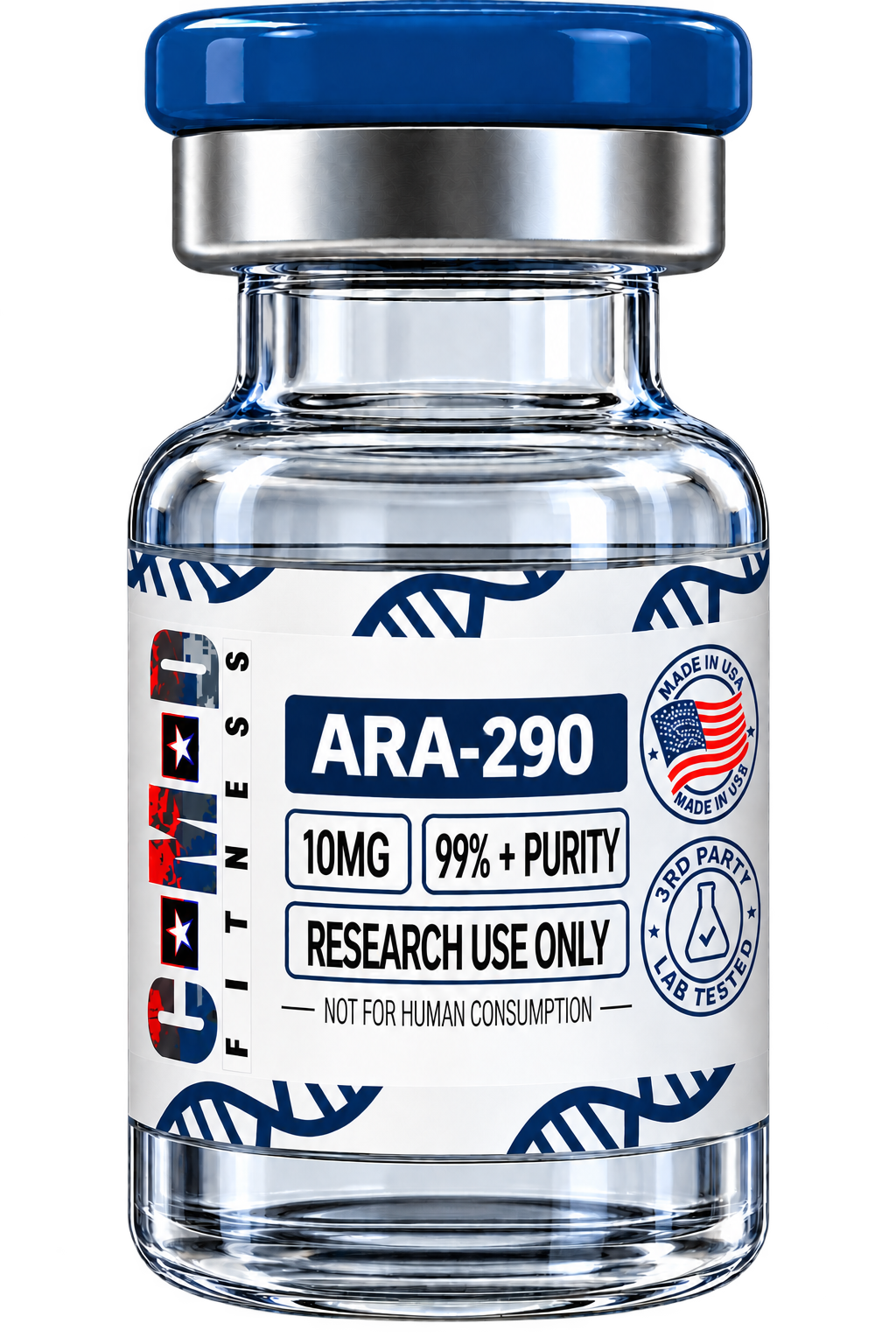

For research use only. Not for human consumption.
ARA-290 (cibinetide) is a synthetic 11–amino-acid peptide derived from the tissue-protective region of erythropoietin (EPO). It selectively activates the body’s innate repair receptor to reduce inflammation and promote tissue protection and nerve repair — without stimulating red blood cell production. It is currently an investigational drug studied mainly for neuropathic and inflammatory conditions.
Price:
$50.00
Select Quantity:
54 in stock
ARA-290 is a synthetic peptide composed of 11 amino acids, engineered from a specific region of the hormone erythropoietin (EPO). It’s designed to mimic EPO’s tissue-protective and anti-inflammatory effects without activating the receptor responsible for red blood cell production.
Unlike full-length EPO, ARA-290 does not stimulate erythropoiesis — meaning it doesn’t increase hemoglobin or hematocrit — a key safety advantage.
ARA-290 works by activating the innate repair receptor (IRR) — a heteromeric receptor complex formed by the EPO receptor and the β-common receptor (CD131). This receptor is upregulated in injured or stressed tissues, triggering protective pathways that:
Reduce inflammation
Suppress apoptosis (cell death)
Promote tissue repair and regeneration
Modulate immune responses
Support nerve fiber maintenance
This selective activation offers cytoprotective effects without the hematological risks seen with standard EPO.
ARA-290 has been evaluated mainly in Phase II human studies and preclinical models. Key findings include:
In people with type 2 diabetes and painful neuropathy, 4 mg daily subcutaneous ARA-290 for 28 days reduced pain symptoms and improved metabolic markers like HbA1c and lipid profiles compared with placebo. Nerve integrity (corneal nerve fiber density) also increased in those with baseline loss.
In sarcoidosis-associated small fiber neuropathy, ARA-290 improved nerve symptoms and objective nerve fiber measures over 28 days compared with placebo, with better quality of life and physical function.
In preclinical nerve-injury models, ARA-290 reduced neuropathic pain and suppressed spinal microglial activation (a central inflammation driver in chronic pain).
Available data suggest ARA-290 is well tolerated, with most side effects being mild and transient (e.g., injection site irritation or headache). Because it doesn’t stimulate blood cell production, many of the common risks with full EPO analogs (like elevated hematocrit or clotting) aren’t observed.
However, long-term safety data are limited, and immunogenic effects (antibody formation) remain a theoretical concern requiring further study.
ARA-290 is not approved by the U.S. Food and Drug Administration (FDA) for any therapeutic indication and remains investigational.
It has been granted Orphan Drug designation for rare neuropathic conditions, which supports development but does not equate to full approval.
Clinical use outside formal trials is typically restricted to research settings or approved compassionate protocols; it isn’t legally prescribable as a standard treatment.
Mechanism:
✔ Selectively activates tissue-protective IRR signaling
✔ Anti-inflammatory and cytoprotective
✔ No erythropoiesis
Clinical Evidence:
✔ Positive Phase II results for diabetic neuropathy and small fiber neuropathy
✔ Increased objective nerve fiber regeneration in some trials
✔ Improved symptoms and metabolic markers
Safety:
✔ Generally well tolerated in short-term studies
❗ Long-term safety not fully defined
Regulatory:
❗ Not FDA-approved, investigational status
Type: Synthetic linear peptide
Length: 11 amino acids
Origin: Derived from the tissue-protective B-helix region of Erythropoietin (EPO)
Sequence: Pyroglutamate-Glu-Arg-Ala-Leu-Asn-Ser-Ser-Arg-Leu-Tyr
Molecular weight: ~1.25 kDa
Modification: N-terminal pyroglutamate (improves stability and resistance to enzymatic degradation)
Selectively binds the Innate Repair Receptor (IRR)
A heteromeric complex of:
Erythropoietin receptor (EPOR)
β-common receptor (CD131)
Does NOT bind or activate the homodimeric EPOR responsible for erythropoiesis
Therefore:
❌ No stimulation of red blood cell production
❌ No rise in hematocrit
✔ Activates tissue-protective signaling only
Upon IRR binding, ARA-290 activates intracellular pathways involved in cytoprotection:
JAK2 / STAT3 pathway
PI3K / Akt pathway
NF-κB modulation
Reduced pro-inflammatory cytokine release (e.g., TNF-α, IL-1β)
Anti-apoptotic signaling
These pathways promote:
Reduced inflammation
Reduced oxidative stress
Improved cell survival
Nerve fiber repair and regeneration
Administration: Subcutaneous injection (in clinical studies)
Half-life: Short (minutes in plasma)
Biological effect duration: Longer than plasma half-life due to receptor-mediated signaling cascade
Metabolism: Proteolytic degradation into amino acids
IRR expression increases in:
Inflamed tissue
Hypoxic tissue
Nerve injury sites
This provides injury-selective activity, meaning the peptide primarily acts where tissue stress exists.
| Feature | EPO | ARA-290 |
|---|---|---|
| Size | ~30.4 kDa glycoprotein | ~1.25 kDa peptide |
| Glycosylated | Yes | No |
| Stimulates RBC production | Yes | No |
| Activates IRR | Yes | Yes |
| Activates erythropoietic receptor | Yes | No |
ARA-290 is most extensively studied in small fiber neuropathy (SFN) and diabetic neuropathy.
Research focus areas:
Regeneration of damaged small nerve fibers
Reduction of neuropathic pain
Improvement in corneal nerve fiber density (objective nerve repair marker)
Functional symptom improvement in metabolic neuropathy
It has been evaluated in clinical trials for neuropathy associated with:
Type 2 diabetes
Sarcoidosis
Idiopathic small fiber neuropathy
In preclinical studies, ARA-290 is used to examine:
Protection against peripheral nerve injury
Reduction of microglial activation in spinal cord models
Prevention of neuronal apoptosis
Enhancement of axonal regeneration
These studies explore its potential in:
Chemotherapy-induced neuropathy
Traumatic nerve injury
Central sensitization models
Because it activates the innate repair receptor (IRR), ARA-290 is studied for:
Cytokine suppression (TNF-α, IL-1β, IL-6)
Modulation of macrophage activation
Reduction of chronic inflammatory signaling
Preclinical models include:
Autoimmune inflammation
Tissue injury with sterile inflammation
Systemic inflammatory response conditions
ARA-290 has been investigated in experimental models of:
Ischemia-reperfusion injury
Renal injury
Cardiac tissue stress
Hypoxic tissue damage
Its interest lies in:
Anti-apoptotic signaling
Reduction of oxidative stress
Preservation of microvascular integrity
Early human trials suggest possible effects on:
HbA1c reduction
Lipid profile improvement
Insulin sensitivity markers
This has prompted research into:
Inflammation-driven insulin resistance
Metabolic neuropathy interactions
ARA-290 is frequently used as a tool compound to:
Study selective activation of the Innate Repair Receptor
Differentiate erythropoietic vs. tissue-protective EPO signaling
Investigate JAK2/STAT3 and PI3K/Akt cytoprotective pathways
It is especially valuable in receptor-selectivity experiments because it does not activate erythropoiesis.
Primarily Phase II clinical research
Not broadly approved for therapeutic use
Continued investigation in neuropathy and inflammatory modulation
Chemical class: Synthetic linear peptide
Peptide length: 11 amino acids
Molecular formula: ~C₆₀H₉₄N₁₆O₁₇ (approximate, sequence-dependent)
Molecular weight: ~1,250 Daltons (1.25 kDa)
Sequence: pGlu-Glu-Arg-Ala-Leu-Asn-Ser-Ser-Arg-Leu-Tyr
N-terminal modification: Pyroglutamate (cyclized glutamic acid)
Linear (non-cyclic) peptide
No glycosylation
No disulfide bridges
Contains:
2 positively charged residues (Arginine)
2 polar uncharged residues (Serine)
2 hydrophobic residues (Leucine)
Amphipathic character (mixed hydrophilic and hydrophobic regions)
The N-terminal pyroglutamate increases:
Resistance to aminopeptidase degradation
Stability in plasma
Solubility: Highly water-soluble
Charge at physiological pH: Slightly positive
Isoelectric point (pI): Estimated ~9–10
Stability:
Short plasma half-life (minutes)
Rapid enzymatic degradation by proteases
Storage: Typically lyophilized powder; requires refrigeration after reconstitution
ARA-290 is susceptible to:
Endopeptidase cleavage
Renal clearance
Proteolytic breakdown into individual amino acids
Because it is small and non-glycosylated, it:
Does not have the extended half-life of full erythropoietin
Requires parenteral (subcutaneous) administration in research settings
| Property | Erythropoietin | ARA-290 |
|---|---|---|
| Size | ~30.4 kDa | ~1.25 kDa |
| Glycosylated | Yes | No |
| Structure | 165 aa protein | 11 aa peptide |
| Plasma half-life | Hours | Minutes |
| Chemical complexity | High | Low |
Small synthetic peptide fragment
Biologically active epitope mimic
Protease-sensitive
Water-soluble
Non-glycosylated
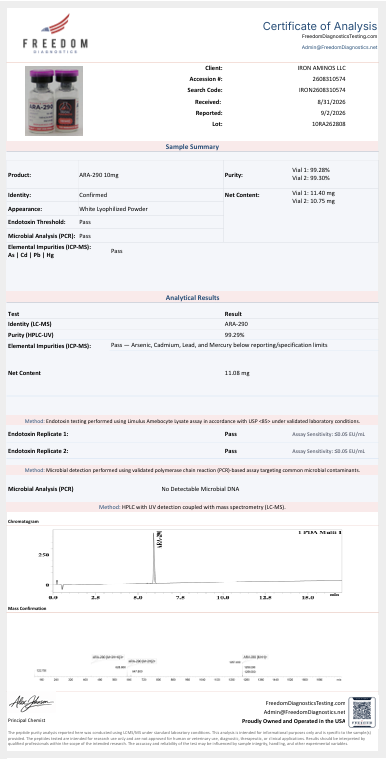
Tested by Freedom Diagnostics Testing @ Freedom Diagnostics Testing – Reliable. Accountable. Accessible.
Temperature: 2–8 °C (refrigerated)
Light protection: Store protected from light
Moisture: Keep dry; avoid humidity exposure
Shelf life: Typically stable for months to a few years when properly stored (manufacturer dependent)
For longer-term storage in research settings:
May be kept at –20 °C in sealed, moisture-proof containers.
Diluent: Usually sterile water for injection or bacteriostatic water (research use)
Temperature: 2–8 °C (refrigerated)
Do not freeze after reconstitution
Use period: Commonly within 7–14 days (varies depending on sterility and formulation)
Because ARA-290 is a small peptide:
It is prone to proteolytic degradation
Repeated freeze–thaw cycles should be avoided
Use sterile technique to minimize contamination
Sensitive to heat and prolonged room-temperature exposure
Stable in aqueous solution for limited time
pH extremes accelerate degradation
✔ Store powder cold and dry
✔ Refrigerate after mixing
✔ Avoid light exposure
✔ Avoid multiple freeze–thaw cycles
✔ Follow supplier-specific storage instructions
Command Center is a leading provider of USA manufactured, research peptides.
Copyright 2026 © Command Center All Rights Reserved