



For research use only. Not for human consumption.
SS‑31 (Elamipretide) is a synthetic mitochondria-targeting tetrapeptide that protects mitochondrial function, reduces oxidative stress, and is used in research on mitochondrial dysfunction, aging, and metabolic disorders
Price:
$60.00
Select Quantity:
48 in stock
SS‑31, also known as Elamipretide or MTP‑131, is a synthetic mitochondria-targeting tetrapeptide designed to protect and enhance mitochondrial function. It selectively localizes to the inner mitochondrial membrane, where it binds to cardiolipin, a lipid critical for maintaining mitochondrial structure and electron transport chain efficiency.
By stabilizing cardiolipin, SS‑31 reduces reactive oxygen species (ROS) production, preserves mitochondrial bioenergetics, and protects cells from oxidative stress and apoptosis. This makes it a valuable research tool in studies of aging, metabolic disorders, neurodegeneration, and cardiac or skeletal muscle dysfunction.
Peptide Type: Synthetic tetrapeptide
Mechanism of Action: Targets mitochondria, stabilizes cardiolipin, and enhances electron transport
Primary Effects: Reduces oxidative stress, improves mitochondrial efficiency, and protects against apoptosis
Research Focus: Mitochondrial dysfunction, oxidative injury, metabolic health, and age-related decline
Studying mitochondrial bioenergetics and ROS regulation
Investigating cardiac, skeletal, and neural mitochondrial dysfunction
Researching age-related diseases, neurodegeneration, and metabolic disorders
Evaluating mitochondria-targeted therapeutics
SS‑31 is a mitochondria-targeting tetrapeptide that enhances mitochondrial function, reduces oxidative stress, and protects against cell damage, making it a key tool in preclinical research on metabolic health, aging, and mitochondrial diseases.
Type: Synthetic tetrapeptide
Amino Acid Sequence: D‑Arg–2′6′-dimethylTyr–Lys–Phe–NH2
Molecular Weight: ~639 Da
Structure: Small linear peptide with cationic and aromatic residues enabling mitochondrial targeting
Target: Inner mitochondrial membrane, specifically interacting with cardiolipin
Mitochondrial Targeting: Positively charged residues allow electrostatic attraction to negatively charged cardiolipin
Cardiolipin Stabilization: Maintains inner mitochondrial membrane structure and supports electron transport chain (ETC) function
Antioxidant Action: Reduces reactive oxygen species (ROS) production and prevents oxidative damage
Bioenergetic Support: Enhances ATP production by improving mitochondrial efficiency
Cytoprotective Effects: Prevents mitochondrial swelling, depolarization, and apoptosis in stressed cells
Mitochondrial Protection: Preserves mitochondrial morphology and function under stress
Oxidative Stress Reduction: Limits ROS-mediated cellular damage
Improved Cellular Energy: Supports ATP synthesis in high-demand tissues such as heart, brain, and skeletal muscle
Anti-Apoptotic: Protects cells from programmed cell death triggered by mitochondrial dysfunction
Water-Soluble: Readily soluble for in vitro and in vivo studies
Chemical Stability: Resistant to rapid degradation in cellular models
Cell Penetrating: Can cross mitochondrial membranes due to its cationic and aromatic residues
SS‑31 is a cationic, aromatic tetrapeptide that selectively targets mitochondria, stabilizes cardiolipin, enhances bioenergetics, and reduces oxidative stress. Its biochemical characteristics—mitochondrial targeting, antioxidant action, and cytoprotection—make it highly valuable for preclinical research on mitochondrial dysfunction, aging, neurodegeneration, and metabolic disorders.
Investigating mechanisms of mitochondrial damage in cardiac, neural, and skeletal muscle tissues
Studying electron transport chain efficiency, ATP production, and mitochondrial bioenergetics
Evaluating strategies to protect mitochondria under oxidative or ischemic stress
Examining reactive oxygen species (ROS) production and mitigation
Studying oxidative damage in aging, neurodegeneration, and metabolic disease models
Testing antioxidant and cytoprotective interventions in preclinical models
Studying age-associated decline in mitochondrial function
Evaluating effects in Alzheimer’s, Parkinson’s, and other neurodegenerative disease models
Investigating mitochondria-targeted therapeutics for lifespan and healthspan improvement
Protecting heart and muscle tissue during ischemia-reperfusion injury
Studying mitochondrial preservation and energy metabolism in high-demand tissues
Researching exercise-mimetic and bioenergetic enhancement effects
Investigating ATP production and energy homeostasis
Studying mitochondrial efficiency in metabolic syndrome or obesity models
Exploring therapeutic strategies for metabolic disorders via mitochondrial protection
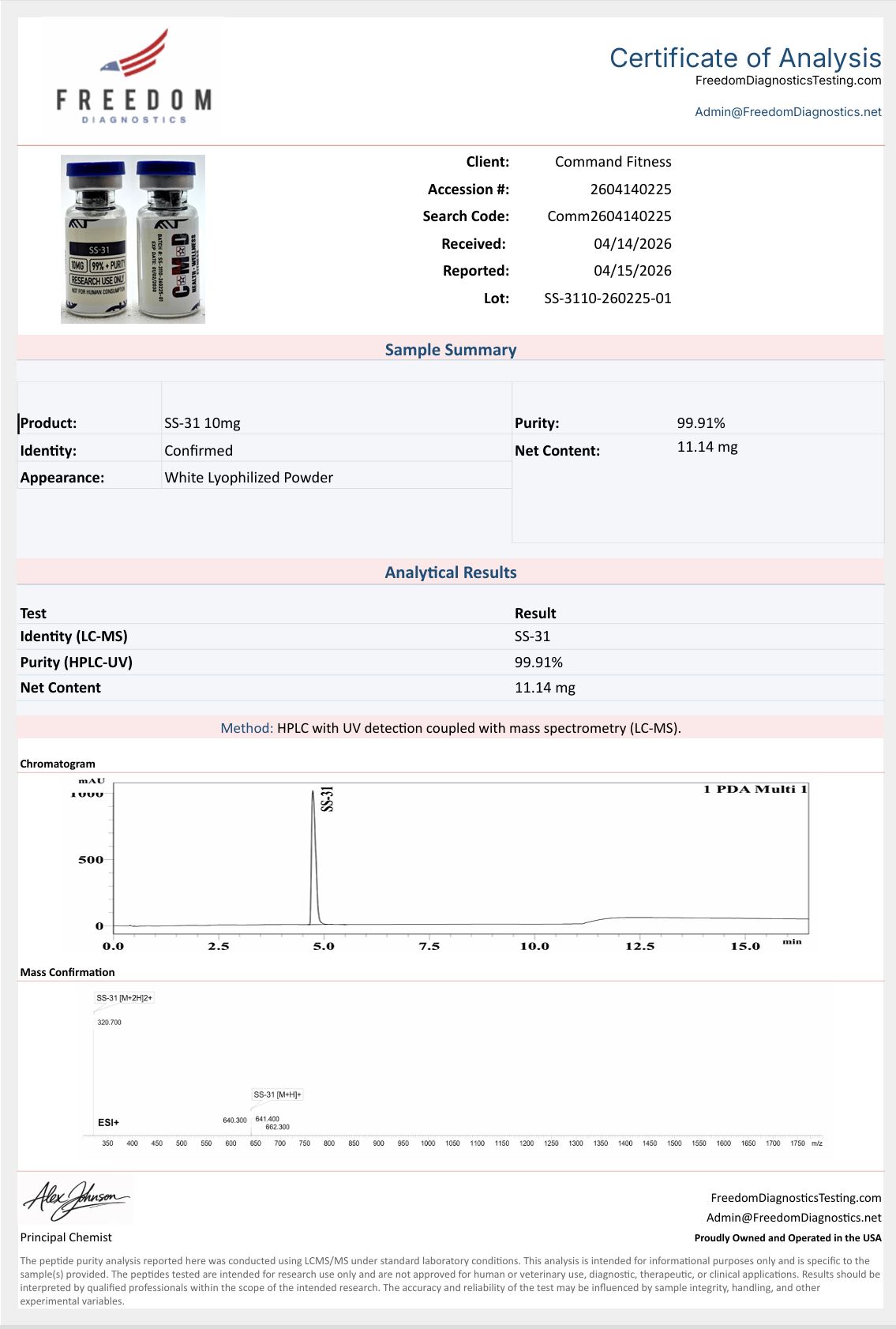
Tested by Freedom Diagnostics Testing @ Freedom Diagnostics Testing – Reliable. Accountable. Accessible.
Research reveals that 5 Amino 1 MQ may have complementary actions in wound repair biology. Although both peptides have been studied in the context of healing and inflammation control, they appear to influence tissue repair through different biochemical “entry points.” This creates a plausible rationale for synergy when the two are evaluated together in controlled laboratory models.
Command Center is a leading provider of USA manufactured, research peptides.
Copyright 2026 © Command Center All Rights Reserved