

Veteran-owned business
Product Usage: This PRODUCT IS INTENDED AS A RESEARCH CHEMICAL ONLY. This designation allows the use of research chemicals strictly for in vitro testing and laboratory experimentation only. All product information available on this website is for educational purposes only. Bodily introduction of any kind into humans or animals is strictly forbidden by law. This product should only be handled by licensed, qualified professionals. This product is not a drug, food, or cosmetic and may not be misbranded, misused or mislabeled as a drug, food or cosmetic.

For research use only. Not for human consumption.

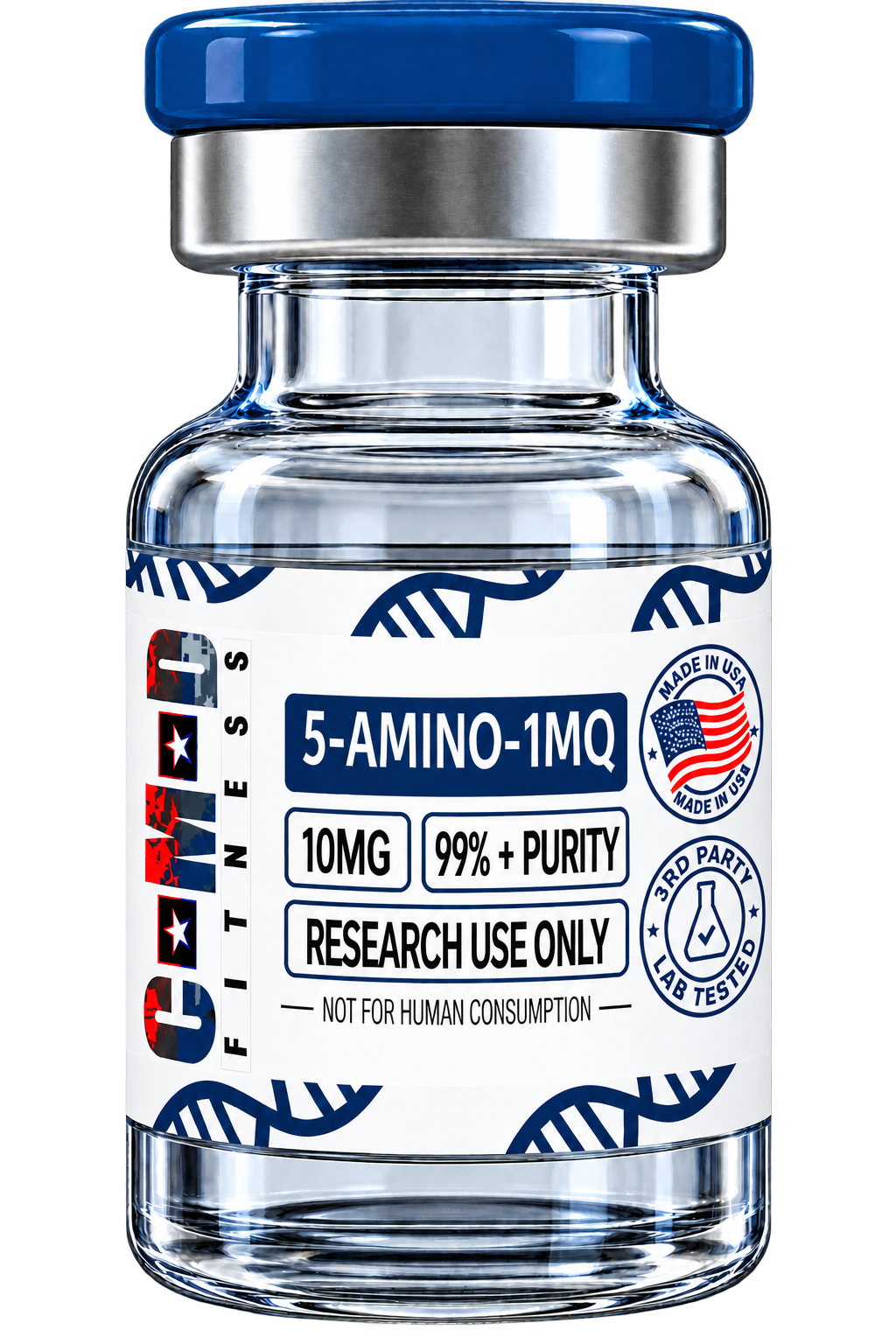
5-AMINO-1MQ

5-AMINO-1MQ is a research compound known for its role as a selective NNMT (Nicotinamide N-methyltransferase) inhibitor, an enzyme involved in cellular metabolism and energy regulation. By targeting NNMT, 5-AMINO-1MQ is widely studied for its potential impact on fat metabolism, metabolic function, and cellular aging pathways.

Primarily used in laboratory and preclinical research settings, 5-AMINO-1MQ is of interest in studies related to weight management, metabolic health, and NAD⁺ biology. It is intended strictly for research purposes and not for human consumption.
Price:

$65.00

Select Quantity:

4 in stock

Overview

5-AMINO-1MQ is a research compound known for its role as a selective NNMT (Nicotinamide N-methyltransferase) inhibitor, an enzyme involved in cellular metabolism and energy regulation. By targeting NNMT, 5-AMINO-1MQ is widely studied for its potential impact on fat metabolism, metabolic function, and cellular aging pathways.

Primarily used in laboratory and preclinical research settings, 5-AMINO-1MQ is of interest in studies related to weight management, metabolic health, and NAD⁺ biology. It is intended strictly for research purposes and not for human consumption.

Biochemical
Characteristics

1️⃣ Molecular Identity

  • Chemical name: 5-Amino-1-methylquinolinium

  • Class: Small-molecule enzyme inhibitor (NOT a peptide)

  • Core structure: Quinolinium ring with amino substitution

  • Molecular formula (cation): C₁₀H₁₁N₂⁺

  • Approx. molecular weight: ~159 g/mol (varies slightly by salt form)

  • Charge: Positively charged (quaternary ammonium structure)


2️⃣ Primary Molecular Target

  • Target enzyme: Nicotinamide N-methyltransferase

  • Inhibition type: Competitive inhibitor (binds at active site)

  • Reported IC₅₀: ~1–5 µM (low micromolar range in enzymatic assays)

  • Selectivity: High selectivity toward NNMT relative to related methyltransferases


3️⃣ Biochemical Mechanism

NNMT normally catalyzes:

Nicotinamide + SAM → 1-Methylnicotinamide (1-MNA) + SAH

When 5-AMINO-1MQ inhibits NNMT:

  • ↑ Intracellular nicotinamide

  • NAD⁺ salvage pathway flux

  • ↑ Cellular NAD⁺ levels

  • ↓ Methyl group consumption from S-adenosylmethionine (SAM)

  • Altered cellular methylation balance

This shifts cellular metabolism toward:

  • Enhanced mitochondrial oxidative metabolism

  • Increased sirtuin activity (NAD⁺-dependent enzymes)

  • Modified adipocyte metabolic signaling


4️⃣ Effects on Cellular Metabolism

In preclinical and in vitro studies:

  • ↓ Adipogenesis (fat cell formation)

  • ↑ Lipolysis (fat breakdown)

  • ↑ Energy expenditure markers

  • ↑ Mitochondrial respiration

  • Modulation of epigenetic methylation status (via SAM preservation)


5️⃣ Pharmacodynamic Characteristics (Preclinical Data)

  • Rapid cellular uptake (small molecular size)

  • Water soluble

  • Demonstrates systemic metabolic effects in animal models

  • Primarily studied in metabolic and obesity models

⚠️ No approved pharmacokinetic profile exists for human clinical use.


6️⃣ Stability & Handling Properties

  • Stable as dry powder

  • Hygroscopic in some salt forms

  • Soluble in water and DMSO

  • Typically stored at −20 °C in research settings


7️⃣ Research Significance

5-AMINO-1MQ is primarily used to investigate:

  • NAD⁺ biology

  • Methyl donor metabolism

  • Obesity and metabolic dysfunction pathways

  • NNMT’s role in cancer cell metabolism

  • Epigenetic regulation via SAM balance

Research Applications

Research Applications & Areas of Investigation

Scientists use 5-Amino-1MQ in preclinical and in vitro research to study:
• Metabolic regulation & obesity models: NNMT inhibition has been shown in animal studies to reduce adiposity and influence energy expenditure.
• NAD⁺ metabolism and cellular energy pathways: Increasing NAD⁺ engages sirtuins and influences mitochondrial function.
• Adipocyte biology and fat cell differentiation.
• Muscle regeneration and satellite cell activity (exploratory).
• Cancer & cell proliferation studies: Some academic research has tested analogous NNMT inhibitors for effects on tumour cell lines.

All applications are research-only and cannot be construed as therapeutic or clinical evidence.

Chemical Properties

5-Amino-1-MQ (short for 5-amino-1-methylquinolinium) is a small organic compound often discussed in biochemical and pharmacological research. Here are its key chemical properties:


🧪 Basic Chemical Information

  • Chemical name: 5-amino-1-methylquinolinium (commonly as a salt, e.g., chloride or iodide)
  • Molecular formula: C₁₀H₁₁N₂⁺ (cation form; varies slightly with counterion)
  • Molecular weight: ~159.21 g/mol (for the cation only)
  • Structure: مشتق من quinoline ring system with:
    • An amino group (-NH₂) at position 5
    • A methyl group attached to the nitrogen (forming a quaternary ammonium-like structure)

⚗️ Physical Properties

  • Appearance: Typically a crystalline solid (often white to off-white)
  • Solubility:
    • Highly soluble in water (due to its ionic nature)
    • Moderately soluble in polar organic solvents (e.g., methanol, ethanol)
  • Melting point: Depends on the salt form (commonly >200 °C for many derivatives)

🔬 Chemical Properties

  • Charge:
    • Exists as a positively charged cation (quinolinium ion), making it:
      • Highly polar
      • Water-soluble
  • Functional groups:
    • Aromatic quinoline ring
    • Primary amine (-NH₂) → can participate in hydrogen bonding
    • Quaternized nitrogen (N⁺–CH₃) → permanently charged
  • Acid-base behavior:
    • The quaternary nitrogen is not basic (already protonated)
    • The amino group may exhibit weak basicity
  • Reactivity:
    • Can participate in:
      • Electrophilic aromatic substitution (limited by ring activation/deactivation)
      • Hydrogen bonding interactions
    • Generally chemically stable under standard lab conditions

🧬 Biochemical Context

  • Known as an inhibitor of NNMT
  • Studied in:
    • Metabolism research
    • Obesity and energy regulation
  • Its cationic nature helps interaction with enzyme active sites

⚠️ Stability & Handling

  • Stable under dry, standard storage conditions
  • Should be protected from:
    • Excessive heat
    • Strong oxidizing agents
  • Handle using standard laboratory safety procedures
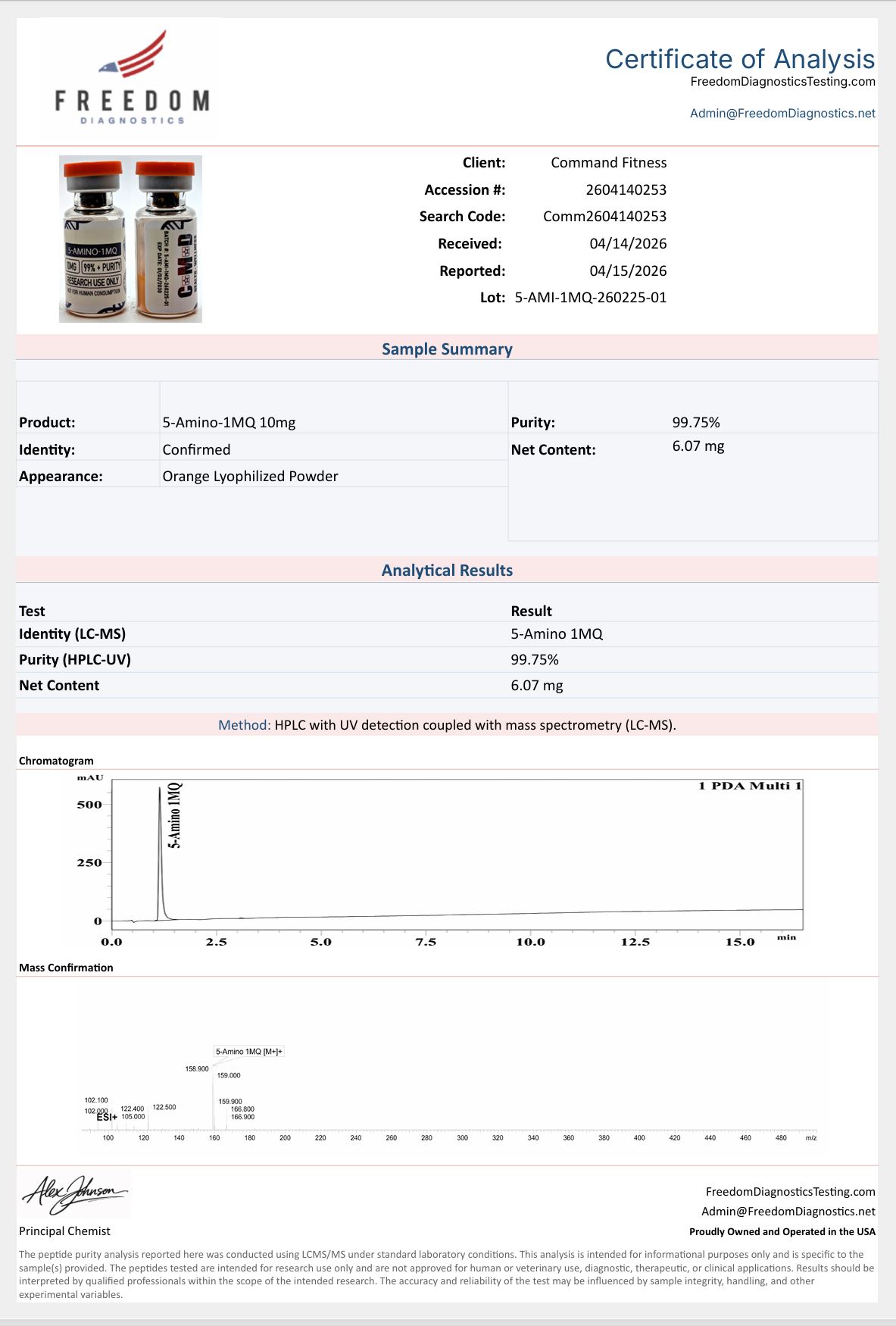
COA /HPLC / MS

3rd Party Testing
Storage

🌡️ Temperature

  • Long-term storage: −20 °C (preferred)

  • Short-term storage (≤1–2 weeks): 2–8 °C

  • Avoid repeated freeze–thaw cycles if reconstituted


💧 Moisture & Light Protection

  • Store dry

  • Keep container tightly sealed

  • Use desiccant if available

  • Protect from prolonged light exposure (store in amber vial or dark container)


🧪 Solution Storage (If Reconstituted)

  • Soluble in sterile water or DMSO for research use

  • Prepare small aliquots to avoid repeated thawing

  • Store aliquots at −20 °C

  • Use freshly prepared aqueous solutions when possible


📅 Stability

  • Stable for extended periods when stored frozen and dry

  • Degradation risk increases with:

    • Heat

    • Humidity

    • Repeated temperature cycling

Your cart is currently empty.

Return to shop

0