

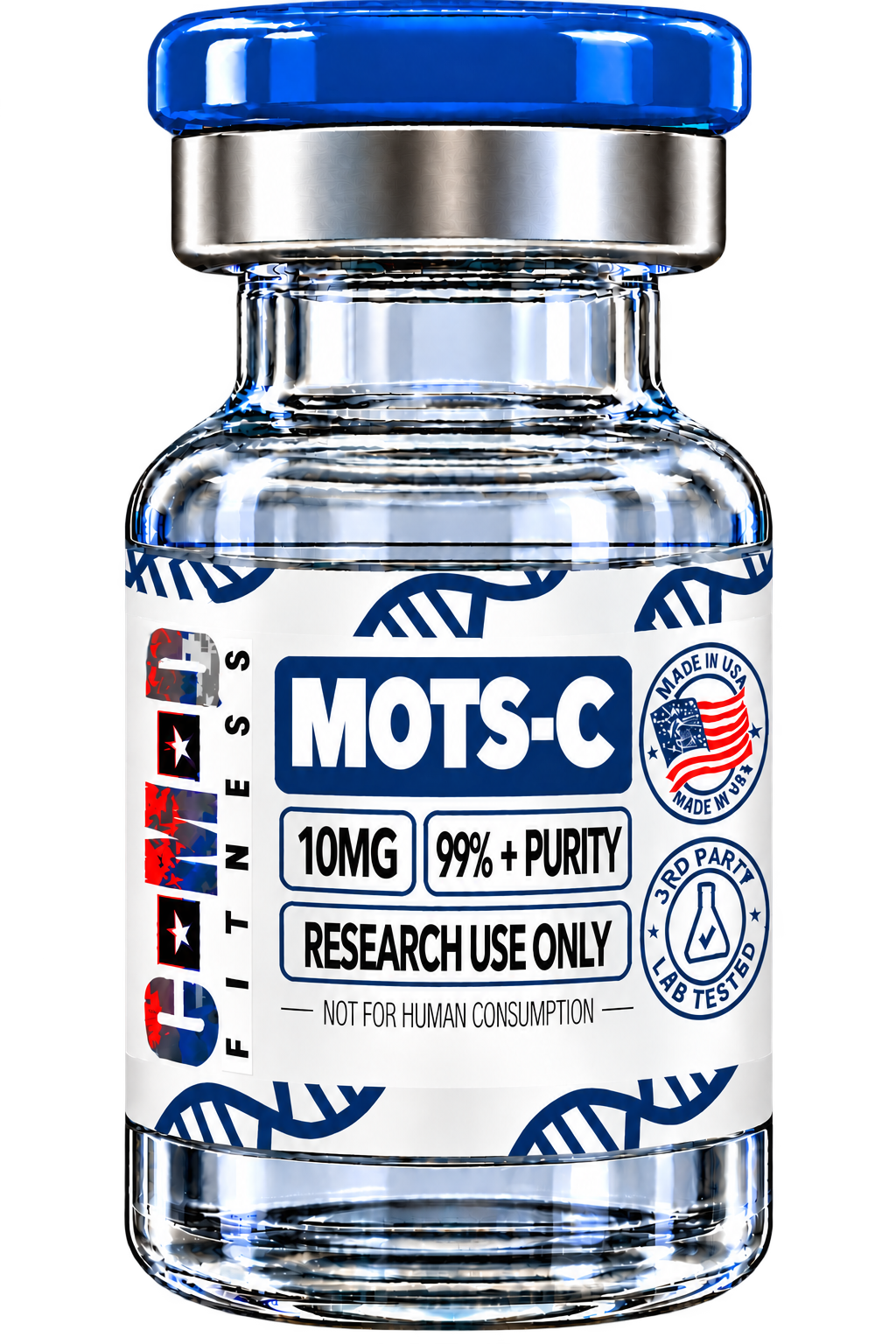

For research use only. Not for human consumption.
MOTS-c is a 16-amino-acid mitochondria-derived peptide that regulates cellular metabolism, insulin sensitivity, and mitochondrial function, making it a key molecule in metabolic and anti-aging research.
Price:
$60.00 – $150.00Price range: $60.00 through $150.00
Select Quantity:
MOTS-c is a mitochondria-derived peptide (MDP) encoded by the mitochondrial genome, consisting of 16 amino acids. It functions as a metabolic regulator, modulating insulin sensitivity, glucose metabolism, and mitochondrial function. By acting as a signaling molecule between mitochondria and the nucleus, MOTS-c helps maintain energy homeostasis, metabolic balance, and cellular resilience, particularly under stress or aging conditions.
Length: 16 amino acids
Structure: Linear, water-soluble peptide
Function: Regulates metabolism, mitochondrial activity, and cellular energy
Mechanism: Influences AMPK signaling, nuclear gene expression, and mitochondrial stress responses
Studying metabolic disorders such as obesity and type 2 diabetes
Investigating mitochondrial function, energy homeostasis, and cellular resilience
Exploring anti-aging pathways and metabolic regulation
Research on muscle metabolism, exercise adaptation, and metabolic signaling
MOTS-c is a mitochondria-derived signaling peptide that plays a pivotal role in energy regulation, metabolic homeostasis, and anti-aging research. Its unique mitochondrial origin makes it a valuable tool for preclinical and laboratory studies in metabolism and mitochondrial biology.
Type: Mitochondria-derived peptide (MDP)
Amino Acid Sequence: 16 amino acids
Molecular Weight: ~2 kDa
Structure: Linear, water-soluble peptide
Origin: Encoded by the 12S rRNA region of mitochondrial DNA
Receptor/Target: Exerts effects through intracellular signaling pathways, particularly AMPK activation
Metabolic Regulation: Enhances insulin sensitivity, glucose uptake, and energy metabolism
Mitochondrial Function: Improves mitochondrial respiration, biogenesis, and stress resistance
Gene Expression: Can translocate to the nucleus to modulate nuclear gene expression related to metabolism
Energy Homeostasis: Maintains cellular and systemic metabolic balance
Anti-Aging Effects: Protects cells from age-related mitochondrial dysfunction
Exercise and Muscle Function: Supports muscle metabolism and adaptation to energetic stress
Cellular Protection: Exhibits cytoprotective and stress-resistance effects
Water-Soluble: Facilitates experimental use in cell culture and in vivo studies
Short Half-Life: Rapidly metabolized; often used in controlled dosing studies
Stability: Sensitive to temperature, pH extremes, and enzymatic degradation
MOTS-c is a linear, mitochondria-derived peptide that regulates metabolic pathways, mitochondrial function, and energy homeostasis. Its biochemical properties—small size, water solubility, nuclear signaling capability, and AMPK activation—make it an essential tool for research in metabolism, anti-aging, and mitochondrial biology.
Investigating insulin sensitivity and glucose metabolism
Studying obesity, type 2 diabetes, and metabolic syndrome
Exploring mitochondrial regulation of energy homeostasis
Research on mitochondrial respiration, biogenesis, and stress resistance
Studying mitochondria-to-nucleus signaling and gene regulation
Evaluating mitochondrial protective effects in aging or metabolic stress
Examining age-related decline in metabolism and mitochondrial function
Researching cellular resilience and cytoprotection under stress
Exploring therapeutic potential in delaying metabolic aging
Studying muscle metabolism and adaptation to energetic stress
Investigating effects on endurance, energy utilization, and mitochondrial efficiency
Evaluating interaction with GH/IGF-1 and other metabolic pathways
MOTS-c is primarily used in research to study metabolism, mitochondrial function, energy homeostasis, anti-aging mechanisms, and muscle physiology. Its mitochondria-derived signaling and influence on AMPK and nuclear pathways make it a valuable peptide for preclinical and laboratory studies in metabolic and mitochondrial biology.
MOTS-C (Mitochondrial Open Reading Frame of the 12S rRNA-c) is a naturally occurring mitochondrial-derived peptide (MDP) encoded within the mitochondrial 12S rRNA region. It is studied for its relationship to cellular metabolism, mitochondrial signaling, and metabolic homeostasis.
Unlike many conventional peptides encoded by nuclear DNA, MOTS-C is notable for its mitochondrial genetic origin. Research has examined its potential involvement in metabolic regulation, cellular energy sensing, glucose metabolism, mitochondrial-nuclear communication, stress-response pathways, and metabolic homeostasis.
For research and laboratory applications only.
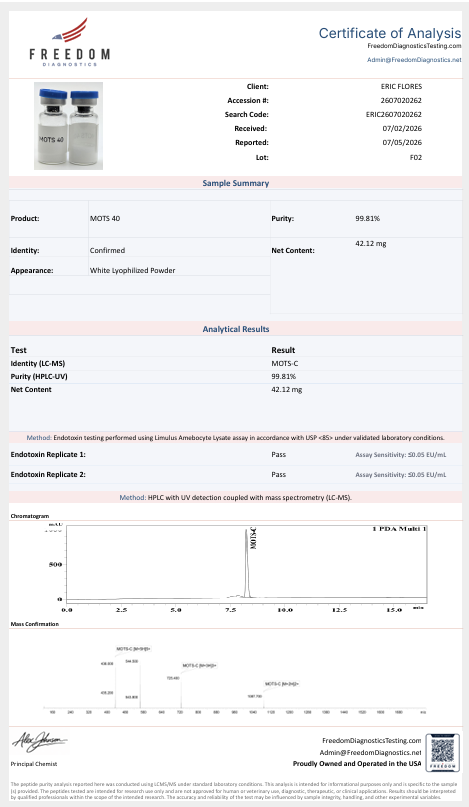
Tested by Freedom Diagnostics Testing @ Freedom Diagnostics Testing – Reliable. Accountable. Accessible.
Temperature: Store refrigerated at 2–8 °C (36–46 °F) for short-term use
Long-Term Storage: Freeze at −20 °C or lower to maintain stability
Light Protection: Keep protected from direct light
Moisture Protection: Keep the vial sealed and dry
Shelf Life: Typically 12–24 months when stored properly
Diluent: Sterile water or bacteriostatic water
Temperature: Store refrigerated at 2–8 °C
Use Period: Recommended within 7–14 days
Handling: Gently swirl to dissolve; avoid vigorous shaking
Do NOT freeze after reconstitution
Inspect solution before use: should be clear, colorless, and free of particulates
Discard if cloudy, discolored, or precipitated
Use sterile technique during reconstitution and handling
Protect from heat, light, and mechanical agitation to maintain peptide integrity
MOTS-c is most stable as a lyophilized powder stored refrigerated or frozen. Once reconstituted, it should be kept cold, used promptly, and protected from light and agitation to preserve biological activity for laboratory and preclinical research.
Command Center is a leading provider of USA manufactured, research peptides.
Copyright 2026 © Command Center All Rights Reserved