IGF-1 LR3 is a long-acting synthetic analog of Insulin-like Growth Factor-1 with enhanced stability and potency, designed to stimulate cell growth, tissue repair, and regeneration in research studies.


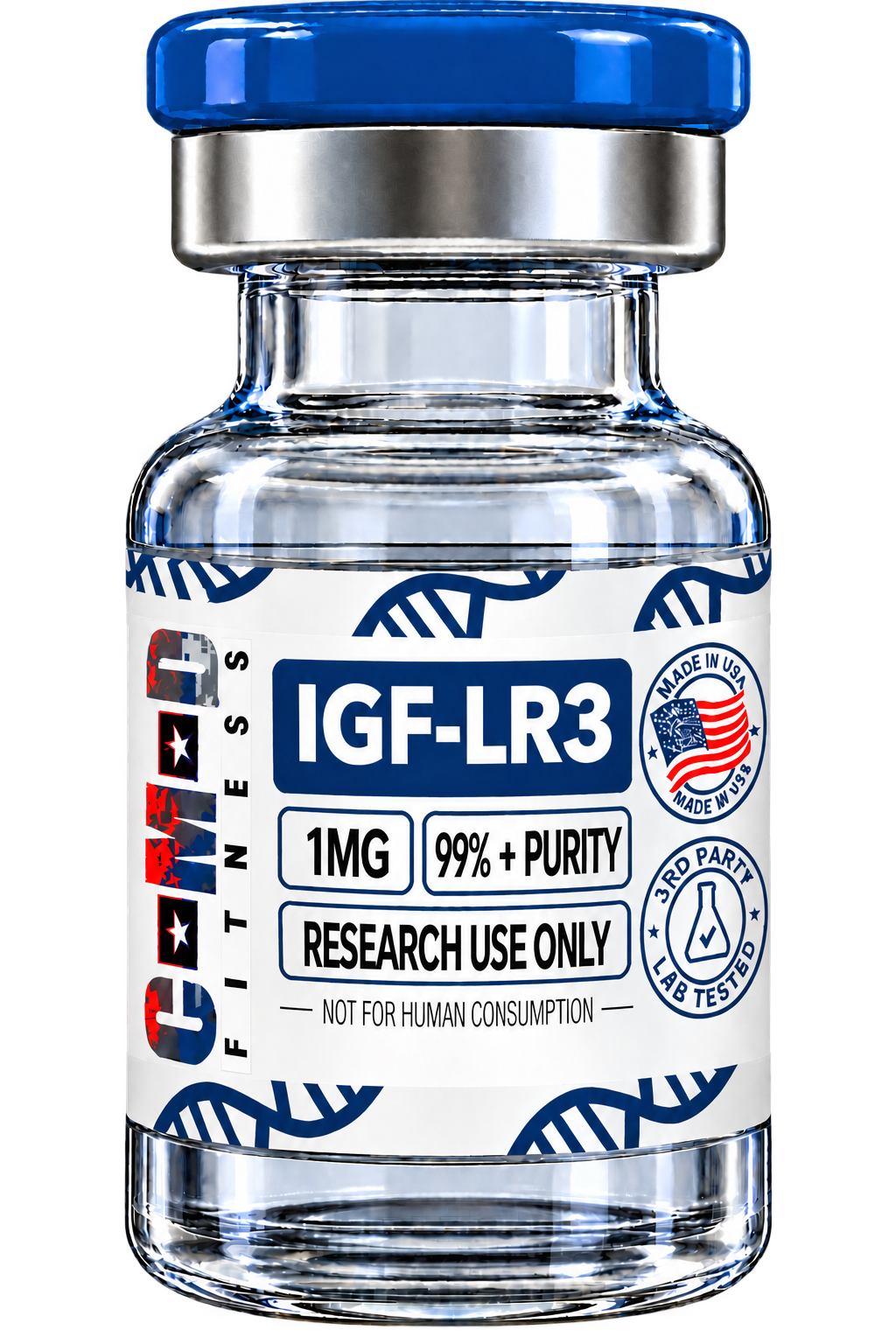

For research use only. Not for human consumption.
IGF-1 LR3 is a long-acting synthetic analog of Insulin-like Growth Factor-1 with enhanced stability and potency, designed to stimulate cell growth, tissue repair, and regeneration in research studies.
Price:
$110.00
Select Quantity:
40 in stock
IGF-1 LR3 (Insulin-like Growth Factor-1 Long R3) is a synthetic analog of IGF-1 engineered for enhanced stability, reduced binding to IGF-binding proteins, and prolonged biological activity. It retains the growth-promoting and metabolic functions of native IGF-1 but exhibits greater receptor availability and longer half-life, making it useful in experimental research.
Peptide Length: 70 amino acids with N-terminal Arg modification (LR3)
Enhanced Stability: Resistant to proteolytic degradation
Potency: Increased activation of IGF-1 receptor pathways due to reduced binding to IGF-binding proteins
Water Solubility: Linear peptide suitable for laboratory use
Studying cellular proliferation and growth signaling pathways
Research on muscle, cartilage, and bone regeneration
Investigation of anti-apoptotic mechanisms and tissue repair
Metabolic studies including glucose uptake and lipid metabolism
IGF-1 LR3 is a long-acting IGF-1 analog with enhanced bioactivity and stability, widely used in research to explore growth factor signaling, tissue regeneration, and metabolic effects, strictly for experimental or in vitro applications.
Type: Synthetic peptide analog of IGF-1
Amino Acid Sequence: 70 amino acids with an Arginine substitution at position 3 (Long R3)
Molecular Weight: ~9.7 kDa
Structure: Linear peptide with N-terminal modification for reduced binding to IGF-binding proteins (IGFBPs)
Receptor Interaction: Binds to IGF-1 receptor (IGF1R) to stimulate intracellular growth and survival signaling pathways
Reduced IGFBP Binding: Minimizes sequestration by IGF-binding proteins, enhancing bioavailability and receptor activation
Signal Transduction: Activates PI3K/Akt/mTOR and MAPK/ERK pathways, promoting protein synthesis, cell proliferation, and anti-apoptotic effects
Stability: Resistant to proteolytic degradation compared to native IGF-1, extending half-life and activity
Cell Growth & Proliferation: Stimulates muscle, bone, and connective tissue growth
Tissue Repair & Regeneration: Enhances healing in experimental wound and tissue models
Metabolic Regulation: Mimics insulin-like effects, facilitating glucose uptake and lipid metabolism
Anti-Apoptotic Activity: Promotes cell survival under stress conditions
Water Soluble: Can be dissolved in sterile water or buffer
Sensitive to: Heat, repeated freeze-thaw cycles, and extreme pH
Storage Stability: Maintained best as lyophilized powder at low temperatures
IGF-1 LR3 is a synthetic, long-acting IGF-1 analog with enhanced stability, reduced IGFBP binding, and potent receptor-mediated activity. Biochemically, it activates growth and survival pathways, supports cell proliferation, tissue repair, and metabolic regulation, making it a widely used peptide in experimental growth factor and regenerative research.
Studying skeletal muscle hypertrophy in animal and cell models
Enhancing muscle repair and recovery after injury
Investigating satellite cell proliferation and differentiation
Promoting cartilage, tendon, and bone regeneration
Studying wound closure and tissue remodeling mechanisms
Exploring angiogenesis and extracellular matrix production
Investigating IGF-1 receptor (IGF1R) pathways
Studying PI3K/Akt/mTOR and MAPK/ERK signaling cascades
Researching anti-apoptotic and pro-survival signaling mechanisms
Examining glucose uptake and insulin-like metabolic effects
Exploring lipid metabolism regulation in vitro or in vivo models
Investigating energy balance and nutrient signaling
Studying cellular aging, senescence, and tissue regeneration
Evaluating growth factor therapy potential in preclinical models
Research on organ repair and recovery
IGF-1 LR3 is used in research to study muscle and tissue growth, wound healing, metabolic regulation, and cellular survival pathways. Its enhanced stability and receptor activity make it an ideal tool for preclinical and in vitro growth factor studies, strictly for experimental use only.
IGF-1 LR3 (Long R3 Insulin-Like Growth Factor-1) is a synthetic analog of human IGF-1 engineered to have a longer biological half-life and reduced binding to IGF-binding proteins (IGFBPs).
| Property | Description |
|---|---|
| Full name | Long R3 Insulin-Like Growth Factor-1 |
| Type | Recombinant/synthetic polypeptide growth-factor analog |
| Length | 83 amino acids |
| Molecular weight | Approximately 9.1 kDa |
| Structure | Single-chain polypeptide containing three intramolecular disulfide bonds |
| Modification | Arginine (R) replaces glutamic acid at position 3 of native IGF-1, with a 13-amino-acid N-terminal extension |
| Primary target | IGF-1 receptor (IGF-1R) |
| IGFBP interaction | Significantly reduced affinity for IGF-binding proteins compared with native IGF-1 |
| Solubility | Generally soluble in appropriately formulated aqueous/acidic laboratory buffers; formulation-specific |
| Stability | Sensitive to temperature, oxidation, repeated freeze-thaw cycles, and improper pH/storage conditions |
| Physical form | Commonly supplied as a lyophilized peptide/protein powder for laboratory research |
| Biological characteristic | Increased biological persistence relative to native IGF-1, largely because of reduced IGFBP binding |
The key chemical distinction is the R3 substitution plus 13-amino-acid N-terminal extension. These modifications substantially reduce binding to IGFBPs, leaving a greater fraction available to interact with IGF-1 receptors in experimental systems.
For a research-use-only product listing, a concise version would be: “IGF-1 LR3 is an 83-amino-acid recombinant IGF-1 analog with an approximate molecular mass of 9.1 kDa. It incorporates an Arg substitution at position 3 and a 13-amino-acid N-terminal extension, resulting in reduced IGF-binding-protein affinity and increased biological persistence compared with native IGF-1.”
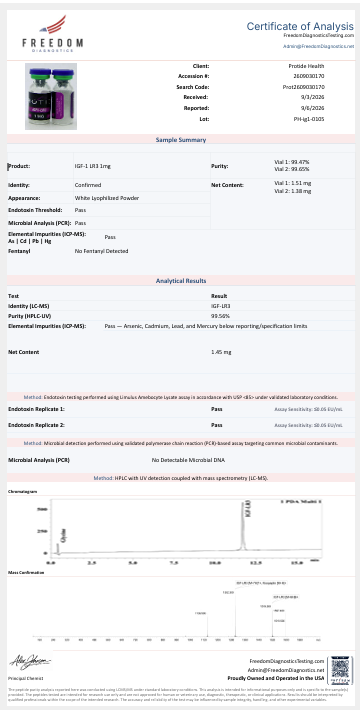
Tested by Freedom Diagnostics Testing @ Freedom Diagnostics Testing – Reliable. Accountable. Accessible.
Temperature: Store refrigerated at 2–8 °C (36–46 °F) for short-term use
Long-Term Storage: Freeze at −20 °C or below to preserve stability
Light Protection: Keep protected from direct light
Moisture Protection: Maintain in original sealed vial
Shelf Life: Typically 12–24 months when stored properly
Diluent: Sterile water or bacteriostatic water
Temperature: Refrigerate at 2–8 °C
Use Period: Recommended within 7–14 days
Handling: Gently swirl to dissolve; avoid vigorous shaking
Do NOT freeze after reconstitution
Inspect solution before use: should be clear, colorless, and free of particulates
Discard if cloudy, discolored, or precipitated
Use sterile technique during reconstitution and experimental handling
Protect from heat, light, and mechanical agitation to maintain peptide integrity
IGF-1 LR3 is most stable as a lyophilized powder stored refrigerated or frozen. Once reconstituted, it should be kept cold, used promptly, and protected from light and agitation to preserve biological activity for laboratory and research applications.
Command Center is a leading provider of USA manufactured, research peptides.
Copyright 2026 © Command Center All Rights Reserved