

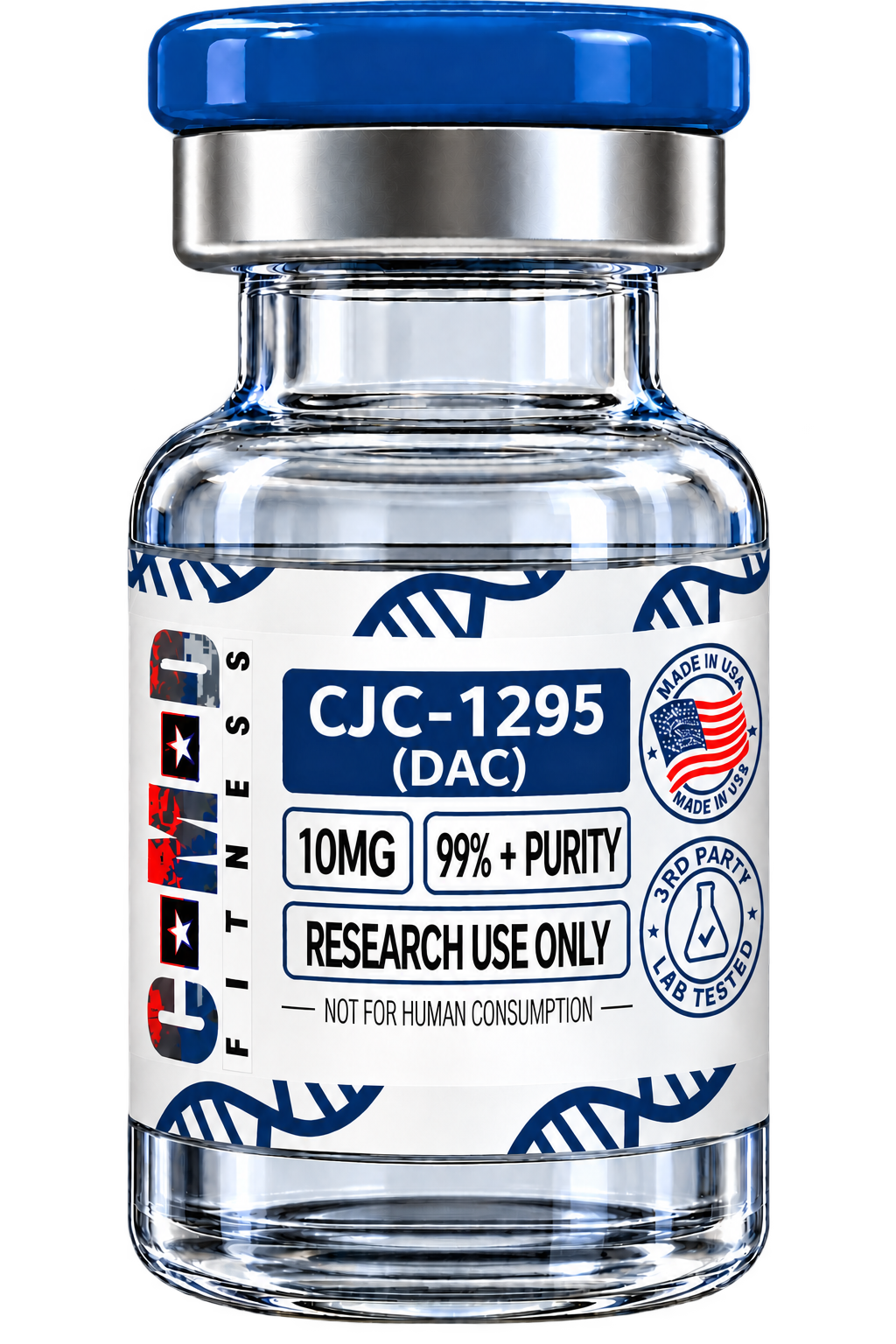

For research use only. Not for human consumption.
CJC-1295 with DAC is a long-acting synthetic analog of growth hormone–releasing hormone (GHRH) designed to provide sustained stimulation of growth hormone release. The DAC (Drug Affinity Complex) modification extends its half-life to several days, allowing prolonged elevation of GH and IGF-1 in research settings.
Price:
$75.00
Select Quantity:
18 in stock
Type: Synthetic peptide analog of growth hormone–releasing hormone (GHRH)
Length: 30 amino acids (modified)
Modification: Attached Drug Affinity Complex (DAC)
Purpose of DAC: Enables reversible binding to serum albumin, dramatically extending half-life
The DAC component differentiates it from the short-acting NO DAC version.
Binds to GHRH receptors on anterior pituitary somatotrophs
Stimulates secretion of growth hormone (GH)
Increases hepatic production of insulin-like growth factor 1 (IGF-1)
Produces prolonged elevation of GH and IGF-1 due to extended circulation
Because of albumin binding, the peptide remains active for several days rather than hours.
Half-life: Approximately 5–8 days
Onset: Gradual but sustained GH elevation
Duration: Prolonged systemic exposure
Dosing frequency (research context): Typically once weekly
This differs significantly from the NO DAC version, which is short-acting and pulsatile.
Long-term GH axis modulation studies
IGF-1 regulation research
Body composition and metabolic studies
Comparative pharmacology (short-acting vs long-acting secretagogues)
Endocrine aging models
Linear peptide with α-helical receptor-binding region
Water-soluble
Albumin-binding via DAC linkage
Sustained receptor activation profile
Extended systemic exposure may reduce natural pulsatility
| Feature | With DAC | NO DAC |
|---|---|---|
| Half-life | 5–8 days | 1–2 hours |
| GH Pattern | Sustained elevation | Pulsatile |
| Albumin Binding | Yes | No |
| Dosing Frequency | Weekly | Daily/multiple |
Investigational use only
Not FDA-approved for therapeutic treatment
Long-term safety data limited
Sustained GH elevation may differ physiologically from natural pulses
CJC-1295 with DAC is a long-acting GHRH analog engineered to provide extended stimulation of growth hormone release through albumin binding. Unlike the short-acting NO DAC version, it produces prolonged GH and IGF-1 elevation, making it primarily useful in research studying sustained endocrine modulation.
Type: Synthetic analog of growth hormone–releasing hormone (GHRH)
Length: 30 amino acids
Structure: Linear peptide with α-helical regions critical for receptor binding
Modification: Covalently linked Drug Affinity Complex (DAC)
The DAC modification enables reversible binding to circulating serum albumin, extending systemic exposure.
Target: GHRH receptors on anterior pituitary somatotroph cells
Primary Signaling Pathway: cAMP → Protein Kinase A (PKA)
Result: Increased synthesis and secretion of growth hormone (GH)
Prolonged presence in circulation allows sustained receptor stimulation.
Half-life: Approximately 5–8 days
Activity Pattern: Sustained GH elevation rather than short pulses
IGF-1 Response: Extended stimulation of hepatic IGF-1 production
Endocrine Impact: May partially blunt natural GH pulsatility due to prolonged exposure
Water-soluble peptide
Supplied as lyophilized powder
Stable when refrigerated (2–8 °C)
Sensitive to heat, light, and agitation
Albumin binding protects from rapid enzymatic degradation
Enhances:
Protein synthesis
Lipolysis
Nitrogen retention
Collagen production
Activates downstream pathways related to:
IGF-1 signaling
mTOR pathway
Metabolic regulation
Because of sustained GH elevation, feedback mechanisms (somatostatin release) may adjust differently compared to short-acting secretagogues.
| Characteristic | CJC-1295 (DAC) | CJC-1295 (NO DAC) |
|---|---|---|
| Albumin Binding | Yes | No |
| GH Release Pattern | Sustained | Pulsatile |
| Half-life | 5–8 days | 1–2 hours |
| Receptor Exposure | Prolonged | Intermittent |
Biochemically, CJC-1295 with DAC is a long-acting GHRH receptor agonist engineered to extend circulation time via albumin binding. This results in sustained GH secretion and prolonged IGF-1 elevation, making it distinct from short-acting GHRH analogs that mimic natural hormone pulses.
Study of sustained GH elevation
Evaluation of prolonged IGF-1 stimulation
Investigation of endocrine feedback regulation (GH–IGF-1–somatostatin axis)
Modeling chronic GH exposure in controlled settings
Because of its extended half-life, CJC-1295 DAC is often used to examine the effects of continuous GH stimulation rather than pulsatile release.
Used experimentally to assess effects on:
Lean body mass regulation
Lipolysis and fat metabolism
Nitrogen balance
Energy partitioning
Its prolonged activity allows researchers to evaluate cumulative metabolic changes over time.
Investigation of age-related decline in GH secretion
Modeling long-term hormonal restoration strategies
Studying sustained IGF-1 elevation in aging physiology research
CJC-1295 DAC is frequently compared to:
CJC-1295 (NO DAC)
Ghrelin receptor agonists (e.g., GHRPs)
Exogenous growth hormone administration
This allows evaluation of:
Sustained vs pulsatile GH stimulation
Short-acting vs long-acting analogs
Physiologic vs supraphysiologic exposure patterns
Researchers evaluate impacts on:
IGF-1–mediated pathways
mTOR signaling
Protein synthesis pathways
Collagen production mechanisms
Metabolic regulatory signaling
Albumin binding dynamics
Extended half-life peptide design
Sustained receptor activation kinetics
CJC-1295 DAC serves as a model compound for studying long-acting peptide therapeutics.
Investigational research use only
Not FDA-approved for therapeutic treatment
Long-term safety and risk profile not fully established
Sustained GH elevation differs physiologically from natural pulsatile secretion
CJC-1295 with DAC is primarily used in research to study long-term growth hormone and IGF-1 modulation, metabolic effects, endocrine aging, and pharmacokinetic design of long-acting peptide therapies. Its defining feature is prolonged systemic activity, making it distinct from short-acting GHRH analogs.
Tested by Freedom Diagnostics @ Freedom Diagnostics Testing – Reliable. Accountable. Accessible.
Temperature: Store refrigerated at 2–8 °C (36–46 °F)
Light Protection: Keep protected from direct light
Moisture Protection: Store in original, tightly sealed vial
Freezing: May be stored frozen (−20 °C) for extended stability if unopened
Shelf Life: Commonly up to 24 months when properly stored
Lyophilized form is the most stable state.
Diluent: Typically bacteriostatic water or sterile water (research context)
Temperature: Store at 2–8 °C
Use Period: Generally recommended within 14–30 days (varies by handling and sterility conditions)
Do NOT freeze after reconstitution
Avoid repeated temperature fluctuations
Gently swirl to mix — do not shake vigorously
Use sterile technique to prevent contamination
Inspect solution before use: should be clear and colorless
Discard if cloudy, discolored, or containing particulates
Although DAC extends biological half-life in vivo, it does not eliminate peptide instability outside the body. The compound remains sensitive to:
Heat
Light
Oxidation
Proteolytic contamination
CJC-1295 with DAC is most stable as a refrigerated lyophilized powder. Once reconstituted, it should be kept refrigerated, protected from light, and used within a limited time to maintain potency and sterility.
Command Center is a leading provider of USA manufactured, research peptides.
Copyright 2026 © Command Center All Rights Reserved