

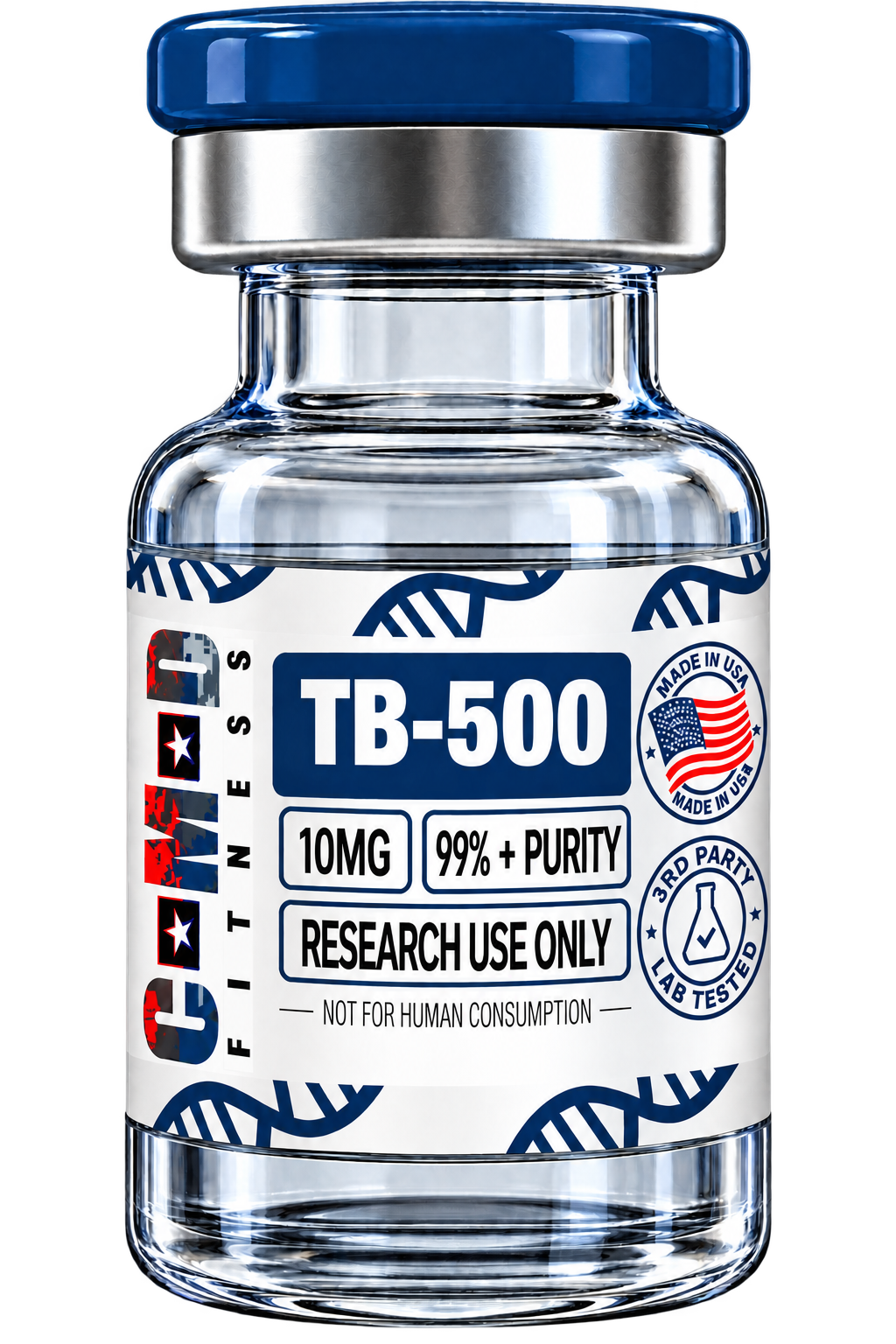

For research use only. Not for human consumption.
TB-500 is a synthetic peptide fragment of Thymosin Beta-4 that promotes tissue repair, wound healing, angiogenesis, and cell migration. It is primarily used in research to study muscle, tendon, and skin regeneration, but it is not approved for human therapeutic use.
Price:
$60.00 – $100.00Price range: $60.00 through $100.00
Select Quantity:
Type: Synthetic peptide
Origin: Derived from Thymosin Beta-4 (Tβ4), a naturally occurring protein involved in tissue repair
Length: 43 amino acids (fragment of Tβ4, residues 17–43)
Molecular Weight: ~4,900–5,000 Da
Formulation: Lyophilized powder, water-soluble, usually reconstituted before use
Cell Migration: Enhances movement of fibroblasts, keratinocytes, and endothelial cells to injury sites
Angiogenesis: Stimulates formation of new blood vessels for tissue repair
Anti-Inflammatory: Reduces inflammatory cytokines, aiding faster recovery
Cytoskeletal Regulation: Modulates actin polymerization to improve cellular motility
Wound Healing: Promotes repair of skin, muscle, tendon, and connective tissue
Musculoskeletal Injuries: Muscle tears, tendon injuries, ligament repair
Skin & Wound Healing: Chronic wounds, burns, surgical recovery
Cardiovascular Research: Angiogenesis and potential cardiac repair
Anti-Fibrotic Studies: Reduces scar tissue formation in certain organs
Route: Subcutaneous or intramuscular injection
Preparation: Reconstituted with sterile water before injection
Dosing: Variable in research; no standard human dose
Frequency: Depends on study protocol; typically short-term pulses
Lyophilized Powder: Refrigerated at 2–8 °C, protected from light and moisture
Reconstituted Solution: Short-term refrigeration; avoid freezing; use immediately or within 24–48 hours
Status: Not approved for human therapeutic use; research-only
Toxicity: Limited human data; generally considered low-risk in short-term animal studies
Potential Effects: Local tissue regeneration; long-term systemic effects unknown
In summary, TB-500 is a research peptide focused on enhancing tissue repair and regeneration through angiogenesis, cell migration, and anti-inflammatory actions, but it is experimental and not clinically approved.
Type: Synthetic peptide
Origin: Fragment of Thymosin Beta-4 (Tβ4), residues 17–43
Length: 43 amino acids
Molecular Weight: ~4,900–5,000 Da
Sequence Features: Contains key amino acids that regulate actin binding and cell motility
Linear Peptide: No complex tertiary folding like larger proteins
Cytoskeletal Interaction: Binds actin monomers to regulate polymerization
Amphipathic Properties: Contains both hydrophilic and hydrophobic residues, aiding solubility and tissue penetration
Modifications: Generally unmodified, though lyophilized formulations are stabilized for storage
Solubility: Highly soluble in water; typically reconstituted from lyophilized powder
Stability:
Stable in lyophilized form at 2–8 °C
Sensitive to heat, prolonged moisture, and strong agitation
Half-Life: Short in vivo, but longer tissue retention compared to full-length Tβ4
Cell Migration: Stimulates fibroblasts, endothelial cells, and keratinocytes
Angiogenesis: Promotes formation of new blood vessels
Anti-Inflammatory Effects: Reduces pro-inflammatory cytokines at injury sites
Wound Healing & Tissue Repair: Enhances regeneration in muscle, tendon, skin, and connective tissues
Actin Regulation:
TB-500 binds G-actin monomers, preventing uncontrolled polymerization
Facilitates cytoskeletal remodeling essential for cell motility
Signal Modulation: Impacts pathways involved in angiogenesis and tissue regeneration (e.g., VEGF-mediated pathways in endothelial cells)
In short, TB-500 is a water-soluble, linear synthetic peptide that promotes tissue repair primarily by regulating actin dynamics, enhancing cell migration, stimulating angiogenesis, and modulating inflammation. Its biochemical profile makes it effective in experimental models of wound healing and tissue regeneration.
Muscle Repair: Studied for accelerating healing of muscle tears, strains, and post-surgical recovery.
Tendon and Ligament Repair: Enhances collagen deposition and cellular migration in tendon and ligament injuries.
Skin and Wound Healing: Applied in research for chronic wounds, burns, and ulcers; improves re-epithelialization.
New Blood Vessel Formation: TB-500 promotes endothelial cell migration and proliferation.
Cardiac Repair: Investigated in animal models for improving recovery after myocardial injury through enhanced angiogenesis.
Inflammation Modulation: Reduces pro-inflammatory cytokines at injury sites, aiding faster recovery.
Fibrosis Prevention: Studied for reducing scar tissue formation in muscles, skin, and organs.
Actin Regulation: TB-500 binds actin monomers, helping researchers understand cytoskeletal remodeling.
Cell Migration Research: Used to study wound closure, endothelial migration, and fibroblast activity in vitro and in vivo.
Route: Subcutaneous or intramuscular injection in animal models.
Dosing and Protocols: Variable depending on the study; short-term pulses are common in tissue regeneration experiments.
TB-500 is not approved for human therapeutic use; all studies are preclinical or experimental.
Most evidence comes from animal models (mice, rats, horses) and in vitro cell studies.
Focus is primarily on accelerating tissue repair, enhancing angiogenesis, and modulating actin cytoskeleton.
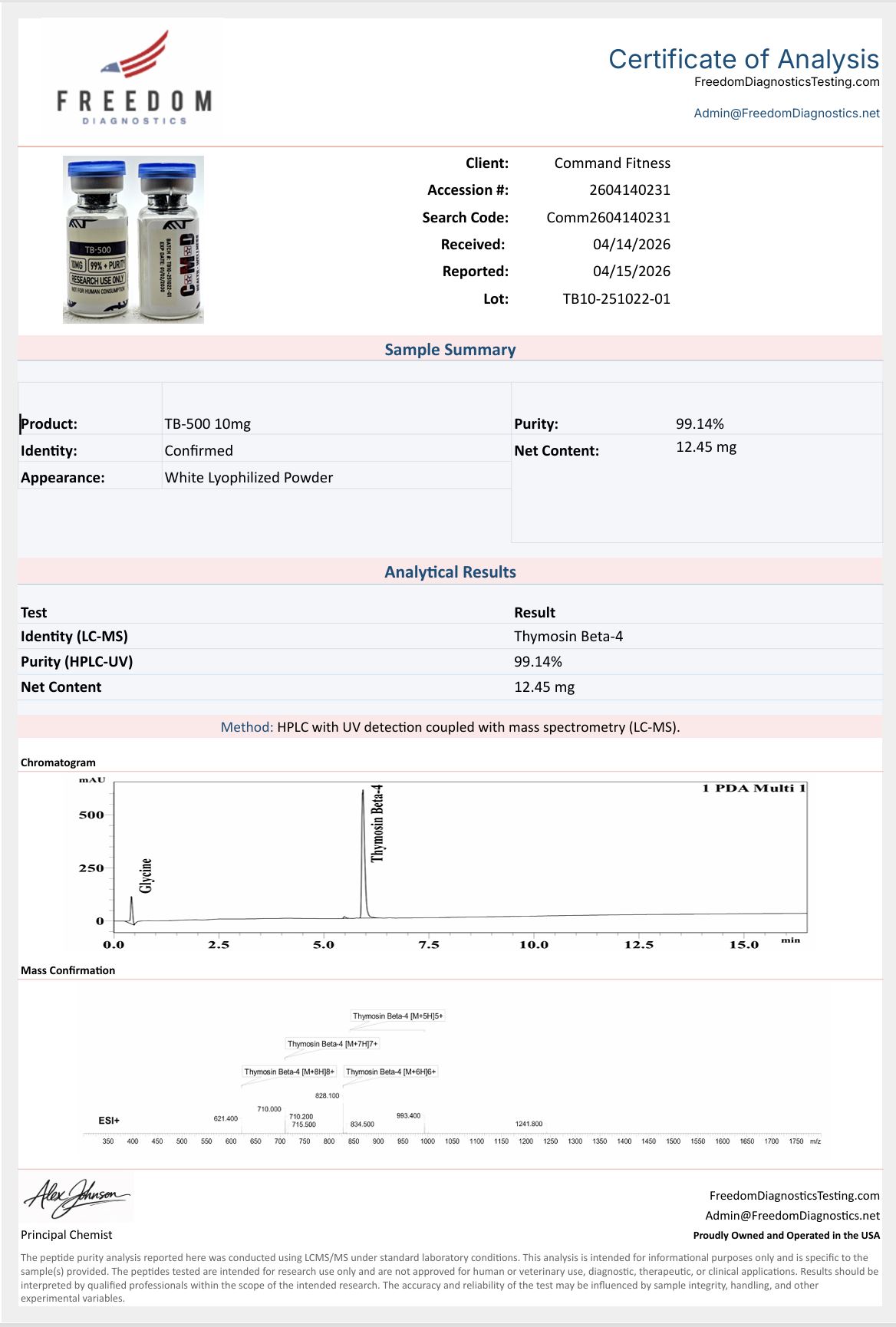
Tested by Freedom Diagnostics Testing @ Freedom Diagnostics Testing – Reliable. Accountable. Accessible.
Temperature: Refrigerate at 2–8 °C (36–46 °F).
Light: Keep protected from light.
Moisture: Store in the original vial, tightly sealed to prevent moisture exposure.
Shelf Life: Typically up to 24 months if stored properly.
Temperature:
Refrigeration: 2–8 °C, recommended for short-term use.
Room Temperature: Only for very brief periods (usually <24 hours).
Container: Use sterile syringes; avoid long-term storage in syringes.
Handling: Avoid shaking; gently swirl if mixing.
Appearance Check: Solution should be clear to slightly opalescent. Discard if cloudy or contains particles.
Do not freeze reconstituted TB-500; freezing can denature the peptide.
Avoid agitation or vortexing, which can degrade the peptide.
Use quickly after reconstitution to maintain activity.
✅ Summary:
TB-500 is most stable as a lyophilized powder in the fridge. Once reconstituted, it should be used immediately or stored refrigerated for very short periods to preserve potency.
Command Center is a leading provider of USA manufactured, research peptides.
Copyright 2026 © Command Center All Rights Reserved