Veteran-owned business
Product Usage: This PRODUCT IS INTENDED AS A RESEARCH CHEMICAL ONLY. This designation allows the use of research chemicals strictly for in vitro testing and laboratory experimentation only. All product information available on this website is for educational purposes only. Bodily introduction of any kind into humans or animals is strictly forbidden by law. This product should only be handled by licensed, qualified professionals. This product is not a drug, food, or cosmetic and may not be misbranded, misused or mislabeled as a drug, food or cosmetic.

For research use only. Not for human consumption.

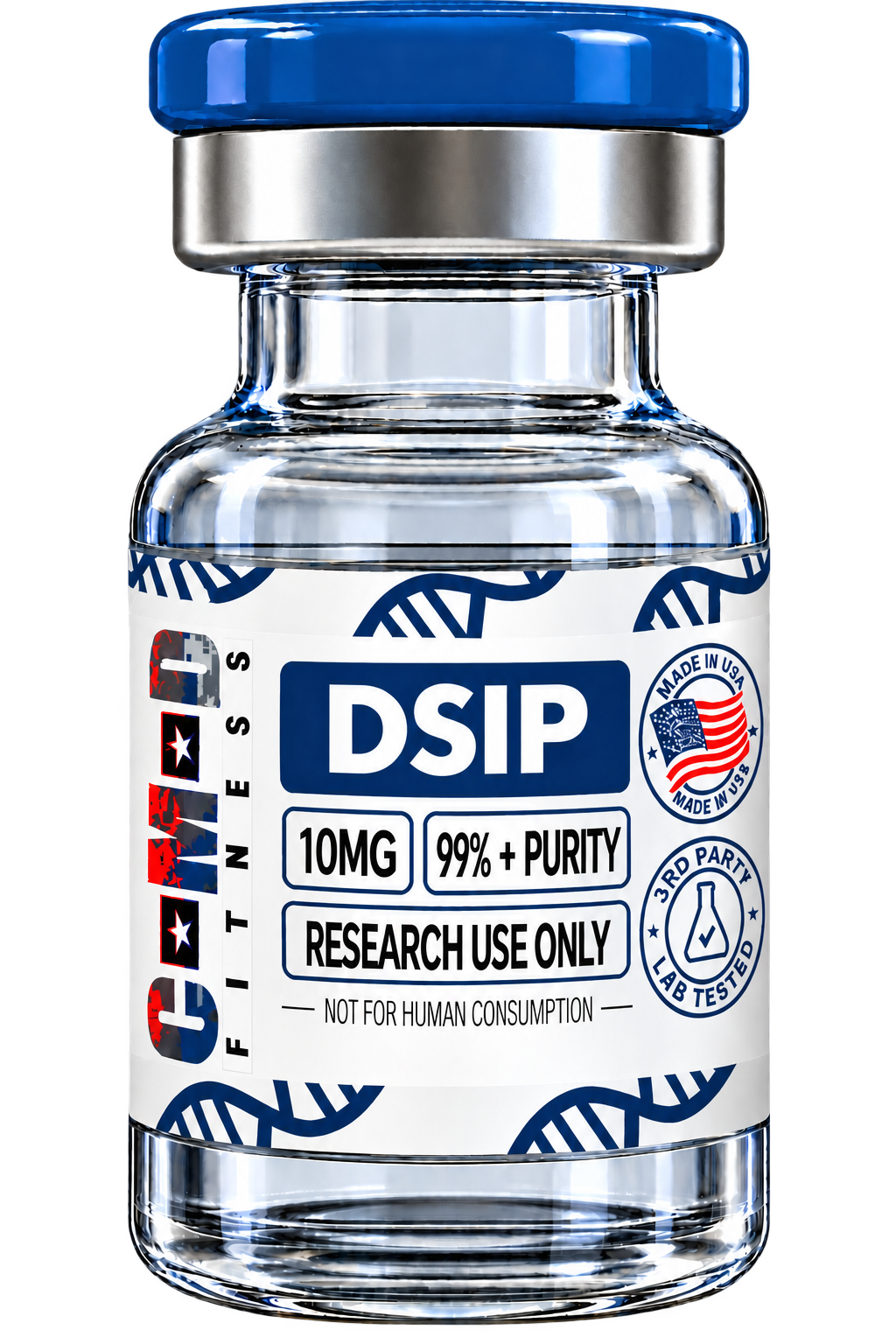
DSIP (10mg)

DSIP (Delta Sleep-Inducing Peptide) is a naturally occurring 9-amino-acid neuropeptide studied for its potential role in regulating sleep cycles, circadian rhythms, and stress-related endocrine activity. It remains investigational, with its precise biological function not fully established.

Price:

$45.00

Select Quantity:

4 in stock

Overview

DSIP (Delta Sleep-Inducing Peptide)

DSIP is a naturally occurring neuropeptide first isolated in 1977 and studied for its potential role in regulating sleep cycles, stress response, and endocrine function. It is a short peptide composed of 9 amino acids and has been investigated primarily in experimental and research settings.


Basic Characteristics

  • Full Name: Delta Sleep-Inducing Peptide

  • Type: Neuropeptide

  • Length: 9 amino acids

  • Molecular Weight: ~848 Da

  • Structure: Small, linear peptide


Proposed Biological Roles (Research Context)

Although its exact physiological role remains debated, DSIP has been studied for:

  • Modulation of slow-wave (delta) sleep

  • Influence on circadian rhythms

  • Interaction with the hypothalamic–pituitary axis

  • Potential effects on stress regulation

  • Possible impact on pain perception


Mechanistic Considerations

  • May influence neurotransmitter systems

  • Investigated for interactions with:

    • GABAergic pathways

    • Cortisol regulation

    • Growth hormone secretion patterns

  • Mechanism of action remains not fully established


Research Applications

  • Sleep regulation models

  • Stress and endocrine response studies

  • Circadian rhythm research

  • Experimental neurobiology investigations


Important Notes

  • Not FDA-approved for therapeutic use

  • Limited and mixed human data

  • Primarily used in experimental or research settings


Summary

DSIP is a short neuropeptide studied for its potential involvement in sleep regulation, endocrine signaling, and stress modulation. While early research suggested sleep-promoting properties, its precise physiological role remains under investigation.

Biochemical
Characteristics

1. Peptide Nature

  • Type: Short neuropeptide

  • Length: 9 amino acids (Trp-Ala-Gly-Gly-Asp-Ala-Ser-Gly-Glu)

  • Molecular Weight: ~848 Da

  • Structure: Linear peptide, small and water-soluble


2. Physicochemical Properties

  • Solubility: Highly soluble in water

  • Charge: Amphipathic, contains acidic (Asp, Glu) and polar residues

  • Stability: Sensitive to heat, light, and enzymatic degradation

  • Lyophilized Form: Stable when refrigerated (2–8 °C)


3. Receptor & Mechanistic Interactions

  • Exact receptor mechanisms are not fully established

  • Proposed to interact with:

    • Hypothalamic pathways regulating sleep

    • Neurotransmitter systems (e.g., GABAergic signaling)

  • May influence:

    • Delta (slow-wave) sleep induction

    • Cortisol and stress hormone modulation

    • Growth hormone secretion patterns


4. Functional Biochemistry

  • Acts as a modulator peptide rather than a classical hormone

  • Short sequence allows rapid diffusion and receptor interaction

  • Potential for neuroendocrine signaling and circadian rhythm effects


5. Summary

DSIP is a small, linear 9-amino-acid neuropeptide with water-soluble, amphipathic properties. Biochemically, it functions as a neuromodulator, influencing sleep, endocrine pathways, and stress regulation in experimental studies. Its stability and activity are highly dependent on proper storage and handling due to its susceptibility to degradation.

Research Applications

1️⃣ Sleep and Circadian Rhythm Studies

  • Investigated for its role in inducing delta (slow-wave) sleep

  • Used in research to explore sleep architecture and sleep disorders

  • Studied for circadian rhythm regulation in experimental models


2️⃣ Stress and Endocrine Modulation

  • Examined for effects on cortisol and other stress-related hormones

  • May influence hypothalamic–pituitary–adrenal (HPA) axis activity

  • Explored in models of stress adaptation and fatigue


3️⃣ Neurotransmitter and Neuromodulation Research

  • Potential interactions with GABAergic pathways and other central neurotransmitters

  • Studied for effects on neuronal excitability and neuroendocrine signaling


4️⃣ Growth Hormone and Metabolic Research

  • Investigated for possible modulation of growth hormone secretion

  • Explored in studies on metabolism, tissue repair, and recovery


5️⃣ Experimental Models

  • Rodent and in vitro studies exploring DSIP’s physiological and biochemical effects

  • Research into peptide therapeutics and neuromodulator mechanisms


Important Notes

  • DSIP is not FDA-approved for clinical use

  • Research is primarily experimental or preclinical

  • Human data are limited and often inconsistent

Chemical Properties
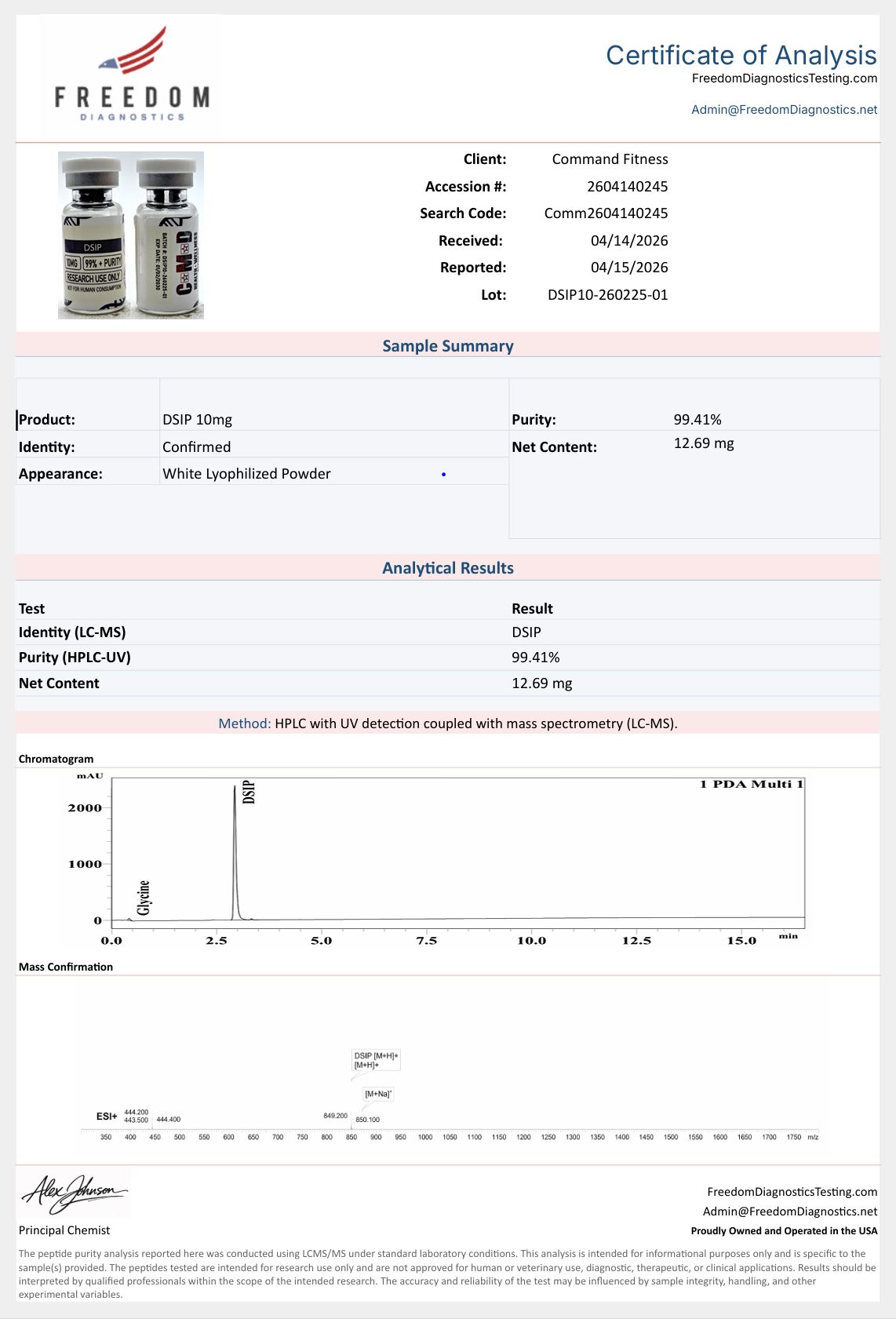
COA /HPLC / MS

3rd Party Testing
Storage

1️⃣ Lyophilized (Powder) Form

  • Temperature: Store refrigerated at 2–8 °C (36–46 °F)

  • Light Protection: Keep protected from direct light

  • Moisture Protection: Store in the original sealed vial

  • Shelf Life: Typically stable for 12–24 months when properly stored

  • Freezing: Can be stored at −20 °C for long-term storage, but avoid repeated freeze-thaw cycles


2️⃣ Reconstituted Solution

  • Diluent: Sterile water or bacteriostatic water

  • Temperature: Refrigerated at 2–8 °C

  • Use Period: Typically recommended within 7–14 days (varies depending on sterility)

  • Do NOT freeze after reconstitution

  • Handling: Gently swirl to mix; avoid vigorous shaking


3️⃣ General Precautions

  • Inspect solution: should be clear and colorless

  • Discard if cloudy, discolored, or containing particulates

  • Use sterile technique for reconstitution and injections

  • Protect from heat, light, and mechanical agitation


Summary

DSIP is most stable as a lyophilized powder stored refrigerated or frozen. Once reconstituted, it should be kept cold, used quickly, and handled gently to maintain biological activity for research applications.

Your cart is currently empty.

Return to shop

0