


Veteran-owned business
Product Usage: This PRODUCT IS INTENDED AS A RESEARCH CHEMICAL ONLY. This designation allows the use of research chemicals strictly for in vitro testing and laboratory experimentation only. All product information available on this website is for educational purposes only. Bodily introduction of any kind into humans or animals is strictly forbidden by law. This product should only be handled by licensed, qualified professionals. This product is not a drug, food, or cosmetic and may not be misbranded, misused or mislabeled as a drug, food or cosmetic.

For research use only. Not for human consumption.

VIP (10mg)

Tesamorelin is a synthetic 44–amino acid peptide analogue of growth hormone–releasing hormone (GHRH) that stimulates the pituitary to increase endogenous growth hormone secretion. It is primarily used to reduce excess abdominal fat in HIV-associated lipodystrophy and is studied in research for its effects on metabolism, body composition, and fat regulation. Supplied as a lyophilized peptide for reconstitution.

Price:

$65.00

Select Quantity:

30 in stock

Overview

VIP Peptide — Product Details

Full Name: Vasoactive Intestinal Peptide (VIP)
Peptide Type: Neuropeptide
Peptide Length: 28 amino acids
Amino Acid Sequence: HSDAVFTDNYTRLRKQMAVKKYLNSILN-NH₂
Molecular Formula: C₁₄₇H₂₁₆N₃₈O₃₁S
Molecular Weight: ~3,329.7 Da
CAS Number: 122934-43-4
Appearance: White to off-white lyophilized powder
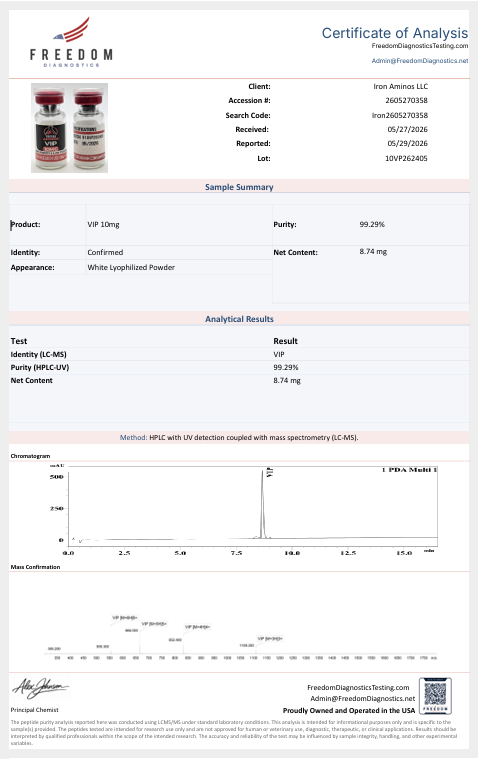
Purity: ≥99% when supported by applicable analytical testing/COA
Primary Receptors: VPAC1 and VPAC2
Peptide Family: Secretin/glucagon superfamily

Biochemical
Characteristics

Biochemical Characteristics

VIP (Vasoactive Intestinal Peptide) is a naturally occurring 28-amino-acid neuropeptide belonging to the secretin/glucagon superfamily. It functions as a signaling molecule in the nervous, gastrointestinal, vascular, respiratory, and immune systems.

  • Peptide length: 28 amino acids
  • Molecular weight: Approximately 3.3 kDa
  • Structure: Linear peptide with a C-terminal amidated residue
  • Amino acid sequence: HSDAVFTDNYTRLRKQMAVKKYLNSILN-NH₂
  • Receptor targets: Primarily VPAC1 and VPAC2, both class B G-protein-coupled receptors
  • Signaling: Receptor activation is primarily associated with stimulation of adenylate cyclase and increased intracellular cyclic AMP (cAMP)
  • Biological distribution: Found throughout the central and peripheral nervous systems and in various peripheral tissues
  • Functional research areas: Neurotransmission, vascular signaling, smooth-muscle regulation, gastrointestinal activity, respiratory physiology, and neuroimmune signaling
  • Biochemical classification: Amidated neuropeptide belonging to the secretin-family peptide group

VIP provides a useful research model for investigating peptide-receptor interactions, GPCR signaling, intracellular second-messenger pathways, and neuroendocrine communication.

Research Use Only. Not for Human Consumption.
Research Applications

Research Applications

VIP (Vasoactive Intestinal Peptide) is widely studied as a signaling molecule involved in neuroendocrine communication, vascular regulation, gastrointestinal physiology, and neuroimmune pathways. Its interactions with VPAC1 and VPAC2 receptors make it a useful research tool for investigating peptide-mediated cellular signaling.

Primary Research Applications

  • Neurobiology Research: Investigation of neuropeptide signaling, neuronal communication, and interactions between the central and peripheral nervous systems.
  • Neuroimmune Research: Study of communication between neural and immune pathways and the role of VIP-mediated signaling in cellular responses.
  • Receptor Signaling: Examination of VPAC1 and VPAC2 receptor activation and downstream GPCR signaling mechanisms, including cAMP-dependent pathways.
  • Vascular Biology: Research into mechanisms associated with vascular tone, vasodilation, and vascular smooth-muscle signaling.
  • Gastrointestinal Research: Investigation of gastrointestinal motility, secretion, enteric nervous-system signaling, and smooth-muscle activity.
  • Respiratory Research: Study of VIP-related signaling within pulmonary tissues, airway smooth muscle, and respiratory physiology.
  • Cellular Signaling: Use in laboratory models examining peptide-receptor interactions, second-messenger systems, and intracellular signaling pathways.
  • Smooth-Muscle Research: Investigation of VIP-mediated relaxation and signaling in smooth-muscle tissues.
  • Inflammatory Pathway Research: Examination of neuropeptide interactions with immune and inflammatory signaling pathways in experimental models.

Research Value

VIP provides researchers with a well-characterized model for studying class B GPCR signaling, neuropeptide physiology, intracellular cAMP pathways, and communication between the nervous, vascular, gastrointestinal, and immune systems.

Research Use Only. Not for Human Consumption.

Chemical Properties

Chemical Properties

  • Chemical Name: Vasoactive Intestinal Peptide (VIP)
  • Peptide Classification: Neuropeptide / amidated peptide
  • Peptide Length: 28 amino acids
  • Amino Acid Sequence: HSDAVFTDNYTRLRKQMAVKKYLNSILN-NH₂
  • Molecular Formula: C₁₄₇H₂₁₆N₃₈O₃₁
  • Molecular Weight: Approximately 3,325 Da
  • CAS Number: 4009-??-? — verify against the supplier’s COA before publication
  • Physical Form: Typically supplied as a white to off-white lyophilized powder
  • Charge Characteristics: Contains multiple basic amino-acid residues, giving VIP a net positive charge under many physiological conditions
  • Terminal Modification: C-terminal amidation
  • Solubility: Generally soluble in aqueous laboratory buffers; solubility depends on concentration, pH, buffer composition, and formulation
  • Stability: Peptide stability is influenced by temperature, pH, moisture, light exposure, and repeated freeze–thaw cycles.
  • Purity: Product purity should be established by applicable analytical methods such as HPLC and mass spectrometry and documented on the batch-specific COA.

Research Use Only. Not for Human Consumption.

COA /HPLC / MS
3rd Party Testing
Storage

Product Storage

  • Lyophilized VIP: Store according to the manufacturer’s batch-specific COA. Refrigerated storage at 2–8°C is commonly used for peptide preparations.
  • Long-Term Storage: Follow the supplier’s validated specifications; lower-temperature storage may be appropriate for extended periods.
  • Protection: Keep the peptide protected from light, heat, moisture, and excessive temperature fluctuations.
  • Container: Maintain the product in its original, tightly sealed container until ready for laboratory use.
  • Freeze–Thaw: Avoid repeated freeze–thaw cycles, which may contribute to peptide degradation.
  • Reconstituted Material: Store according to validated laboratory procedures and the manufacturer’s specifications. Minimize repeated temperature cycling and contamination.
  • Handling: Use appropriate laboratory handling practices when opening and preparing the product.

Proper storage is essential for maintaining the chemical integrity and research quality of VIP peptide.

Research Use Only. Not for Human Consumption.

Your cart is currently empty.

Return to shop

0