

Veteran-owned business
Product Usage: This PRODUCT IS INTENDED AS A RESEARCH CHEMICAL ONLY. This designation allows the use of research chemicals strictly for in vitro testing and laboratory experimentation only. All product information available on this website is for educational purposes only. Bodily introduction of any kind into humans or animals is strictly forbidden by law. This product should only be handled by licensed, qualified professionals. This product is not a drug, food, or cosmetic and may not be misbranded, misused or mislabeled as a drug, food or cosmetic.

For research use only. Not for human consumption.

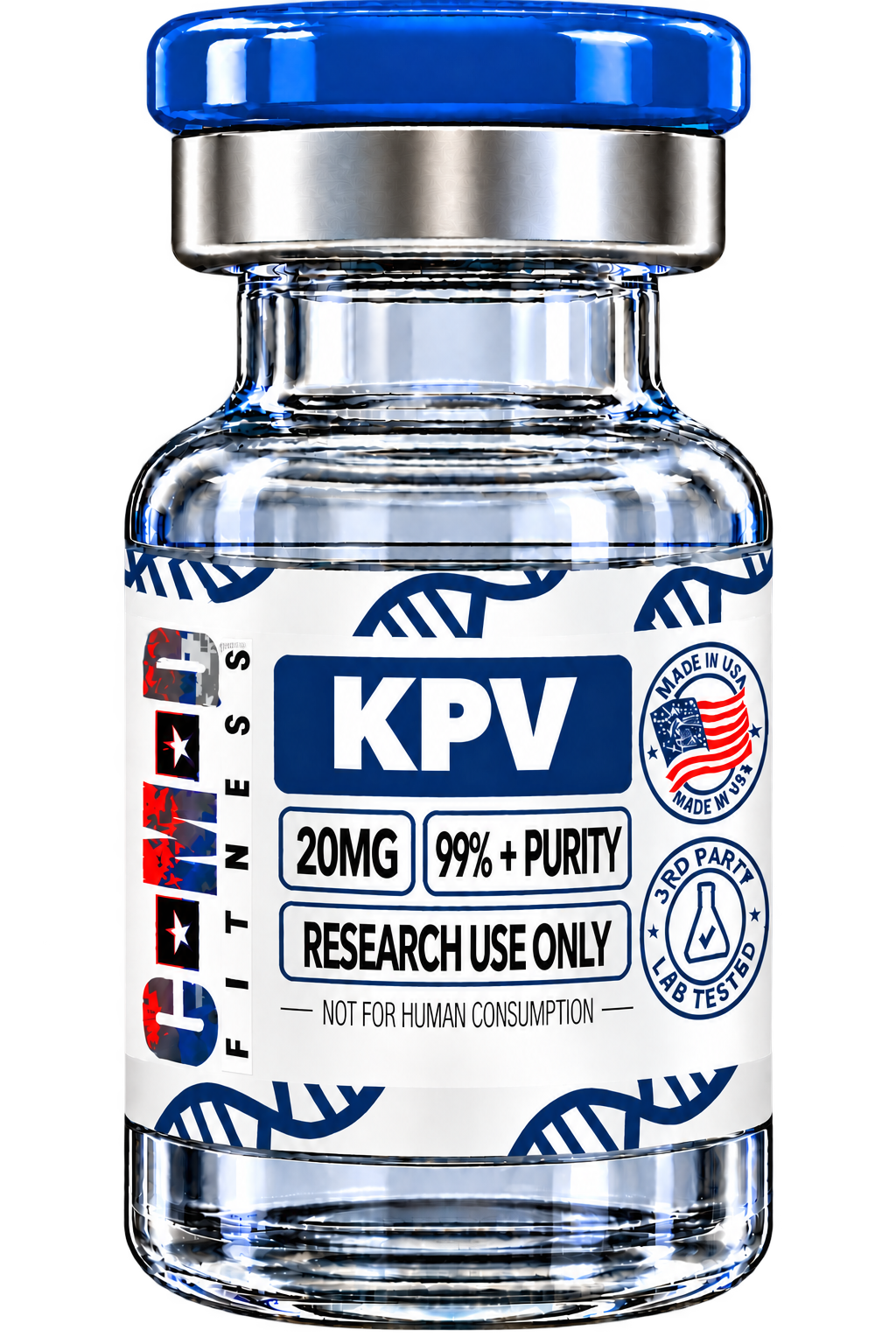
KPV (10mg)

KPV is a naturally derived tripeptide studied for its potential role in inflammatory signaling, immune modulation, gut-barrier research, and tissue-protective pathways. Its relationship to α-MSH signaling makes it an interesting compound for ongoing research into inflammation and cellular response.

Price:

$40.00

Select Quantity:

35 in stock

Overview

KPV — Product Details

Product: KPV (Lys-Pro-Val)
Category: Research Peptide
Peptide Type: Tripeptide
Amino Acid Sequence: Lysine–Proline–Valine (KPV)
Research Focus: Inflammatory signaling, immune response, intestinal barrier function, and tissue-protective mechanisms

Description:
KPV is a naturally occurring tripeptide associated with the C-terminal sequence of α-melanocyte-stimulating hormone (α-MSH). It is studied for its interaction with inflammatory and immune-signaling pathways and has been investigated primarily in preclinical models.

Key Research Applications:

  • Inflammatory signaling research
  • Gastrointestinal and intestinal-barrier research
  • Immune-response modulation
  • Oxidative-stress research
  • Epithelial-cell and tissue-protection research
  • α-MSH-related pathway research
  • Microbiome/inflammation research

Product Specifications:

  • Form: Lyophilized research material
  • Purity: 99%+ when supported by the applicable batch COA
  • Packaging: Sterile research vial
  • Testing: HPLC and/or mass spectrometry, as documented by the applicable batch COA
  • Storage: Follow the manufacturer’s batch-specific storage specifications and protect from heat, light, moisture, and repeated temperature fluctuations.

Important: KPV is an experimental research compound and is not FDA-approved as a treatment for human disease. Research findings should not be represented as established clinical benefits.

Research Use Only — Not for Human Consumption.

Biochemical
Characteristics

KPV — Biochemical Characteristics

  • Full name: Lysine–Proline–Valine
  • Abbreviation: KPV
  • Peptide type: Short tripeptide
  • Amino acid sequence: Lys–Pro–Val
  • Molecular origin: C-terminal fragment of α-melanocyte-stimulating hormone (α-MSH)
  • Molecular class: Bioactive peptide
  • Primary research focus: Inflammatory and immune-signaling pathways
  • Mechanistic interest: Investigated for interactions with pathways associated with NF-κB signaling, inflammatory cytokines, and α-MSH-related activity
  • Research areas: Intestinal inflammation, epithelial-barrier function, immune response, oxidative stress, and tissue-protection mechanisms
  • Structure: Contains one basic amino acid (lysine), one cyclic imino acid (proline), and one branched-chain hydrophobic amino acid (valine).
  • Stability: As a small peptide, stability can be influenced by temperature, pH, moisture, light, and formulation conditions.
  • Typical research form: Lyophilized powder.

Note: Exact molecular weight, purity, formulation, and analytical specifications should be taken from the specific manufacturer’s batch COA.

Research Use Only — Not for Human Consumption.

Research Applications

KPV — Research Applications

KPV is investigated primarily for its potential role in inflammatory signaling, immune response, and tissue-protection pathways.

Key research applications include:

  • Inflammation research — studying mechanisms involved in regulating inflammatory signaling and cytokine activity.
  • Gastrointestinal research — investigating intestinal inflammation and epithelial-barrier function.
  • Immune signaling — examining interactions between KPV and cellular immune-response pathways.
  • NF-κB pathway research — studying pathways involved in inflammatory gene expression.
  • Oxidative-stress research — investigating cellular responses to oxidative damage.
  • Tissue-protection research — exploring mechanisms involved in maintaining epithelial and cellular integrity.
  • α-MSH pathway research — examining the biological activity of the KPV sequence derived from α-MSH.
  • Dermatological research — investigating inflammatory signaling and barrier-related mechanisms in skin models.

Research Use Only — Not for Human Consumption.

Chemical Properties

KPV — Chemical Properties

  • Chemical name: Lysine–Proline–Valine
  • Abbreviation: KPV
  • Peptide type: Tripeptide
  • Amino acid sequence: H-Lys-Pro-Val-OH
  • Molecular formula: C₁₇H₂₇N₃O₄
  • Molecular weight: 337.42 g/mol (free peptide; exact value may vary with salt/formulation)
  • CAS number: 67727-17-3
  • Charge characteristics: Contains a basic ε-amino group from lysine; net charge is formulation- and pH-dependent.
  • Physical form: Typically supplied as a lyophilized powder for research use.
  • Solubility: Generally soluble in aqueous research buffers; actual solubility depends on concentration, pH, temperature, and formulation.
  • Stability: Influenced by pH, temperature, moisture, light, and repeated freeze/thaw exposure.
  • Analytical characterization: HPLC and mass spectrometry are commonly used to verify identity and purity.

Note: Exact specifications—including molecular weight, purity, salt form, and solubility—should be confirmed using the batch-specific Certificate of Analysis (COA).

Research Use Only — Not for Human Consumption.

COA /HPLC / MS
3rd Party Testing
Storage

KPV — Product Storage

  • Lyophilized KPV: Store according to the manufacturer’s batch-specific COA, preferably in a temperature-controlled environment.
  • Protect from: Direct light, heat, moisture, and prolonged exposure to room temperature.
  • Container: Keep the vial tightly sealed to minimize moisture exposure.
  • Temperature stability: Avoid repeated temperature fluctuations and unnecessary warming/cooling cycles.
  • After reconstitution: Follow the supplier’s specified storage conditions and minimize repeated freeze-thaw cycles.
  • Handling: Avoid excessive agitation or shaking; gently handle the vial when necessary.
  • Long-term storage: Follow the manufacturer’s stability data rather than assuming a universal storage temperature.

Important: Storage requirements can vary with formulation, purity, vial closure, and manufacturer. The COA or technical data sheet supplied with the specific KPV batch should take precedence over general storage recommendations.

Research Use Only — Not for Human Consumption.

Your cart is currently empty.

Return to shop

0