

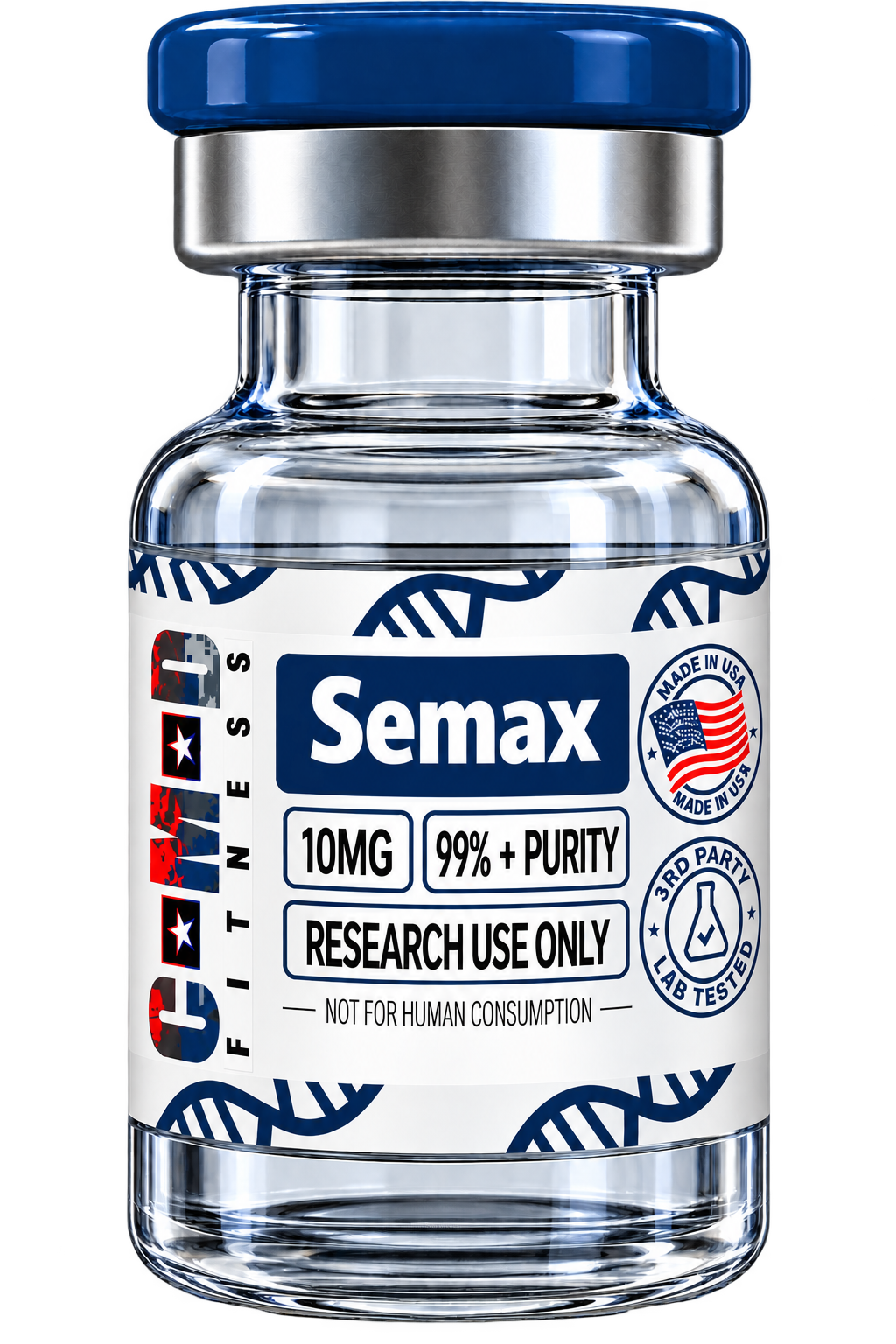

For research use only. Not for human consumption.
Semax is a synthetic heptapeptide derived from ACTH(4–10) that exhibits neuroprotective, cognitive-enhancing, and anxiolytic effects, used in research to study memory, learning, stress response, and CNS neuroprotection.
Price:
$50.00
Select Quantity:
59 in stock
Semax is a synthetic heptapeptide derived from the adrenocorticotropic hormone (ACTH) fragment 4–10. It is designed to exert central nervous system (CNS) effects with minimal side effects, making it a focus of neuroprotective, nootropic, and anxiolytic research.
Semax works by modulating neurotransmitter systems including dopamine, serotonin, and acetylcholine, and by upregulating neurotrophic factors such as brain-derived neurotrophic factor (BDNF). These actions support neuroplasticity, cognitive function, and neuronal survival.
Chemically stabilized for resistance to enzymatic degradation, Semax is suitable for preclinical studies, in vitro assays, and research on neurodegenerative or cognitive disorders.
Peptide Type: Synthetic heptapeptide
Mechanism of Action: Modulates CNS neurotransmitters and neurotrophic pathways
Primary Effects: Enhances learning, memory, attention, and provides neuroprotection
Water-Soluble: Suitable for in vitro and in vivo studies
Stability: Resistant to rapid degradation for research purposes
Studying cognition, memory, and learning mechanisms
Investigating neuroprotection in stroke, ischemia, or oxidative stress models
Researching stress, anxiety, and mood regulation
Evaluating peptide-based therapies for CNS disorders
Semax is a stable, CNS-active heptapeptide with neuroprotective, cognitive-enhancing, and anxiolytic properties, making it a valuable tool for research on memory, learning, stress, and neuroprotection.
Type: Synthetic heptapeptide
Amino Acid Sequence: Met-Glu-His-Phe-Pro-Gly-Pro (ACTH 4–10 fragment)
Molecular Weight: ~839 Da
Structure: Linear peptide, chemically stabilized for CNS activity and enzymatic resistance
Origin: Derived from adrenocorticotropic hormone (ACTH)
Neurotransmitter Modulation: Influences dopamine, serotonin, and acetylcholine systems in the CNS
Neurotrophic Activity: Upregulates brain-derived neurotrophic factor (BDNF) and other neurotrophins
Neuroprotective Action: Reduces oxidative stress, ischemic damage, and neuronal apoptosis
Anxiolytic Effect: Modulates stress-related pathways without sedative effects
Cognitive Support: Enhances learning, memory, attention, and focus
Neuroprotection: Protects neurons under oxidative or ischemic stress
Mood Regulation: Reduces anxiety and stress-related behaviors
Neurotrophic Support: Supports neuroplasticity and synaptic function
Water-Soluble: Easily dissolved for in vitro and in vivo research
Chemical Stability: Resistant to enzymatic degradation due to structural modifications
Bioavailability: Suitable for intranasal or parenteral administration in research
Semax is a water-soluble, chemically stabilized heptapeptide that modulates CNS neurotransmitters, neurotrophic factors, and stress pathways. Its biochemical characteristics—neuroprotective, cognitive-enhancing, and anxiolytic—make it ideal for preclinical research on learning, memory, neuroprotection, and stress response.
Studying learning, memory, attention, and focus
Investigating neuroplasticity and synaptic function
Evaluating cognitive-enhancing effects in preclinical and clinical models
Researching protection against ischemia, stroke, and oxidative stress
Studying mechanisms of neuronal survival and anti-apoptotic pathways
Evaluating peptide-based interventions for neurodegenerative disorders
Examining stress response modulation and anxiolytic effects
Studying behavioral responses to acute or chronic stress
Investigating CNS pathways involved in mood and emotional regulation
Investigating dopamine, serotonin, and acetylcholine modulation
Studying BDNF and other neurotrophic factor regulation
Researching interactions between neuropeptides and CNS signaling pathways
Semax is widely used in research to study cognition, memory, neuroprotection, stress response, and neurotransmitter modulation. Its stable heptapeptide structure and CNS activity make it a valuable tool for preclinical and clinical studies on neurodegenerative diseases, cognitive enhancement, and neuropsychiatric disorders.
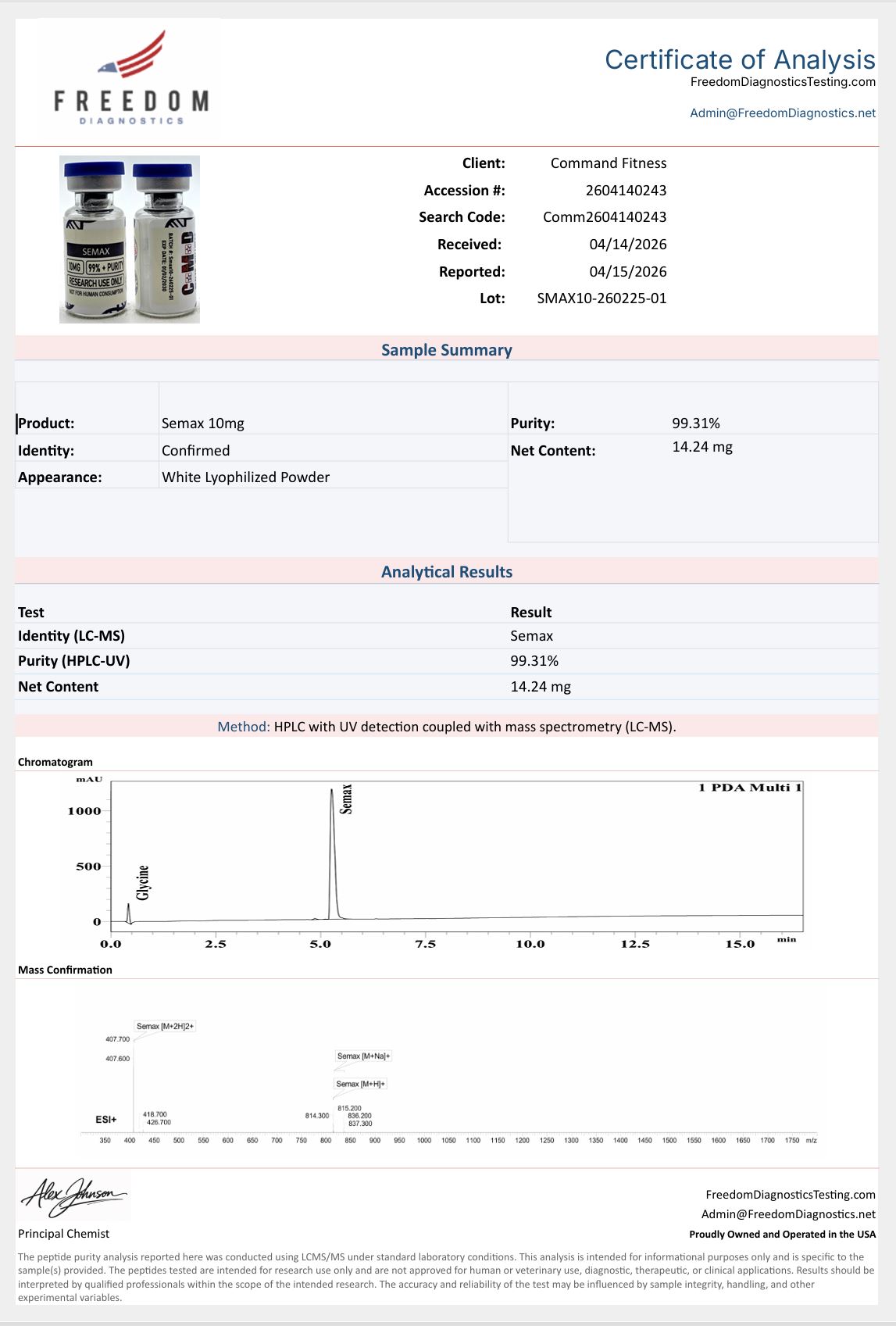
Tested by Freedom Diagnostics Testing @ Freedom Diagnostics Testing – Reliable. Accountable. Accessible.
Temperature: Store refrigerated at 2–8 °C (36–46 °F) for short-term stability
Long-Term Storage: Freeze at −20 °C or lower for extended preservation
Light Protection: Keep protected from direct light
Moisture Protection: Store in sealed, dry vials
Shelf Life: Typically 12–24 months under proper storage conditions
Diluent: Sterile water or appropriate buffer
Temperature: Store refrigerated at 2–8 °C
Use Period: Recommended within 7–14 days after reconstitution
Handling: Gently swirl to dissolve; avoid vigorous shaking
Do NOT freeze after reconstitution
Inspect solution before use: should be clear, colorless, and free of particulates
Discard if cloudy, discolored, or precipitated
Use sterile techniques during reconstitution and experimental handling
Protect from heat, light, and mechanical agitation to maintain peptide integrity
Semax is most stable as a lyophilized powder stored refrigerated or frozen. Once reconstituted, it should be kept cold, protected from light, and used promptly to maintain biological activity for research on cognition, memory, neuroprotection, and stress modulation.
Command Center is a leading provider of USA manufactured, research peptides.
Copyright 2026 © Command Center All Rights Reserved