

Veteran-owned business
Product Usage: This PRODUCT IS INTENDED AS A RESEARCH CHEMICAL ONLY. This designation allows the use of research chemicals strictly for in vitro testing and laboratory experimentation only. All product information available on this website is for educational purposes only. Bodily introduction of any kind into humans or animals is strictly forbidden by law. This product should only be handled by licensed, qualified professionals. This product is not a drug, food, or cosmetic and may not be misbranded, misused or mislabeled as a drug, food or cosmetic.

For research use only. Not for human consumption.

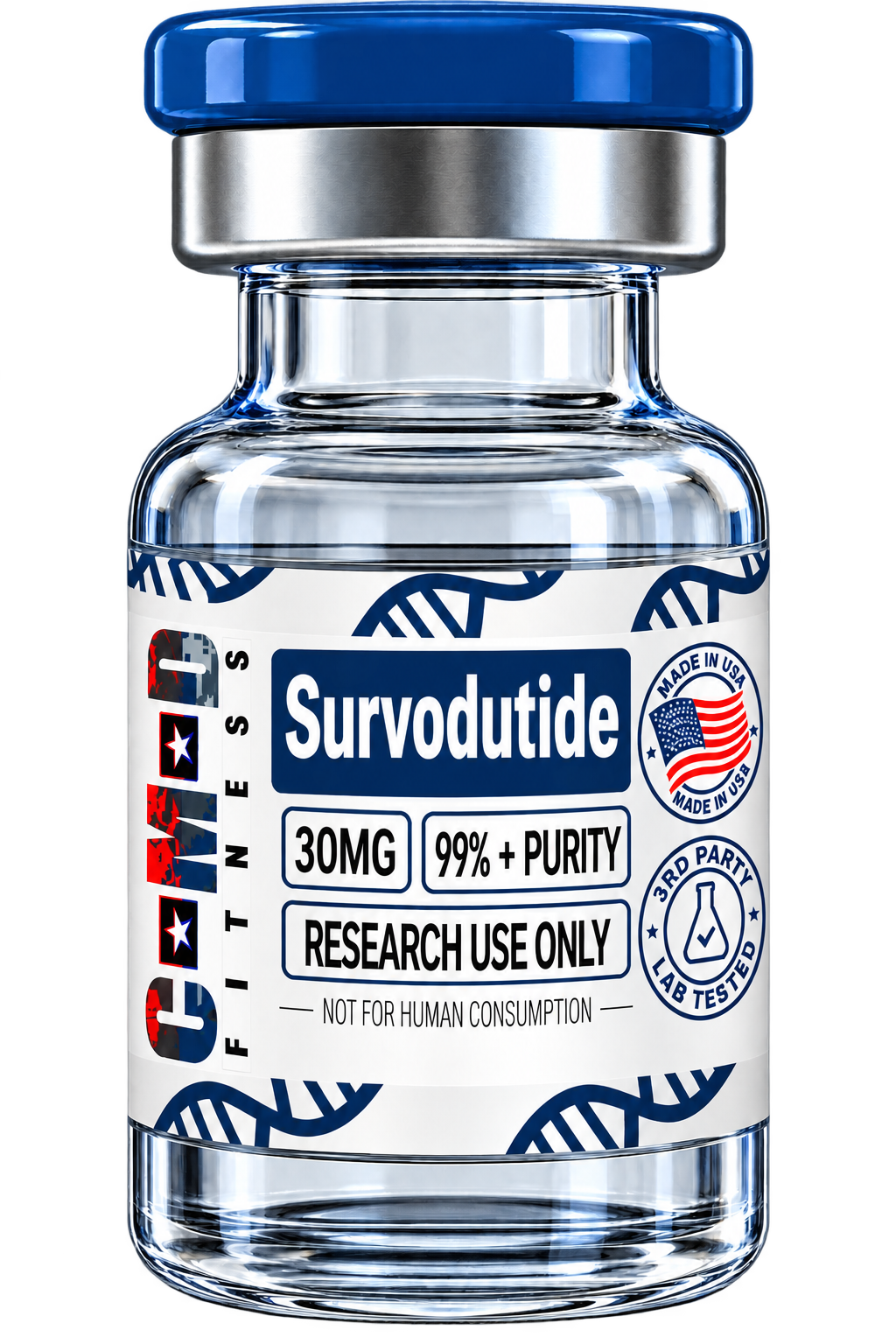
Survodutide (30mg)

SS‑31 (Elamipretide) is a synthetic mitochondria-targeting tetrapeptide that protects mitochondrial function, reduces oxidative stress, and is used in research on mitochondrial dysfunction, aging, and metabolic disorders

Price:

$215.00

Select Quantity:

48 in stock

Overview

Survodutide (BI 456906) is an investigational peptide-based compound engineered to provide dual agonist activity at the glucagon (GCGR) and glucagon-like peptide-1 (GLP-1R) receptors. This dual mechanism is being investigated for its effects on metabolic signaling, energy balance, glucose regulation, appetite-related pathways, and hepatic metabolism.

Product Details:

  • Compound Name: Survodutide
  • Development Code: BI 456906
  • Compound Type: Synthetic peptide-based receptor agonist
  • Pharmacological Class: Dual GLP-1R/GCGR agonist
  • Primary Targets: GLP-1 receptor and glucagon receptor
  • Research Areas: Metabolic regulation, glucose homeostasis, appetite signaling, energy expenditure, lipid metabolism, obesity, and liver metabolism
  • Development Status: Investigational; evaluated in human clinical trials
  • Regulatory Status: Not FDA-approved as of September 2026
  • Typical Research Form: Lyophilized peptide material, depending on supplier and formulation
  • Research Classification: Experimental metabolic research compound

Mechanistic Profile

Survodutide is designed to simultaneously activate two metabolically important receptor systems. GLP-1 receptor agonism is associated with glucose-dependent insulin secretion, appetite and satiety signaling, and delayed gastric emptying. Glucagon receptor agonism influences hepatic energy metabolism, lipid utilization, and energy expenditure.

This dual-receptor approach is being investigated to determine whether coordinated GLP-1 and glucagon signaling can produce complementary metabolic effects beyond those associated with activation of either pathway alone.

Survodutide has attracted particular research interest for body-weight regulation and metabolic dysfunction-associated steatohepatitis (MASH), including its effects on liver fat and other metabolic parameters.

For research and laboratory applications only. Not for human consumption.

Biochemical
Characteristics

Survodutide (BI 456906) is an investigational peptide-based dual glucagon receptor (GCGR) and glucagon-like peptide-1 receptor (GLP-1R) agonist engineered to activate complementary metabolic signaling pathways. Its biochemical profile is designed to combine GLP-1-mediated effects on glucose and appetite regulation with glucagon-mediated effects on hepatic metabolism and energy expenditure.

Key biochemical characteristics include:

  • Dual-Receptor Agonism: Activates both GLP-1R and GCGR, two G-protein-coupled receptors involved in metabolic regulation.
  • GLP-1 Receptor Signaling: GLP-1R activation stimulates intracellular cyclic AMP (cAMP) signaling and is associated with glucose-dependent insulin secretion and regulation of appetite and satiety pathways.
  • Glucagon Receptor Signaling: GCGR activation influences hepatic glucose and lipid metabolism and pathways involved in energy expenditure.
  • Metabolic Signaling: The combined receptor profile is being investigated for coordinated effects on energy balance, nutrient utilization, glucose homeostasis, and lipid metabolism.
  • Hepatic Metabolism: Glucagon-receptor activity makes Survodutide particularly relevant to research examining liver-fat metabolism and metabolic liver disease.
  • Appetite and Satiety Pathways: GLP-1R signaling influences central and peripheral pathways involved in food intake and satiety.
  • Lipid Metabolism: Investigated for effects on lipid handling, adipose-tissue metabolism, and mobilization of stored energy substrates.
  • Peptide Engineering: Survodutide is chemically modified to provide prolonged pharmacological activity compared with native glucagon-family peptide hormones.
  • Receptor Selectivity: Its pharmacological activity is intentionally balanced between GLP-1 and glucagon receptor pathways rather than functioning as a conventional single-receptor GLP-1 agonist.

These biochemical characteristics make Survodutide particularly relevant to research involving metabolic regulation, obesity, glucose homeostasis, energy expenditure, lipid metabolism, hepatic steatosis, and MASH-related pathways.

For research and laboratory applications only. Not for human consumption.

Research Applications

Survodutide (BI 456906) is an investigational dual glucagon receptor (GCGR) and glucagon-like peptide-1 receptor (GLP-1R) agonist studied across metabolic, endocrine, and liver-disease research. Its dual-receptor activity provides a research model for examining how coordinated glucagon and GLP-1 signaling influences energy balance and metabolic function.

Key research applications include:

  • Metabolic Regulation: Investigation of pathways controlling energy balance, nutrient utilization, and systemic metabolic homeostasis.
  • Body-Weight Regulation: Clinical research examining changes in body weight, body composition, and obesity-associated metabolic parameters.
  • Appetite & Satiety Signaling: Studies of GLP-1-associated pathways involved in hunger, satiety, food intake, and central regulation of energy balance.
  • Glucose Homeostasis: Investigation of glucose-dependent insulin secretion, blood-glucose regulation, and interactions between glucagon and insulin signaling.
  • Energy Expenditure: Research into glucagon-receptor-mediated mechanisms associated with energy utilization and expenditure.
  • Lipid Metabolism: Studies examining triglyceride metabolism, fatty-acid utilization, adipose-tissue biology, and related metabolic pathways.
  • Hepatic Metabolism: Investigation of liver-fat accumulation, hepatic lipid handling, and metabolic processes associated with steatotic liver disease.
  • MASH Research: Survodutide has been studied clinically for metabolic dysfunction-associated steatohepatitis (MASH), including effects on liver disease activity and fibrosis-related outcomes.
  • Obesity-Associated Metabolic Dysfunction: Research examining relationships among excess adiposity, insulin resistance, dyslipidemia, and other metabolic abnormalities.
  • Dual-Agonist Research: Used to investigate whether simultaneous GLP-1R and GCGR activation produces metabolic effects distinct from selective GLP-1 receptor agonism.

Survodutide is particularly valuable as an investigational compound for studying the intersection of GLP-1 signaling, glucagon signaling, obesity, energy metabolism, and metabolic liver disease.

For research and laboratory applications only. Not for human consumption.

Chemical Properties

Survodutide (BI 456906) is a synthetic, long-acting peptide engineered as a dual glucagon receptor (GCGR) and glucagon-like peptide-1 receptor (GLP-1R) agonist. Its structure is derived from the glucagon peptide family and incorporates modifications designed to improve metabolic stability and extend biological activity.

  • Compound Name: Survodutide
  • Development Code: BI 456906
  • Compound Class: Synthetic peptide / dual GLP-1R and GCGR agonist
  • Peptide Structure: Modified glucagon-family peptide
  • Molecular Weight: Approximately 4.8 kDa, depending on the precise molecular form and associated counterions
  • Structural Modification: Engineered amino-acid substitutions and lipidation contribute to enhanced stability and prolonged pharmacological activity.
  • Lipidation: Contains a fatty-acid-derived moiety that promotes albumin binding, helping reduce rapid clearance.
  • Primary Molecular Targets: GLP-1 receptor (GLP-1R) and glucagon receptor (GCGR)
  • Receptor Type: Both targets are class B G-protein-coupled receptors (GPCRs).
  • Primary Intracellular Signaling: Receptor activation primarily stimulates adenylyl cyclase and cyclic AMP (cAMP)-dependent signaling.
  • Physical Form: Research-grade material may be supplied as a white to off-white lyophilized peptide powder.
  • Solubility: Solubility depends on pH, concentration, counterion, and formulation; appropriately formulated aqueous buffers are generally used in laboratory research.
  • Stability: Peptide stability is influenced by temperature, moisture, oxidation, light exposure, pH, and repeated freeze-thaw cycles.
  • Biological Characteristic: Designed for prolonged receptor activity compared with endogenous glucagon-family peptides.

The combination of peptide engineering, lipidation, albumin association, and dual GLP-1R/GCGR activity distinguishes Survodutide from conventional single-target GLP-1 receptor agonists and makes it particularly relevant to research involving metabolic signaling, energy expenditure, glucose regulation, lipid metabolism, and hepatic metabolism.

For research and laboratory applications only. Not for human consumption.

COA /HPLC / MS
3rd Party Testing
Storage

Survodutide (BI 456906) should be stored under controlled conditions to help preserve peptide stability, purity, and structural integrity.

  • Lyophilized Powder: For longer-term laboratory storage, typically maintain at −20°C (−4°F) or colder when supported by the supplier’s stability documentation.
  • Short-Term Storage: Refrigeration at 2°C–8°C (36°F–46°F) may be appropriate for some lyophilized preparations when specifically supported by the manufacturer or supplier.
  • Reconstituted Material: Storage requirements depend on the solvent, concentration, pH, preservatives, and formulation. Follow validated product-specific stability data rather than assuming a universal refrigerated shelf life.
  • Protect from direct sunlight, excessive heat, and moisture.
  • Keep lyophilized material tightly sealed and minimize exposure to atmospheric humidity.
  • Avoid repeated freeze-thaw cycles, which can accelerate peptide degradation.
  • Use appropriate laboratory handling techniques to minimize contamination and unnecessary exposure to air.
  • Do not use material showing unexpected discoloration, precipitation, cloudiness, or particulate formation.

Because Survodutide is an investigational peptide and research formulations can differ, the supplier’s COA, product label, and validated stability data should take precedence over general peptide-storage recommendations.

For research and laboratory applications only. Not for human consumption.

Your cart is currently empty.

Return to shop

Categories , ,
0