

Veteran-owned business
Product Usage: This PRODUCT IS INTENDED AS A RESEARCH CHEMICAL ONLY. This designation allows the use of research chemicals strictly for in vitro testing and laboratory experimentation only. All product information available on this website is for educational purposes only. Bodily introduction of any kind into humans or animals is strictly forbidden by law. This product should only be handled by licensed, qualified professionals. This product is not a drug, food, or cosmetic and may not be misbranded, misused or mislabeled as a drug, food or cosmetic.

For research use only. Not for human consumption.

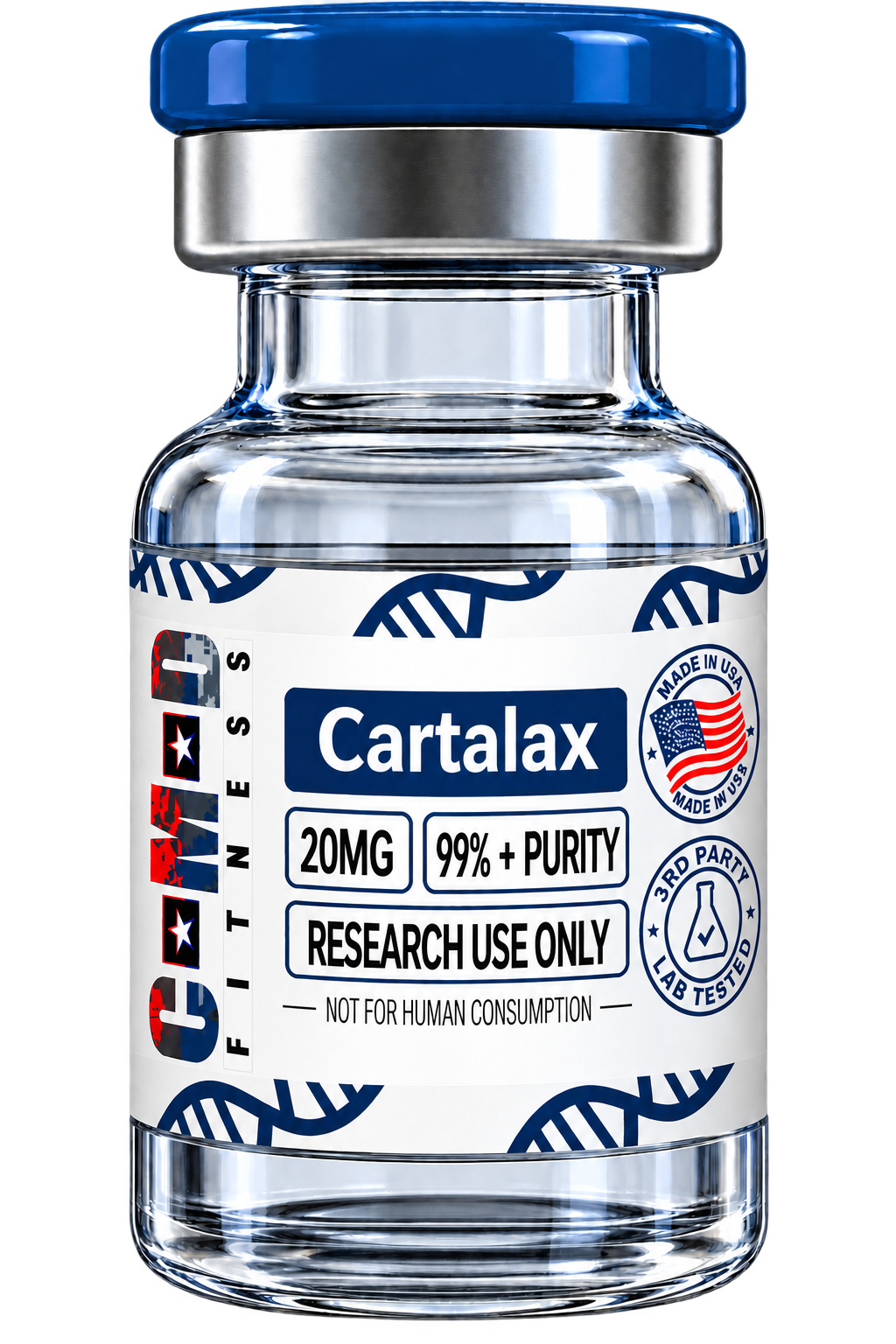
Cartalax (20mg)

Price:

$65.00

Select Quantity:

50 in stock

Overview

Cartalax (AED) is a synthetic tripeptide studied as a peptide bioregulator with research interest centered on cartilage and connective-tissue biology. Preclinical research has explored its potential influence on cellular signaling, extracellular-matrix processes, and pathways associated with cartilage tissue maintenance.

Cartalax is provided as a lyophilized research peptide for controlled laboratory investigation. Research into Cartalax remains primarily preclinical, and its biological effects and potential applications continue to be investigated.

Research Use Only • Not for Human Consumption • Not a Drug or Dietary Supplement
Biochemical
Characteristics

Cartalax Peptide — Biochemical Characteristics

  • Peptide Type: Synthetic short-chain peptide / tripeptide
  • Sequence: Ala-Glu-Asp (AED)
  • Molecular Composition: Alanine–glutamic acid–aspartic acid
  • Molecular Weight: Approximately 347.3 g/mol
  • Structure: Linear, three-amino-acid peptide
  • Charge Characteristics: Contains acidic amino-acid residues, giving the molecule an overall acidic character under physiological conditions
  • Solubility: Generally evaluated for aqueous solubility under controlled laboratory conditions
  • Physical Form: Typically supplied as a lyophilized powder
  • Research Classification: Peptide bioregulator investigated in connection with cartilage and connective-tissue biology
  • Research Focus: Cellular signaling, extracellular-matrix processes, and mechanisms associated with cartilage tissue biology

Research Use Only • Not for Human Consumption

Research Applications

Cartalax Peptide — Research Applications

Cartalax (AED) may be investigated in laboratory settings for:

  • Cartilage Biology: Study of cellular pathways involved in cartilage tissue maintenance.
  • Chondrocyte Research: Investigation of signaling and functional characteristics of cartilage cells.
  • Extracellular Matrix Research: Examination of pathways associated with collagen, proteoglycans, and matrix organization.
  • Connective-Tissue Studies: Exploration of peptide interactions with connective-tissue cellular processes.
  • Cellular Aging Research: Investigation of peptide-related mechanisms involved in cellular aging and tissue homeostasis.
  • Gene-Expression Studies: Experimental evaluation of changes in tissue-specific gene-expression pathways.
  • Peptide Bioregulation: Research into how short-chain peptides may influence cellular signaling and regulatory mechanisms.

Research Use Only • Not for Human Consumption • For Laboratory Research Applications Only

Chemical Properties

Cartalax Peptide — Chemical Properties

  • Chemical Name: Ala-Glu-Asp (AED)
  • Peptide Sequence: L-Alanine–L-Glutamic Acid–L-Aspartic Acid
  • Peptide Type: Synthetic tripeptide
  • Molecular Formula: C₁₁H₁₇N₃O₇
  • Molecular Weight: ~303.27 g/mol
  • Appearance: Typically supplied as a white to off-white lyophilized powder
  • Solubility: Generally soluble in aqueous solutions under appropriate laboratory conditions
  • Chemical Character: Contains acidic carboxyl groups from glutamic and aspartic acid residues
  • Stability: Lyophilized peptide should be protected from excessive heat, moisture, and prolonged exposure to light.
  • Storage: Store according to the supplier’s Certificate of Analysis (COA) and product-specific storage specifications.

Research Use Only • Not for Human Consumption

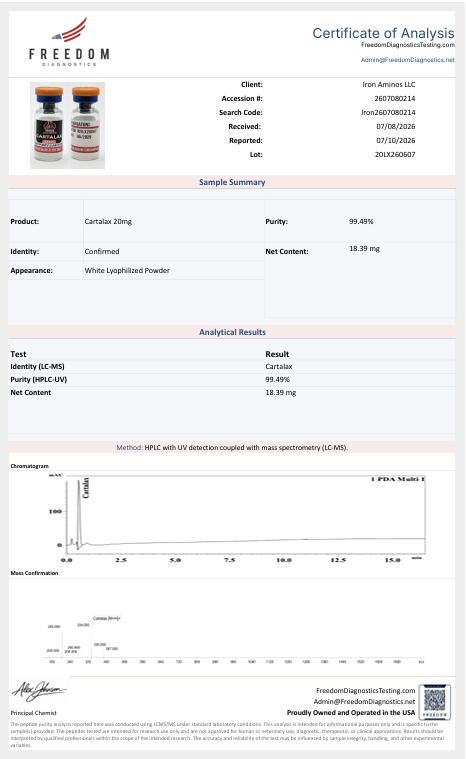
COA /HPLC / MS

3rd Party Testing

Third Party Tested by Freedom Diagnostics Testing @Freedom Diagnostics Testing – Reliable. Accountable. Accessible.

Storage

Cartalax Peptide — Product Storage

  • Unreconstituted / Lyophilized: Store in a cool, dry environment, preferably 2–8°C (36–46°F).
  • Protect From: Direct light, excessive heat, humidity, and repeated temperature fluctuations.
  • Container: Keep sealed in the original vial until needed to minimize exposure to moisture and contaminants.
  • Long-Term Storage: For extended storage, follow the manufacturer/supplier specifications and batch-specific COA; appropriately frozen storage may be recommended.
  • After Reconstitution: Storage requirements depend on the solvent and formulation used. Follow the applicable laboratory protocol and product-specific stability information.
  • Handling: Minimize unnecessary exposure to heat and repeated freeze–thaw cycles.

Research Use Only • Not for Human Consumption • Store According to Product Specifications

Your cart is currently empty.

Return to shop

0