

Veteran-owned business
Product Usage: This PRODUCT IS INTENDED AS A RESEARCH CHEMICAL ONLY. This designation allows the use of research chemicals strictly for in vitro testing and laboratory experimentation only. All product information available on this website is for educational purposes only. Bodily introduction of any kind into humans or animals is strictly forbidden by law. This product should only be handled by licensed, qualified professionals. This product is not a drug, food, or cosmetic and may not be misbranded, misused or mislabeled as a drug, food or cosmetic.

For research use only. Not for human consumption.

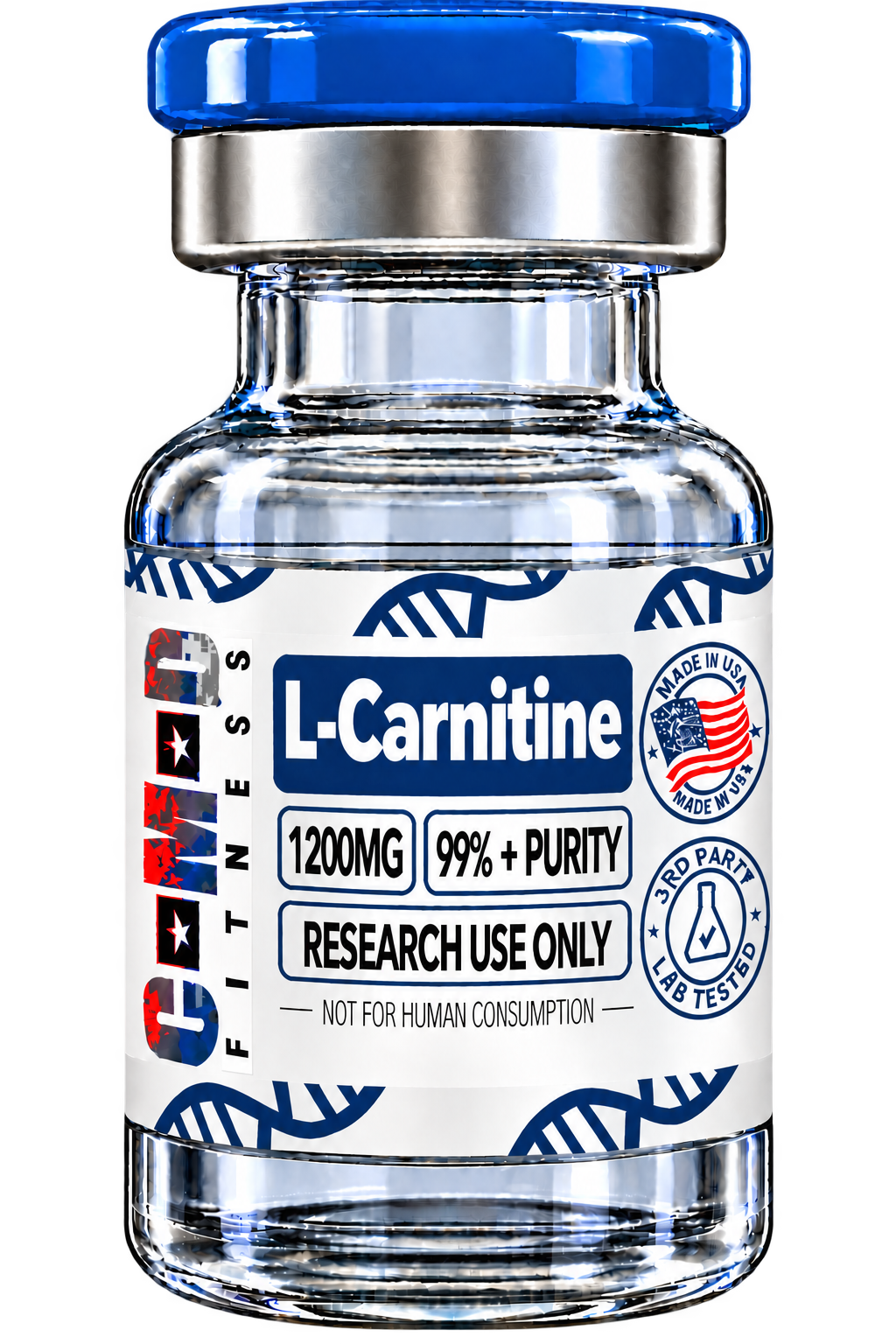
L-Carnitine 1200mg

Price:

$105.00

Select Quantity:

50 in stock

Overview

L-Carnitine 1200mg Injectable is a concentrated formulation of L-Carnitine, a naturally occurring amino-acid derivative that plays a fundamental role in mitochondrial energy metabolism. Its primary biochemical function is to facilitate the transport of long-chain fatty acids into the mitochondrial matrix, where they undergo beta-oxidation for cellular energy production.

L-Carnitine is extensively studied in metabolic and biochemical research involving fatty-acid oxidation, mitochondrial function, cellular energy production, skeletal-muscle metabolism, exercise physiology, and metabolic efficiency. It also contributes to maintaining the balance between free and acylated coenzyme A within cells, making it an important component of normal cellular energy regulation.

The 1200mg injectable formulation provides a concentrated preparation for controlled research applications investigating L-Carnitine’s role in lipid metabolism, mitochondrial bioenergetics, energy utilization, and cellular metabolic pathways.

For research and laboratory applications only.

Biochemical
Characteristics

L-Carnitine is a naturally occurring quaternary ammonium compound derived from the amino acids lysine and methionine. It serves as an essential component of the carnitine shuttle, the biochemical system responsible for transporting long-chain fatty acids across the inner mitochondrial membrane for subsequent beta-oxidation and cellular energy production.

Key biochemical characteristics include:

  • Mitochondrial Fatty-Acid Transport: Transfers long-chain fatty-acyl groups into the mitochondrial matrix through the CPT-I, carnitine-acylcarnitine translocase, and CPT-II system.
  • Beta-Oxidation Support: Enables fatty acids to become available as substrates for mitochondrial oxidation and ATP-generating metabolic pathways.
  • Acyl-CoA Regulation: Helps regulate the cellular ratio of free CoA to acyl-CoA by facilitating the formation and transport of acylcarnitines.
  • Metabolic Homeostasis: Contributes to normal carbohydrate and lipid metabolism by influencing mitochondrial substrate availability.
  • Skeletal-Muscle Metabolism: High concentrations of the body’s carnitine stores are found in skeletal muscle, making L-Carnitine particularly relevant to research involving muscular energy metabolism and bioenergetics.
  • Mitochondrial Function: Its central involvement in fatty-acid utilization makes L-Carnitine an important research compound for investigating mitochondrial efficiency, cellular energy balance, and metabolic function.

These biochemical properties make L-Carnitine particularly useful in research examining mitochondrial metabolism, lipid utilization, cellular energetics, skeletal-muscle metabolism, and metabolic regulation.

For research and laboratory applications only.

Research Applications

L-Carnitine is widely investigated in laboratory and clinical research because of its central role in mitochondrial fatty-acid transport and cellular energy metabolism. Research applications span metabolic science, mitochondrial biology, exercise physiology, and cellular bioenergetics.

Key areas of investigation include:

  • Mitochondrial Function: Research into fatty-acid transport, mitochondrial energy production, and cellular bioenergetics.
  • Fatty-Acid Oxidation: Studies examining the transport and utilization of long-chain fatty acids through mitochondrial beta-oxidation.
  • Energy Metabolism: Investigation of L-Carnitine’s involvement in substrate utilization, ATP production, and cellular energy balance.
  • Skeletal-Muscle Metabolism: Research examining carnitine availability, muscle energy metabolism, metabolic efficiency, and exercise-related physiology.
  • Lipid Metabolism: Studies exploring fatty-acid utilization, lipid handling, and metabolic regulation.
  • Glucose Metabolism: Investigation into relationships among carnitine status, mitochondrial substrate selection, glucose oxidation, and insulin-related metabolic pathways.
  • Exercise & Recovery Research: Studied for potential effects on exercise metabolism, fatigue-related biomarkers, muscle physiology, and recovery.
  • Oxidative-Stress Research: Evaluation of relationships between mitochondrial metabolism, reactive oxygen species, and cellular oxidative balance.
  • Metabolic Health Research: Used experimentally to investigate metabolic dysfunction and conditions associated with altered mitochondrial or carnitine metabolism.

These applications make L-Carnitine an important research compound for studying the relationship between mitochondrial function, fatty-acid metabolism, skeletal-muscle energetics, and overall cellular energy regulation.

For research and laboratory applications only.

Chemical Properties

L-Carnitine is a naturally occurring, water-soluble quaternary ammonium compound involved in fatty-acid transport and mitochondrial energy metabolism.

  • Chemical Name: (R)-3-Hydroxy-4-(trimethylazaniumyl)butanoate
  • Molecular Formula: C₇H₁₅NO₃
  • Molecular Weight: 161.20 g/mol
  • CAS Number: 541-15-1
  • Compound Class: Quaternary ammonium compound / amino-acid derivative
  • Physical Appearance: White crystalline material in its pure form; typically clear and colorless when formulated as an aqueous solution
  • Solubility: Highly soluble in water
  • Stereochemistry: L-Carnitine is the biologically active R-enantiomer
  • Ionic Character: Exists predominantly as a zwitterion, containing a permanently charged quaternary ammonium group and a carboxylate group
  • Functional Groups: Hydroxyl, carboxylate, and trimethylammonium groups
  • Stability: Generally chemically stable under appropriate formulation and storage conditions; stability of an injectable preparation depends on pH, concentration, sterility, excipients, container system, and manufacturer specifications.

Its combination of high aqueous solubility, ionic character, and biological stereospecificity supports L-Carnitine’s function as a carrier of activated long-chain fatty acids within the mitochondrial carnitine-shuttle system.

For research and laboratory applications only.

COA /HPLC / MS
3rd Party Testing

Third Party Tested by Freedom Diagnostics Testing at Freedom Diagnostics Testing – Reliable. Accountable. Accessible.

Storage

Product Storage

L-Carnitine 1200mg Injectable (Liquid) should be stored under controlled conditions to maintain product stability and integrity.

  • Recommended Storage Temperature: Refrigerate at 2°C–8°C (36°F–46°F) when that range is specified for the particular formulation.
  • Keep the vial tightly sealed and protected from contamination.
  • Protect from direct sunlight, excessive heat, and prolonged exposure to elevated temperatures.
  • Do not freeze unless frozen storage has been specifically validated for the formulation.
  • Avoid repeated or unnecessary temperature fluctuations.
  • Before laboratory use, visually inspect the solution for unexpected discoloration, cloudiness, precipitation, or particulate matter.
  • Follow appropriate sterile laboratory handling procedures when accessing the vial.

Important: Liquid L-Carnitine products can have different validated storage requirements depending on their concentration, pH, preservatives, excipients, and manufacturing process. The manufacturer’s label, COA, or validated stability data should take precedence over general storage recommendations.

For research and laboratory applications only.

Your cart is currently empty.

Return to shop

Categories , ,
0