

Veteran-owned business
Product Usage: This PRODUCT IS INTENDED AS A RESEARCH CHEMICAL ONLY. This designation allows the use of research chemicals strictly for in vitro testing and laboratory experimentation only. All product information available on this website is for educational purposes only. Bodily introduction of any kind into humans or animals is strictly forbidden by law. This product should only be handled by licensed, qualified professionals. This product is not a drug, food, or cosmetic and may not be misbranded, misused or mislabeled as a drug, food or cosmetic.

For research use only. Not for human consumption.

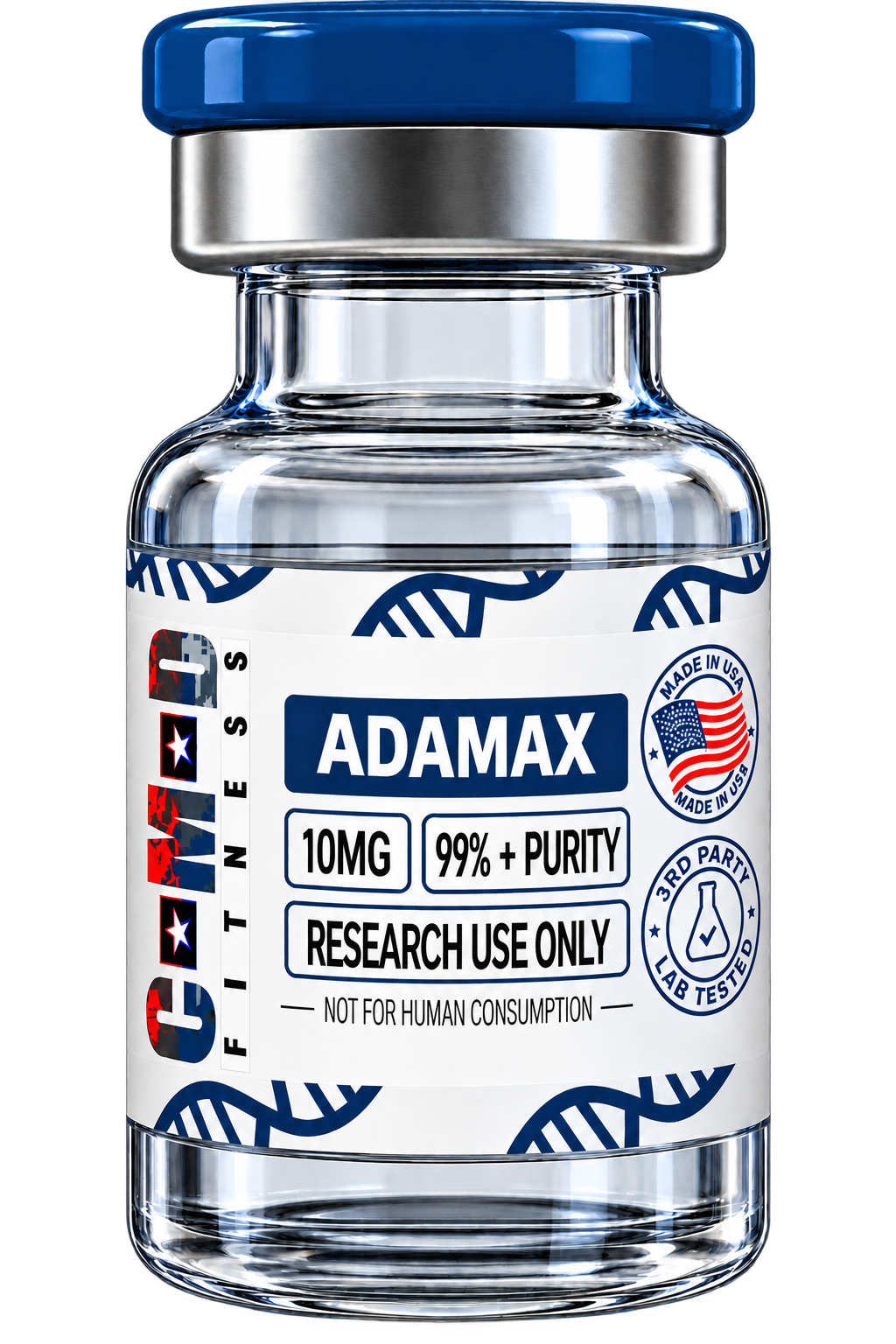
Adamax (10MG)

Adamax is an investigational nootropic research peptide derived from the Semax family. Researchers are exploring its potential role in cognitive performance, memory, focus, neuroplasticity, and neurological function. Structural modifications may enhance stability and central nervous system activity compared to the parent peptide. Adamax is intended exclusively for research and educational purposes and is not approved for human or veterinary use.

Price:

$75.00

Select Quantity:

50 in stock

Overview

Adamax is a novel research peptide developed from the Semax peptide family and designed with structural modifications intended to enhance stability and central nervous system activity. Researchers are exploring Adamax for its potential role in cognitive function, memory, learning, neuroplasticity, and neurotrophic signaling pathways. Its unique molecular design has generated interest within neuroscience and nootropic research communities as a potential advancement over traditional Semax analogs.

While preliminary interest is growing, published research on Adamax remains limited, and much of the current understanding is based on theoretical mechanisms and findings from related peptides. Adamax is supplied as a high-purity research compound for laboratory investigation and scientific study.

For Research and Educational Purposes Only. Not for human or veterinary use.

Biochemical
Characteristics

Biochemical Characteristics

  • Compound Name: Adamax
  • Peptide Class: Modified Semax Analog
  • Structure: Semax derivative incorporating an adamantane moiety and N-terminal acetylation
  • Molecular Type: Synthetic neuroactive peptide
  • Physical Appearance: White to off-white lyophilized powder
  • Solubility: Generally soluble in bacteriostatic water and other standard peptide research solvents
  • Stability: Structural modifications are intended to enhance molecular stability and resistance to enzymatic degradation compared with the parent peptide
  • Lipophilicity: Increased lipophilicity due to the adamantane group may support improved blood-brain barrier penetration in research models
  • Research Focus: Cognitive function, memory, learning, neuroplasticity, neurotrophic signaling, and central nervous system research
  • Mechanistic Interest: Investigated for potential effects on brain-derived neurotrophic factor (BDNF), nerve growth factor (NGF), and neurotransmitter pathways involved in cognition and mood
  • Purity: Typically manufactured to research-grade standards with high-performance liquid chromatography (HPLC) verification
  • Storage Conditions: Refrigerate at 2–8°C for short-term storage; freeze at -20°C for long-term preservation. Protect from heat, moisture, and direct light.

Research Status

Adamax is an investigational research compound. It is not approved by the U.S. Food and Drug Administration (FDA) for the diagnosis, treatment, cure, or prevention of any disease. Safety and efficacy have not been established in human clinical trials.

For Research and Educational Purposes Only. Not for human or veterinary use.

Research Applications

Adamax is an investigational neuroactive peptide that has attracted interest in neuroscience and cognitive research due to its structural relationship to Semax and its proposed enhanced central nervous system activity. Current research is limited, and many areas of investigation are based on theoretical mechanisms and findings from related peptide compounds.

Areas of Scientific Investigation

  • Cognitive Performance Research
    Studied for its potential influence on attention, focus, information processing, and cognitive function in experimental models.
  • Learning and Memory Studies
    Investigated for its possible role in memory formation, retention, and learning processes through modulation of neurotrophic pathways.
  • Neuroplasticity Research
    Explored for potential effects on neuronal adaptation, synaptic plasticity, and brain signaling mechanisms associated with cognitive performance.
  • Neurotrophic Factor Expression
    Research has focused on potential interactions with brain-derived neurotrophic factor (BDNF) and nerve growth factor (NGF), which are involved in neuronal growth, maintenance, and communication.
  • Stress Response Studies
    Evaluated in experimental settings for potential effects on neurological responses to physical and psychological stressors.
  • Neuroprotection Research
    Investigated for its possible ability to support neuronal resilience and recovery pathways in preclinical research models.
  • Neurotransmitter Signaling
    Examined for potential interactions with dopaminergic, serotonergic, and other neurotransmitter systems involved in cognition, mood, and behavioral function.

Research Considerations

Research involving Adamax remains in the early stages, and published human clinical data are extremely limited. Many proposed applications are derived from the known pharmacology of Semax and the theoretical advantages of Adamax’s structural modifications. Additional research is required to fully characterize its biological activity, safety profile, and potential scientific value.

For Research and Educational Purposes Only. Not for human or veterinary use.

Chemical Properties
  • Compound Name: Adamax
  • Compound Class: Synthetic modified neuroactive peptide
  • Peptide Family: Semax analog / Semax-derived research compound
  • Chemical Nature: Short-chain synthetic peptide incorporating structural modifications designed to alter stability and biological characteristics
  • Structural Modification: Contains an adamantane moiety and N-terminal acetylation, modifications intended to increase molecular stability and lipophilicity compared with the parent peptide structure
  • Molecular Formula: Not consistently reported in publicly available literature due to limited characterization data
  • Molecular Weight: Reported values may vary depending on synthesis specifications and analytical characterization
  • Appearance: White to off-white lyophilized powder
  • Purity: Typically supplied as a high-purity research compound with analytical verification (commonly HPLC testing)
  • Solubility: Expected to be compatible with standard peptide research solvents; solubility may vary based on concentration, formulation, and laboratory conditions
  • Stability Profile: Structural modifications are designed to improve resistance to enzymatic degradation and enhance peptide stability during research applications
  • Chemical Properties:
    • Synthetic peptide-based compound
    • Non-naturally occurring Semax derivative
    • Designed for increased lipophilic characteristics due to adamantane incorporation
    • Potential for enhanced membrane interaction compared with unmodified peptide structures

Analytical Characterization

Research-grade Adamax may be characterized using analytical methods such as:

  • High-Performance Liquid Chromatography (HPLC) for purity assessment
  • Mass Spectrometry (MS) for molecular identification
  • Peptide sequencing methods for structural verification

Research Status

Adamax remains an investigational research compound. Detailed chemical characterization, pharmacokinetics, and biological activity profiles continue to require additional scientific investigation.

For Research and Educational Purposes Only. Not for human or veterinary use.
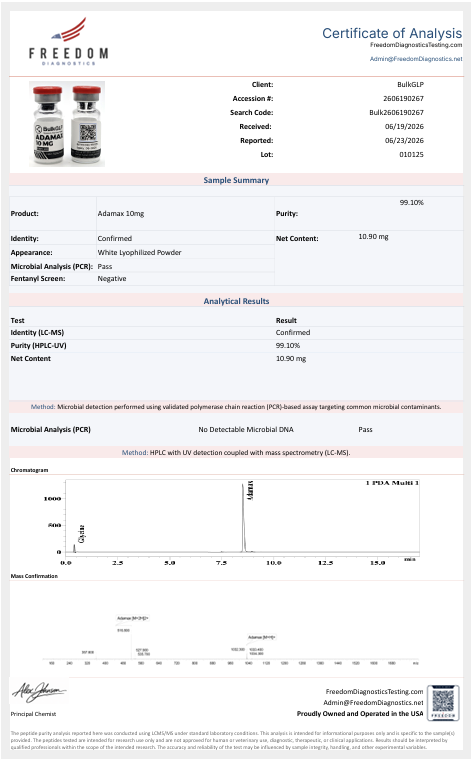
COA /HPLC / MS

3rd Party Testing

3rd Party Tested by Freedom Diagnostics Testing @ Freedom Diagnostics Testing – Reliable. Accountable. Accessible.

Storage

Proper storage conditions help maintain the stability and integrity of Adamax for laboratory research applications.

Lyophilized (Unreconstituted) Peptide

  • Store in a cool, dry environment protected from moisture, heat, and direct light.
  • Recommended short-term storage: 2–8°C (refrigerated)
  • Recommended long-term storage: -20°C (frozen)
  • Keep the vial sealed until use to minimize exposure to humidity and contaminants.
  • Avoid repeated temperature fluctuations.

After Reconstitution

  • Store according to the requirements of the selected research solvent and laboratory protocol.
  • Keep reconstituted solutions protected from light and minimize unnecessary temperature changes.
  • Use appropriate sterile laboratory handling procedures to reduce contamination risk.

Handling Recommendations

  • Allow refrigerated or frozen vials to reach room temperature before opening to reduce condensation risk.
  • Avoid excessive agitation, as peptides may be sensitive to mechanical stress.
  • Maintain proper documentation of storage conditions for research quality control.

Storage Summary:
Lyophilized Adamax: 2–8°C short term | -20°C long term
Protect from: Heat, moisture, light, and repeated freeze–thaw cycles

For Research and Educational Purposes Only. Not for human or veterinary use.

Your cart is currently empty.

Return to shop

0