Veteran-owned business
Product Usage: This PRODUCT IS INTENDED AS A RESEARCH CHEMICAL ONLY. This designation allows the use of research chemicals strictly for in vitro testing and laboratory experimentation only. All product information available on this website is for educational purposes only. Bodily introduction of any kind into humans or animals is strictly forbidden by law. This product should only be handled by licensed, qualified professionals. This product is not a drug, food, or cosmetic and may not be misbranded, misused or mislabeled as a drug, food or cosmetic.

For research use only. Not for human consumption.

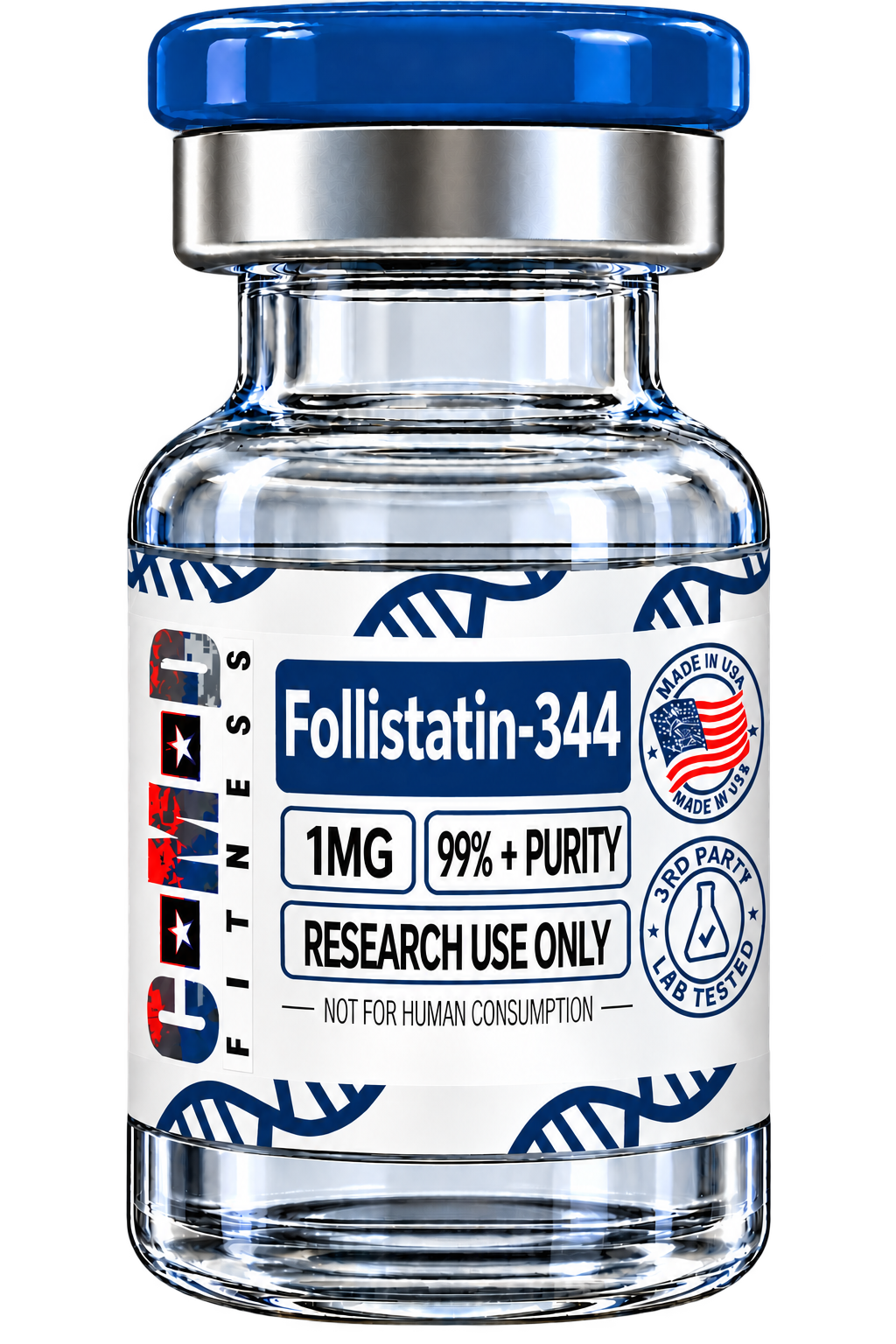
Follistatin 344 (1MG)

Follistatin 344 (FST-344) is an advanced research peptide studied for its interaction with myostatin and activin signaling, pathways involved in regulating muscle growth and development. A compelling compound for researchers exploring muscle-building mechanisms, muscle preservation, and next-generation myostatin inhibition research.

Research use only. Not for human consumption.

Price:

$110.00

Select Quantity:

29 in stock

Overview

Product: Follistatin 344 (FST-344)
Category: Research Peptide
Primary Research Area: Myostatin/activin signaling
Research Focus: Skeletal-muscle growth, muscle preservation, and muscle biology

Description:
Follistatin 344 is a naturally occurring follistatin isoform investigated for its ability to interact with myostatin and activin signaling pathways. Myostatin is a negative regulator of skeletal-muscle growth, making FST-344 an important research compound for studying mechanisms involved in muscle development and muscle wasting.

Research Applications:

  • Myostatin inhibition research
  • Activin signaling research
  • Skeletal-muscle growth and development
  • Muscle preservation and wasting research
  • Muscle regeneration research
  • Neuromuscular disease research

Human studies of FST-344 have primarily investigated gene-transfer approaches in conditions such as Becker muscular dystrophy and sporadic inclusion-body myositis; these studies are early-stage and do not establish FST-344 as an approved muscle-building therapy.

Format: Lyophilized research material
Purity: [Insert your batch-specific purity]
Storage: Store according to the manufacturer’s Certificate of Analysis and handling specifications.

Research Use Only — Not for Human Consumption.

Biochemical
Characteristics

Follistatin 344 — Biochemical Characteristics

  • Peptide: Follistatin 344 (FST-344)
  • Protein family: Follistatin / activin-binding protein
  • Biological class: Secreted glycoprotein
  • Primary role: Binds and modulates members of the TGF-β superfamily, including activins and myostatin
  • Molecular relationship: FST-344 is a splice variant/precursor form associated with follistatin biology and extracellular ligand binding.
  • Research interest: Myostatin signaling, activin regulation, skeletal-muscle biology, and tissue remodeling
  • Structure: Contains multiple follistatin domains involved in ligand binding.
  • Mechanism of interest: Follistatin can sequester extracellular signaling proteins, potentially reducing their interaction with corresponding cell-surface receptors.
  • Research significance: Particularly relevant to studies examining the regulation of skeletal-muscle growth and muscle-wasting pathways.

Important: FST-344 is a research compound, and its biochemical activity should not be interpreted as an established clinical muscle-building effect.

Research Applications

Follistatin 344 — Research Applications

Follistatin 344 (FST-344) is primarily investigated for its interaction with myostatin, activin, and related TGF-β signaling pathways.

Key research applications:

  • Myostatin signaling research — studying mechanisms that regulate skeletal-muscle growth.
  • Muscle hypertrophy research — investigating how modulation of myostatin/activin pathways affects muscle development.
  • Muscle-wasting research — exploring pathways involved in muscle loss and preservation.
  • Neuromuscular disease research — investigating follistatin-based approaches in disorders associated with muscle weakness or degeneration.
  • Activin pathway research — examining follistatin’s ability to bind and modulate activin-family ligands.
  • Muscle regeneration research — studying signaling pathways involved in muscle repair and remodeling.
  • TGF-β superfamily research — investigating interactions among follistatin, myostatin, activins, and related growth factors.

Research use only. Not approved for human therapeutic use.

Chemical Properties

Follistatin 344 — Chemical Properties

  • Name: Follistatin 344 (FST-344)
  • Molecular type: Recombinant protein/peptide research material
  • Protein family: Follistatin
  • Isoform: FST-344
  • Biological classification: Secreted glycoprotein
  • Primary binding targets: Activin-family ligands, including myostatin (GDF-8)
  • Structural features: Contains multiple follistatin domains responsible for extracellular ligand binding.
  • Molecular structure: Disulfide-bonded protein structure with glycosylation sites characteristic of follistatin.
  • Solubility: Generally formulated for aqueous research applications; solubility depends on formulation, concentration, and buffer conditions.
  • Stability: Protein stability is influenced by temperature, pH, concentration, agitation, and repeated freeze/thaw cycles.
  • Form: Typically supplied as a lyophilized (freeze-dried) research material.
  • Purity: Should be verified using the batch-specific Certificate of Analysis (COA), commonly by analytical methods such as HPLC and mass spectrometry.

Note: Exact molecular weight, sequence, purity, formulation, and physicochemical specifications can vary by manufacturer and should be taken directly from the product’s batch-specific COA.

Research use only. Not for human consumption.

COA /HPLC / MS
3rd Party Testing
Storage

Follistatin 344 — Product Storage

  • Lyophilized powder: Store frozen, typically at −20°C or below, according to the manufacturer’s specifications.
  • Protect from: Light, heat, moisture, and prolonged exposure to room temperature.
  • After reconstitution: Store under the conditions specified by the manufacturer/COA. Avoid repeated freeze-thaw cycles.
  • Handling: Minimize unnecessary agitation and temperature fluctuations.
  • Packaging: Keep the vial tightly sealed until use to minimize exposure to moisture and environmental contaminants.
  • Long-term storage: A dedicated laboratory freezer is preferred.

Important: Storage requirements can vary depending on the formulation and manufacturer. For a commercial product page, use the exact storage conditions provided on your supplier’s COA or technical data sheet rather than assuming a universal temperature.

Research use only. Not for human consumption.

Your cart is currently empty.

Return to shop

0