

Veteran-owned business
Product Usage: This PRODUCT IS INTENDED AS A RESEARCH CHEMICAL ONLY. This designation allows the use of research chemicals strictly for in vitro testing and laboratory experimentation only. All product information available on this website is for educational purposes only. Bodily introduction of any kind into humans or animals is strictly forbidden by law. This product should only be handled by licensed, qualified professionals. This product is not a drug, food, or cosmetic and may not be misbranded, misused or mislabeled as a drug, food or cosmetic.

For research use only. Not for human consumption.

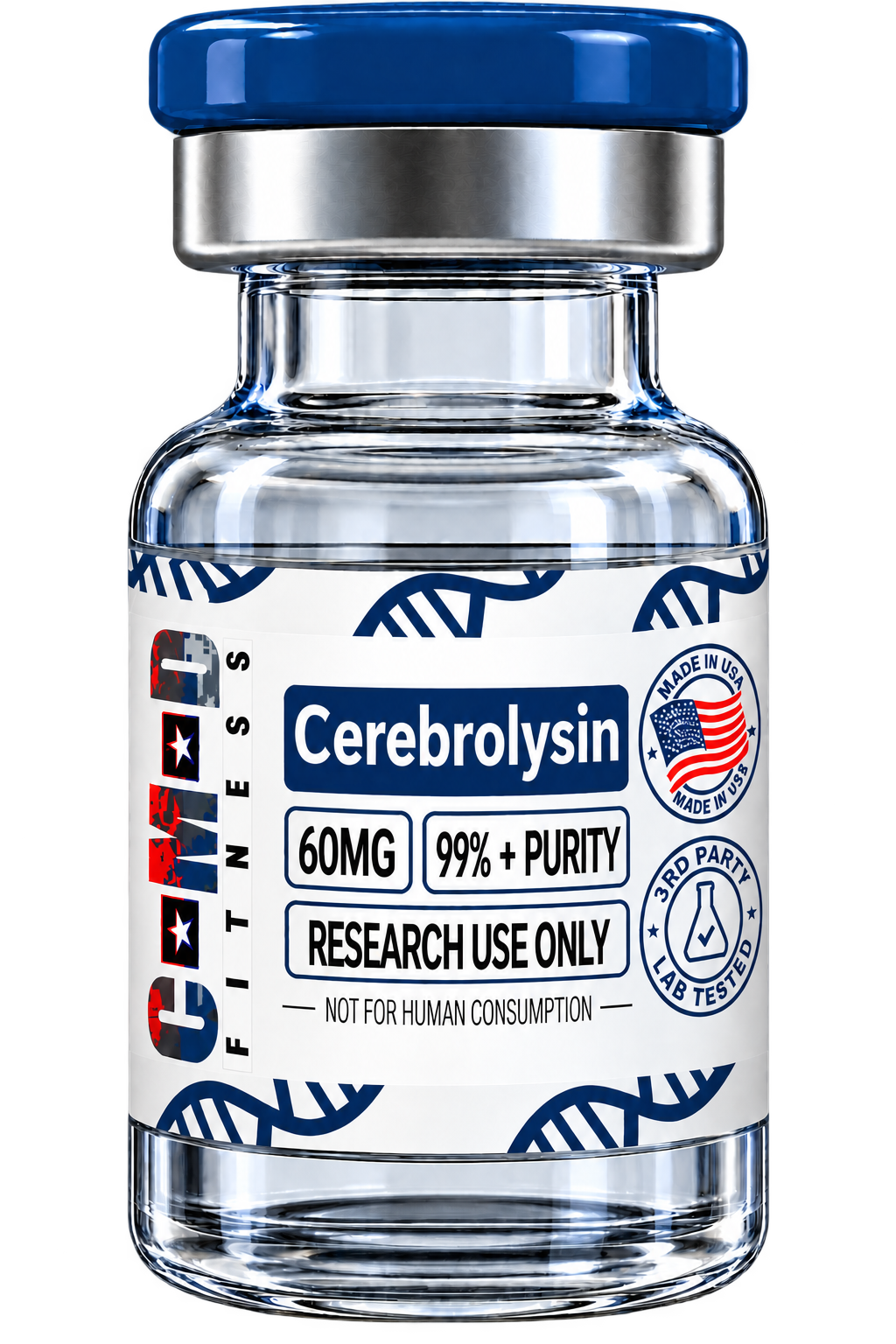
Cerebrolysin (60 MG)

Price:

$90.00

Select Quantity:

50 in stock

Overview

Neurotrophic Peptide Complex / Cognitive Support Peptide

Composition

A proprietary blend of low‑molecular‑weight neuropeptides derived from porcine brain tissue. These peptides are designed to mimic endogenous neurotrophic factors such as BDNF, NGF, and CNTF, supporting neuronal growth, repair, and metabolic efficiency.

Mechanisms of Action

  • Neurotrophic Support Promotes synaptic plasticity, dendritic growth, and neuronal resilience.
  • Metabolic Enhancement Improves neuronal energy utilization and mitochondrial efficiency.
  • Neuroprotection Helps reduce oxidative stress, inflammation, and excitotoxicity.
  • Cognitive Optimization Supports memory formation, learning speed, and mental clarity.

Key Functional Benefits

  • Supports memory retention and recall
  • Enhances focus, clarity, and mental stamina
  • Promotes neuroplasticity and brain adaptability
  • Assists in cognitive recovery after stress or burnout
  • Non‑stimulant, restorative cognitive support

Typical Use Cases

  • High‑performance professionals
  • Students or individuals under heavy cognitive load
  • Wellness protocols targeting long‑term brain health
  • Recovery programs following mental fatigue or stress
  • Stacks with Semax, Selank, Dihexa, NAD+, or Noopept

Product Format

  • Sterile peptide solution
  • Clear, colorless liquid
  • Packaged in sealed vials suitable for research and laboratory use

Storage

  • Store refrigerated (2–8°C)
  • Protect from light
  • Do not freeze

Stability

  • Maintains peptide integrity under proper cold‑chain storage
  • Shelf life varies by manufacturer batch specifications

Notes

This product is intended for research and educational purposes only. Not for human consumption.

Biochemical
Characteristics

Cerebrolysin is a low‑molecular‑weight neuropeptide complex with high biological activity, rapid CNS penetration, and strong affinity for neurotrophic signaling pathways. Its biochemical profile is what makes it uniquely effective among cognitive‑support peptides.

Molecular Composition

  • Peptide fragments <10 kDa Allows fast absorption, efficient blood–brain barrier (BBB) penetration, and direct interaction with neuronal receptors.
  • Derived neurotrophic peptides Structurally similar to endogenous factors such as BDNF, NGF, CNTF, and GDNF.
  • Amino acid sequence diversity Contains a broad spectrum of short peptides that target multiple neurobiological pathways simultaneously.

Physicochemical Properties

  • Appearance: Clear, colorless aqueous solution
  • Solubility: Fully water‑soluble
  • Stability: Maintains structural integrity under refrigerated conditions (2–8°C)
  • pH Range: Slightly acidic, optimized for peptide stability
  • Molecular Weight Distribution: Highly uniform low‑weight peptide fractions for rapid CNS bioavailability

Biological Activity

  • Neurotrophic modulation Enhances signaling through Trk receptors and supports neuronal growth, differentiation, and synaptic formation.
  • Anti‑apoptotic effects Reduces caspase activation and supports mitochondrial membrane stability.
  • Antioxidant & anti‑inflammatory activity Lowers oxidative stress markers and modulates microglial activation.
  • Synaptic plasticity enhancement Promotes long‑term potentiation (LTP), supporting memory and learning processes.

Pharmacokinetic Characteristics

  • Rapid BBB penetration due to low molecular weight
  • High receptor affinity for neurotrophic pathways
  • Short plasma half‑life, but long biological effect duration due to downstream gene expression changes
  • Non‑stimulant mechanism — works through cellular repair and signaling, not neurotransmitter spikes

Functional Biochemical Outcomes

  • Increased neuronal survival
  • Enhanced synaptic density
  • Improved neurotransmitter balance (glutamate, acetylcholine, dopamine modulation)
  • Strengthened mitochondrial efficiency
  • Reduced neuroinflammation

Research Applications

Cerebrolysin is widely used in neuroscience, cognitive enhancement, and neuroprotection research, thanks to its unique ability to modulate neurotrophic signaling, synaptic plasticity, and neuronal metabolism.

🧬 1. Neuroprotection & Cellular Resilience

Cerebrolysin is frequently studied for its ability to protect neurons from:

  • Oxidative stress
  • Excitotoxicity
  • Inflammatory damage
  • Mitochondrial dysfunction

Researchers use it to model interventions for neurodegenerative conditions, cellular aging, and toxin‑induced neuronal injury.

🧠 2. Neuroplasticity & Synaptic Growth

Its peptide components mimic endogenous neurotrophic factors, making it valuable in studies focused on:

  • Synaptic density
  • Dendritic branching
  • Long‑term potentiation (LTP)
  • Learning and memory formation

This makes Cerebrolysin a key tool in cognitive enhancement and memory research.

🧪 3. Cognitive Function & Behavioral Studies

Rodent and in‑vitro models use Cerebrolysin to evaluate:

  • Memory retention
  • Learning speed
  • Executive function
  • Stress‑induced cognitive decline

It’s often paired with behavioral tests like Morris water maze, novel object recognition, and maze‑based learning paradigms.

🧩 4. Neurodegenerative Disease Models

Cerebrolysin is used in preclinical research involving:

  • Alzheimer’s disease
  • Parkinson’s disease
  • Vascular dementia
  • Post‑stroke cognitive impairment

Its neurotrophic and metabolic effects make it a candidate for studying disease‑modifying mechanisms.

🧯 5. Anti‑Inflammatory & Glial Modulation

Research shows Cerebrolysin influences:

  • Microglial activation
  • Astrocyte signaling
  • Cytokine balance

This makes it useful for exploring neuroinflammation, immune‑brain interactions, and chronic inflammatory states.

⚡ 6. Mitochondrial & Metabolic Optimization

Studies investigate its role in:

  • ATP production
  • Mitochondrial membrane stability
  • Neuronal energy efficiency

Useful in research on fatigue, aging, and metabolic brain disorders.

🧩 7. Recovery & Regeneration Models

Cerebrolysin is commonly used in:

  • Stroke recovery research
  • Traumatic brain injury (TBI) models
  • Neuroregeneration studies

Its peptide profile supports axonal repair, synaptic rebuilding, and functional recovery.

🔬 8. Combination & Synergy Research

Researchers often combine Cerebrolysin with:

  • Semax
  • Selank
  • Dihexa
  • BDNF mimetics
  • NAD+ or NMN

To explore synergistic cognitive and neuroprotective effects.

Chemical Properties

Cerebrolysin is a low‑molecular‑weight neuropeptide solution with high aqueous solubility, strong biochemical stability under cold storage, and a physicochemical profile optimized for rapid CNS penetration and neurotrophic activity.

1. Molecular Weight Profile

  • <10 kDa peptide fragments Ensures fast absorption and efficient blood–brain barrier permeability.
  • Highly uniform distribution of short peptides and amino acid chains.

2. Physical Appearance

  • Clear, colorless aqueous solution
  • No visible particulates when properly stored
  • Slightly acidic pH optimized for peptide stability

3. Solubility & Stability

  • Fully water‑soluble Allows rapid dispersion in biological environments.
  • Stable at 2–8°C Cold‑chain storage preserves peptide integrity.
  • Sensitive to heat, UV light, and oxidation, requiring protection from light.

4. pH Characteristics

  • Typically pH 5.0–6.0 This mildly acidic range prevents peptide denaturation and maintains structural fidelity.

5. Chemical Behavior

  • Non‑reactive with common excipients Formulated to avoid peptide aggregation or precipitation.
  • Low viscosity Ensures consistent handling and uniform distribution.
  • Non‑lipophilic Water‑based chemistry supports rapid systemic uptake.

6. Biochemical Reactivity

  • High affinity for:
    • Neurotrophic receptors (Trk family)
    • Cellular repair pathways
    • Mitochondrial metabolic regulators
  • Exhibits:
    • Anti‑oxidative behavior
    • Anti‑inflammatory modulation
    • Anti‑apoptotic signaling

7. Degradation Profile

  • Peptide fragments undergo enzymatic breakdown into amino acids and smaller peptides.
  • No accumulation in tissues due to rapid metabolic clearance.
  • Biological effects persist longer than chemical presence due to gene‑expression modulation.

8. Formulation Characteristics

  • Sterile, preservative‑free solution
  • Manufactured under controlled peptide hydrolysis processes
  • Designed for high bioactivity and purity
COA /HPLC / MS
3rd Party Testing

3rd Party Tested by Freedom Diagnostic Testing @ Freedom Diagnostics Testing – Reliable. Accountable. Accessible.

Storage

Cerebrolysin requires strict cold‑chain storage, protection from light, and avoidance of temperature fluctuations to maintain peptide stability and biological activity.

Optimal Storage Conditions

  • Temperature: Store at 2–8°C (standard refrigeration). This range preserves peptide structure and prevents degradation.
  • Light Protection: Keep vials away from direct light—UV exposure can denature peptide fragments.
  • Do Not Freeze: Freezing can cause peptide precipitation, structural breakdown, and loss of bioactivity.

Handling Guidelines

  • Keep sealed until use to prevent contamination.
  • Avoid repeated temperature cycling (taking in/out of refrigeration).
  • If transported, use insulated packaging with cold packs to maintain 2–8°C.

Stability Profile

  • Maintains chemical integrity under proper refrigeration.
  • Shelf life varies by batch but is typically longest when stored consistently at 2–8°C.
  • Once exposed to room temperature, stability decreases over time.

Short‑Term Conditions

If temporarily removed from refrigeration:

  • Stable for short periods at room temperature
  • Should be returned to 2–8°C as soon as possible
  • Avoid exposure to heat sources or sunlight

Storage Summary

  • Refrigerated: 2–8°C
  • Light‑protected: Yes
  • Freeze: No
  • Temperature cycling: Avoid
  • Shelf life: Batch‑dependent, maximized under proper cold‑chain storage
Your cart is currently empty.

Return to shop

0