

Veteran-owned business
Product Usage: This PRODUCT IS INTENDED AS A RESEARCH CHEMICAL ONLY. This designation allows the use of research chemicals strictly for in vitro testing and laboratory experimentation only. All product information available on this website is for educational purposes only. Bodily introduction of any kind into humans or animals is strictly forbidden by law. This product should only be handled by licensed, qualified professionals. This product is not a drug, food, or cosmetic and may not be misbranded, misused or mislabeled as a drug, food or cosmetic.

For research use only. Not for human consumption.

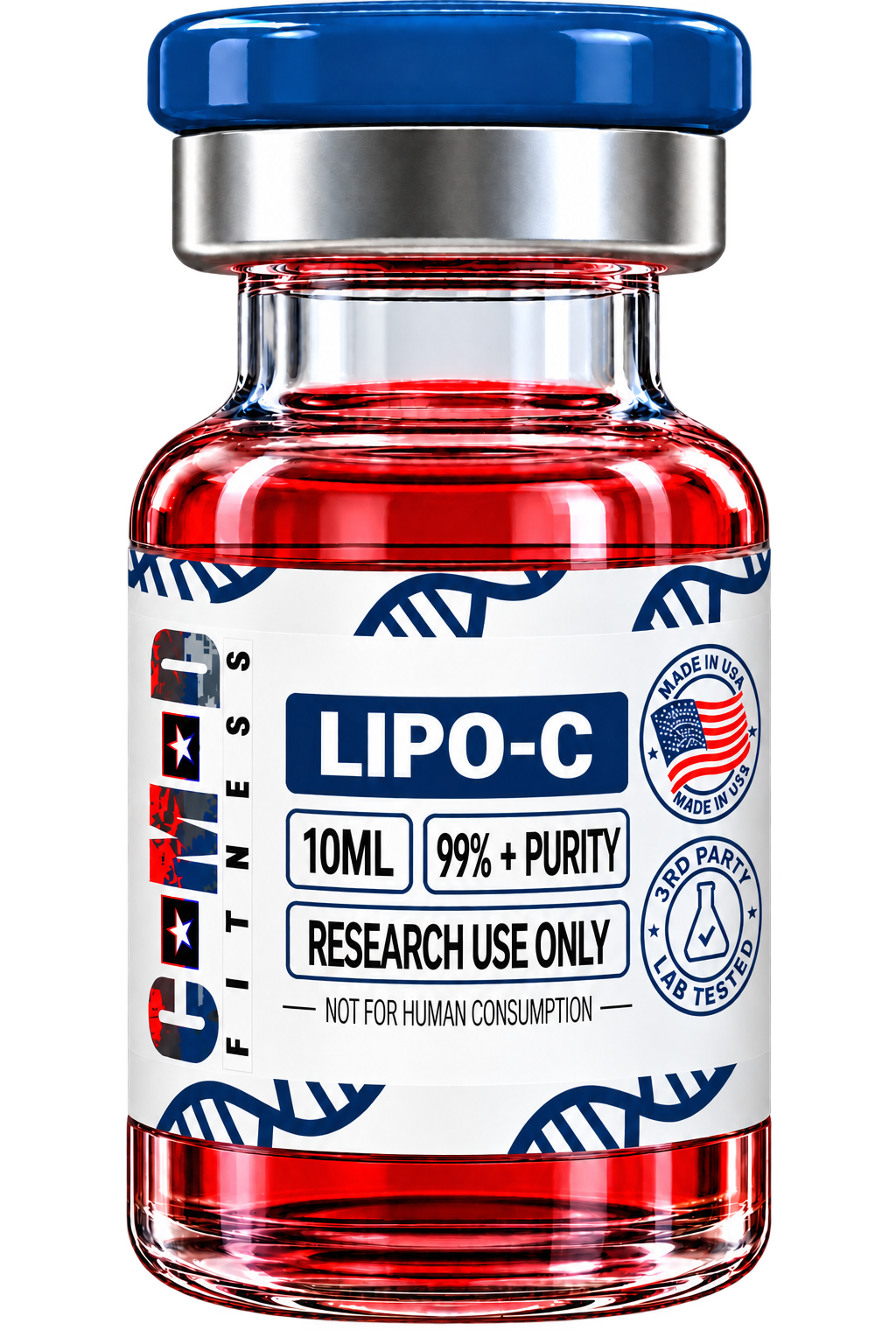
LIPO-C (10ML)

Price:

$90.00

Select Quantity:

50 in stock

Overview

Lipo-C is a multi-component lipotropic formulation designed for research involving lipid metabolism, mitochondrial energy production, and nutrient-dependent metabolic pathways. Depending on the specific formulation, Lipo-C commonly incorporates compounds such as L-Carnitine, methionine, inositol, and choline, sometimes alongside B vitamins or other metabolic cofactors.

These components participate in complementary biochemical pathways. L-Carnitine supports mitochondrial transport of long-chain fatty acids for beta-oxidation, while choline, inositol, and methionine are involved in phospholipid metabolism, methylation reactions, cellular signaling, and normal lipid handling.

Lipo-C is studied in research related to fatty-acid utilization, cellular energy metabolism, mitochondrial function, hepatic lipid metabolism, and overall metabolic efficiency.

Because Lipo-C formulations are not standardized, the precise composition, concentration, and chemical characteristics depend on the individual product formulation.

For research and laboratory applications only.

Biochemical
Characteristics

Lipo-C is a multi-component lipotropic formulation containing nutrients that participate in fatty-acid metabolism, mitochondrial energy production, methylation, phospholipid synthesis, and cellular metabolic pathways. Exact biochemical characteristics depend on the specific ingredients and concentrations used in the formulation.

Key biochemical characteristics commonly associated with Lipo-C components include:

  • Fatty-Acid Transport: L-Carnitine facilitates transport of long-chain fatty acids into the mitochondrial matrix, where they can undergo beta-oxidation.
  • Mitochondrial Bioenergetics: Carnitine-dependent fatty-acid transport contributes to mitochondrial substrate utilization and cellular energy production.
  • Methyl-Group Metabolism: Methionine functions as a precursor to S-adenosylmethionine (SAM), an important methyl-group donor involved in numerous biochemical reactions.
  • Phospholipid Metabolism: Choline contributes to phosphatidylcholine synthesis and is involved in cellular membrane structure and normal lipid transport.
  • Lipid Metabolism: Methionine, inositol, choline, and L-Carnitine participate through distinct pathways associated with lipid processing, transport, and utilization.
  • Cellular Signaling: Inositol and its derivatives serve important roles in intracellular signaling and membrane-associated biochemical processes.
  • Acyl-CoA Regulation: L-Carnitine helps regulate the balance between free CoA and acyl-CoA through formation and transport of acylcarnitines.
  • Metabolic Cofactor Activity: When B vitamins are included, they may function as cofactors in pathways involving energy metabolism, amino-acid metabolism, and redox reactions.

Together, these biochemical characteristics make Lipo-C relevant to research investigating mitochondrial metabolism, fatty-acid utilization, cellular bioenergetics, phospholipid synthesis, methylation, and metabolic regulation.

Research Applications

Lipo-C formulations are used in research examining the interactions among lipotropic nutrients, fatty-acid metabolism, mitochondrial bioenergetics, methylation pathways, and cellular metabolic function. Because Lipo-C is a combination formulation, research applications depend on its specific ingredients and concentrations.

Key areas of investigation include:

  • Lipid Metabolism: Investigation of biochemical pathways involved in fatty-acid transport, processing, and utilization.
  • Mitochondrial Function: Research examining mitochondrial fatty-acid oxidation and cellular energy production.
  • Fatty-Acid Beta-Oxidation: Evaluation of L-Carnitine-dependent transport of long-chain fatty acids into mitochondria.
  • Cellular Energy Metabolism: Studies of nutrient-dependent pathways involved in substrate utilization and cellular bioenergetics.
  • Hepatic Lipid Metabolism: Research into the roles of choline, methionine, and related nutrients in phospholipid synthesis and normal hepatic lipid transport.
  • Methylation Pathways: Investigation of methionine and S-adenosylmethionine (SAM)-dependent biochemical reactions.
  • Cellular Signaling: Research examining inositol-dependent signaling pathways and membrane-associated cellular processes.
  • Exercise Metabolism: Investigation of fatty-acid utilization, skeletal-muscle energy metabolism, and metabolic responses to physical activity.
  • Metabolic Regulation: Evaluation of interactions among lipotropic nutrients and pathways governing carbohydrate and lipid metabolism.

Lipo-C is therefore primarily relevant to research involving lipid handling, mitochondrial function, cellular energy production, methylation, and nutrient-dependent metabolic regulation.

For research and laboratory applications only.

Chemical Properties

Lipo-C is a multi-component lipotropic formulation rather than a single chemical compound. Its chemical properties therefore depend on the specific active ingredients, concentrations, pH, and excipients used in the formulation. Common Lipo-C preparations may contain L-Carnitine, methionine, inositol, and choline, with some formulations incorporating B vitamins or other metabolic cofactors.

Typical Chemical Characteristics:

  • Compound Type: Multi-component lipotropic nutrient formulation
  • Physical Form: Typically formulated as a clear aqueous solution
  • Solubility: Major components are generally highly soluble or readily soluble in water
  • L-Carnitine: Molecular formula C₇H₁₅NO₃; molecular weight 161.20 g/mol
  • L-Methionine: Molecular formula C₅H₁₁NO₂S; molecular weight 149.21 g/mol
  • Myo-Inositol: Molecular formula C₆H₁₂O₆; molecular weight 180.16 g/mol
  • Choline: Commonly incorporated as a water-soluble choline salt; molecular properties depend on the specific salt used
  • Chemical Functionality: Components include amino-acid, quaternary ammonium, hydroxyl, carboxyl, sulfur-containing, and polyol functional groups.
  • Solution Characteristics: Final pH and ionic strength depend on formulation, concentration, buffering agents, and other excipients.
  • Stability: Influenced by temperature, light exposure, pH, oxidation, sterility, and formulation-specific ingredients.

Because Lipo-C is not a standardized single molecule, it does not have one molecular formula, molecular weight, CAS number, or universal chemical specification. Chemical documentation should therefore identify the individual ingredients and concentrations contained in the specific formulation.

For research and laboratory applications only.

COA /HPLC / MS
3rd Party Testing

Third Party Tested by Freedom Diagnostics Testing at Freedom Diagnostics Testing – Reliable. Accountable. Accessible.

Storage

Lipo-C Liquid should be stored under controlled conditions appropriate for the specific formulation to maintain stability and product integrity.

  • Recommended Storage Temperature: Refrigerate at 2°C–8°C (36°F–46°F) when specified for the formulation.
  • Keep the vial tightly sealed and protected from contamination.
  • Protect from direct sunlight, excessive heat, and prolonged exposure to elevated temperatures.
  • Do not freeze unless frozen storage has been specifically validated by the manufacturer.
  • Avoid repeated or significant temperature fluctuations.
  • Store in the original container and minimize unnecessary exposure to light.
  • Before laboratory use, visually inspect the solution for unexpected discoloration, cloudiness, precipitation, or particulate matter.
  • Follow appropriate sterile laboratory handling procedures when accessing multi-use containers.

For research and laboratory applications only.

Your cart is currently empty.

Return to shop

0