

Veteran-owned business
Product Usage: This PRODUCT IS INTENDED AS A RESEARCH CHEMICAL ONLY. This designation allows the use of research chemicals strictly for in vitro testing and laboratory experimentation only. All product information available on this website is for educational purposes only. Bodily introduction of any kind into humans or animals is strictly forbidden by law. This product should only be handled by licensed, qualified professionals. This product is not a drug, food, or cosmetic and may not be misbranded, misused or mislabeled as a drug, food or cosmetic.

For research use only. Not for human consumption.

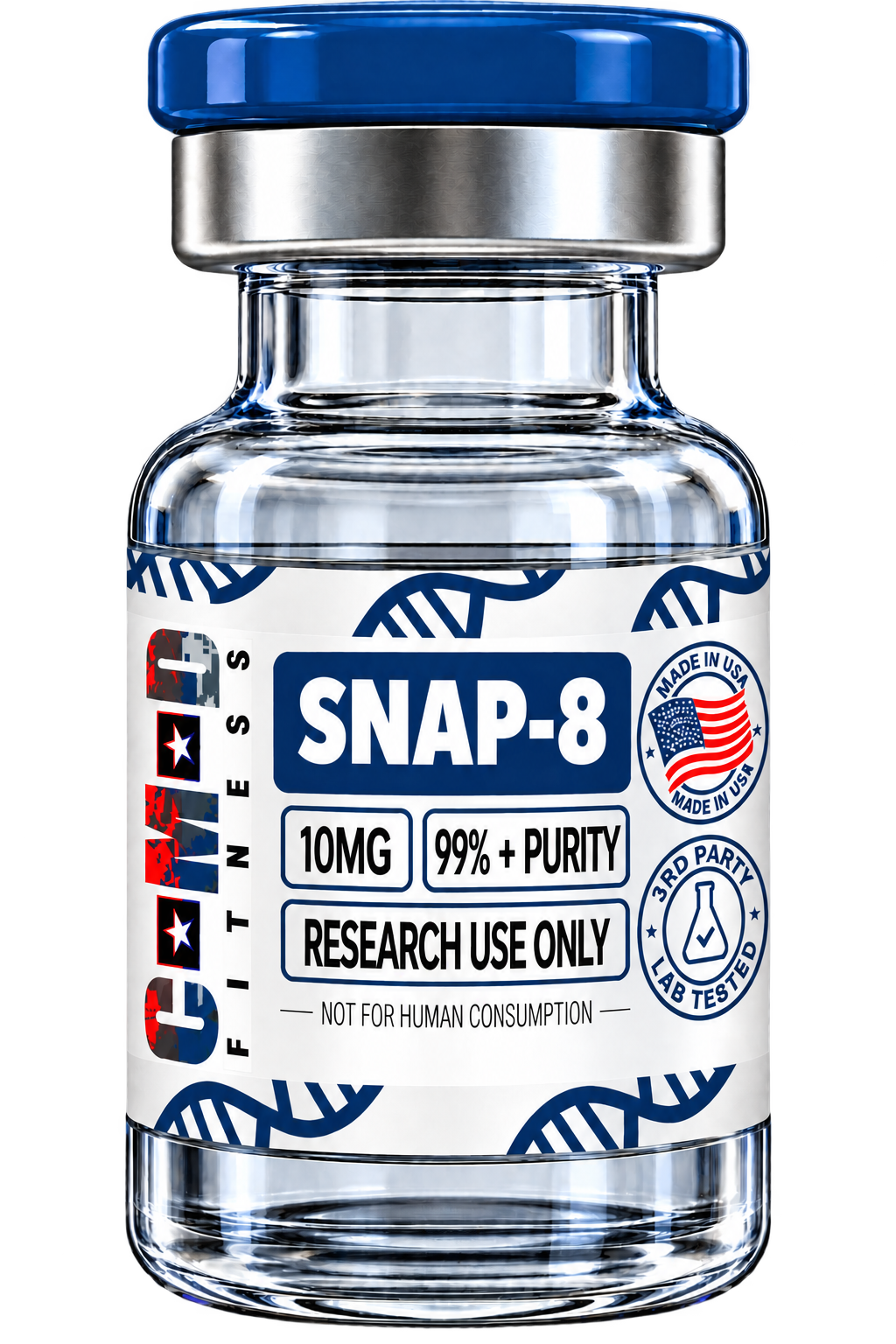
SNAP-8 (10mg)

SS‑31 (Elamipretide) is a synthetic mitochondria-targeting tetrapeptide that protects mitochondrial function, reduces oxidative stress, and is used in research on mitochondrial dysfunction, aging, and metabolic disorders

Price:

$45.00

Select Quantity:

48 in stock

Overview

SNAP-8 (Acetyl Octapeptide-3) is a synthetic cosmetic peptide developed for research into skin aging, expression lines, and neurotransmitter-associated signaling pathways. It is an eight-amino-acid peptide related to Acetyl Hexapeptide-8 and is commonly investigated as an active ingredient in advanced cosmetic and dermatological formulations.

SNAP-8 is designed to interact with mechanisms associated with the SNARE complex, which participates in synaptic vesicle fusion and neurotransmitter release. Through this mechanism, researchers have investigated SNAP-8 for its potential to modulate signaling associated with repetitive facial muscle contraction and the formation of visible expression lines.

Research applications commonly focus on wrinkle appearance, skin smoothness, facial expression lines, cosmetic anti-aging formulations, peptide-based skin technologies, and neuromuscular signaling.

As a small synthetic peptide, SNAP-8 provides researchers with a targeted compound for investigating peptide-based approaches to improving the visible characteristics of aging skin without employing botulinum neurotoxins.

For research and laboratory applications only.

Biochemical
Characteristics

SNAP-8 (Acetyl Octapeptide-3) is a synthetic octapeptide developed as an extended analog of Acetyl Hexapeptide-8 (Argireline). It is primarily investigated for its interaction with molecular pathways involved in SNARE-complex formation, neurotransmitter release, and neuromuscular signaling.

Key biochemical characteristics include:

  • Synthetic Octapeptide: Composed of eight amino-acid residues with an acetylated N-terminus.
  • SNARE-Associated Activity: Designed to influence interactions involved in formation of the SNARE protein complex, which participates in synaptic vesicle docking and neurotransmitter release.
  • SNAP-25 Mimetic Concept: SNAP-8 was developed to mimic a region associated with SNAP-25, a protein involved in SNARE-complex assembly.
  • Neurotransmitter-Signaling Research: Investigated for its potential to modulate signaling associated with acetylcholine release and neuromuscular communication.
  • Muscle-Contraction Pathways: Its proposed activity has led to research examining signaling associated with repetitive facial muscle contractions and expression-line formation.
  • Cosmetic Peptide Activity: Primarily studied as a topical cosmetic ingredient for its potential influence on the visible appearance of wrinkles and expression lines.
  • Water-Compatible Peptide: Its peptide structure permits incorporation into appropriately designed aqueous cosmetic and laboratory formulations, although solubility and stability depend on pH, concentration, and formulation.
  • Peptide Stability: Susceptible to hydrolysis and other degradation processes depending on temperature, pH, enzymes, and storage conditions.

These biochemical characteristics make SNAP-8 particularly relevant to research involving SNARE-associated signaling, neurotransmitter release, neuromuscular communication, skin biology, expression lines, and peptide-based cosmetic formulations.

For research and laboratory applications only.

Research Applications

SNAP-8 (Acetyl Octapeptide-3) is primarily investigated in cosmetic, dermatological, and biochemical research involving skin aging, expression lines, peptide signaling, and mechanisms associated with neurotransmitter release.

Key research applications include:

  • Expression-Line Research: Investigated for its potential effects on the appearance and development of facial expression lines associated with repetitive muscle movement.
  • Wrinkle Appearance Studies: Used in cosmetic research examining changes in wrinkle depth, surface texture, and visible signs of skin aging.
  • SNARE-Complex Research: Studied for its proposed interaction with molecular mechanisms involved in SNARE-complex assembly and vesicle-mediated signaling.
  • Neurotransmitter-Release Research: Investigated in experimental models examining pathways associated with neurotransmitter release and neuromuscular communication.
  • SNAP-25-Associated Signaling: Used to investigate peptide-based modulation of processes involving SNAP-25 and related proteins.
  • Skin-Aging Research: Evaluated in studies of age-associated changes in skin appearance, texture, and smoothness.
  • Cosmetic Formulation Development: Studied as an active ingredient in topical serums, creams, gels, and other experimental cosmetic formulations.
  • Peptide Delivery Research: Used to investigate formulation strategies designed to improve peptide stability, skin compatibility, and topical delivery.
  • Combination Peptide Research: Investigated alongside other cosmetic peptides and skin-care ingredients to evaluate complementary effects on visible skin characteristics.

Overall, SNAP-8 is primarily relevant to research examining peptide-based cosmetic technologies, expression-line appearance, skin aging, SNARE-associated signaling, and topical formulation development.

For research and laboratory applications only.

Chemical Properties

SNAP-8 (Acetyl Octapeptide-3) is a synthetic acetylated octapeptide developed primarily for cosmetic and biochemical research. Its peptide structure is designed as an extended analog of Acetyl Hexapeptide-8 and is associated with research into SNARE-complex signaling and neurotransmitter-release pathways.

  • Chemical Name: Acetyl Octapeptide-3
  • Common Name: SNAP-8
  • Compound Class: Synthetic acetylated peptide
  • Peptide Length: 8 amino acids
  • Sequence: Ac-Glu-Glu-Met-Gln-Arg-Arg-Ala-Asp-NH₂
  • Molecular Formula: C₄₁H₇₀N₁₆O₁₆S
  • Molecular Weight: Approximately 1,075.2 g/mol
  • Structure: Linear, N-terminally acetylated octapeptide with a C-terminal amide
  • Physical Appearance: Typically supplied as a white to off-white peptide powder or as part of an aqueous cosmetic formulation
  • Solubility: Generally water-soluble; actual solubility depends on concentration, pH, ionic strength, and formulation.
  • Functional Groups: Contains peptide bonds along with amide, carboxyl, amino/guanidinium, and sulfur-containing functional groups.
  • Biochemical Target: Developed to mimic a region associated with SNAP-25 and investigated for its potential influence on SNARE-complex formation and neurotransmitter-associated signaling.
  • Stability: Stability depends on temperature, moisture, pH, light exposure, and formulation. As with many peptides, prolonged exposure to elevated temperatures and repeated freeze-thaw cycles may accelerate degradation.
  • Research Classification: Experimental cosmetic peptide / neuromuscular-signaling research compound.

The acetylated peptide structure of SNAP-8 makes it particularly relevant to research involving peptide-protein interactions, SNARE-associated pathways, neurotransmitter signaling, expression-line biology, and cosmetic formulation development.

For research and laboratory applications only.
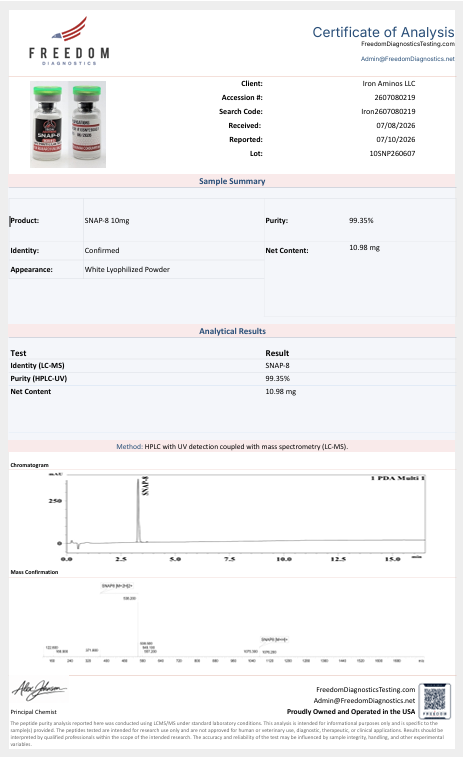
COA /HPLC / MS

3rd Party Testing
Storage

SNAP-8 (Acetyl Octapeptide-3) should be stored under controlled conditions to help maintain peptide stability, purity, and integrity.

  • Lyophilized Powder: For longer-term storage, typically store refrigerated at 2°C–8°C (36°F–46°F) or frozen at −20°C (−4°F) when supported by the supplier’s stability data.
  • Reconstituted Solution: Typically store refrigerated at 2°C–8°C (36°F–46°F) when appropriate for the specific formulation.
  • Protect from direct sunlight, excessive heat, and moisture.
  • Keep lyophilized material tightly sealed to minimize exposure to humidity.
  • Avoid repeated freeze-thaw cycles, which can contribute to peptide degradation.
  • For prepared solutions, use clean laboratory handling techniques and minimize unnecessary exposure to air and environmental contaminants.
  • Inspect solutions for unexpected discoloration, cloudiness, precipitation, or particulate matter before research use.
  • Storage duration after reconstitution depends on the solvent, concentration, pH, preservatives, sterility, and formulation.

For optimal stability, the manufacturer’s product-specific storage instructions, COA, and validated stability data should take precedence over general peptide-storage recommendations.

For research and laboratory applications only.

Your cart is currently empty.

Return to shop

0